
Quick answer
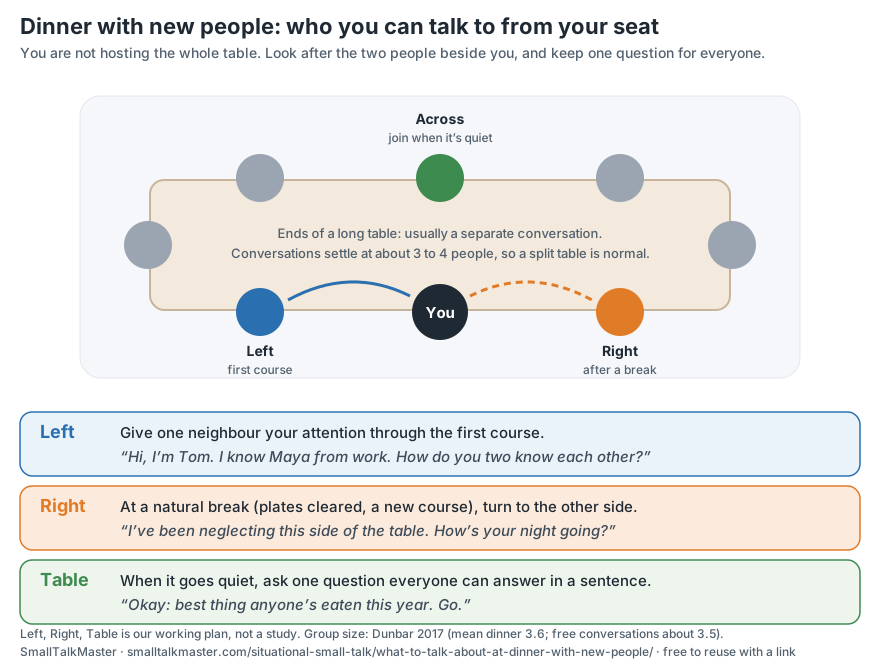
At dinner with people you don't know, you don't need a list of topics. You need a plan for your seat. Talk mostly to the person on one side, turn to the other side at a natural break, and keep one easy question ready for the whole table. We call that Left, Right, Table.
For what to talk about, start with what everyone shares (the food, the place, how each of you knows the host), then move to small stories: a recent trip, a good meal, something that went funny-wrong this week. In a survey of 2,000 UK adults, the dinners that left people feeling closer were the ones with laughter and reminiscing (people swapping stories). Telling jokes and eating chocolate made no detectable difference (Dunbar, 2017). So you don't need to be clever. Keep things easy enough that people start telling stories.
This page: five worries set against what studies found, the Left, Right, Table plan, a course-by-course guide with lines, topics that work at a table (and why), what to do with a quiet or very talkative neighbour, a made-up worked example, and a short drill for the day before.
What a dinner is (and isn't)
A dinner with new people isn't like a party. At a party you can drift away after two minutes. At a table you're seated next to the same people for an hour or two, and you can't walk off when a topic dies. That's why a list of dinner party questions only gets you so far: the hard part isn't finding a first question. It's pacing two hours and staying in the conversation without carrying it.
It's also not one conversation. In Robin Dunbar's survey, the average dinner had 3.6 people at it, close to the size that free-forming conversations tend to settle at (about 3.5, from his earlier work with Duncan and Nettle, 1995) (Dunbar, 2017). So when a table of eight breaks into two or three conversations, nothing has gone wrong. Your job is the conversation within reach of your seat, not the whole table.
Five worries, and what studies found
| The worry | What a study found | Source |
|---|---|---|
| "I need great topics." | In a survey of 2,000 UK adults (April 2016), people felt closer to their dinner companions after evening meals that had laughter (67.9% of dinners) and reminiscing and story-telling (51.5%). Number of diners and alcohol also mattered. Jokes on their own and eating chocolate did not. | Dunbar, 2017 (full text) |
| "Strangers won't want to talk to me." | Commuters told to talk to a stranger had a more positive trip than those who kept to themselves. Other commuters predicted the opposite, partly because they underestimated how interested others would be. | Epley & Schroeder, 2014 |
| "Anything beyond small talk will be awkward." | In conversations between strangers, people overestimated how awkward deeper topics would be, and felt more connected after deep conversations than shallow ones. They expected others to care less about what they shared than others did. | Kardas, Kumar & Epley, 2022 |
| "Asking lots of questions will feel like an interview." | People who asked more questions, especially follow-up questions, were liked more by their partners, in online chats and in speed dating. | Huang et al., 2017 |
| "They'll think I was boring." | After getting-acquainted conversations, people underestimated how much their partners liked them and enjoyed their company. The authors call this the liking gap. | Boothby, Cooney, Sandstrom & Clark, 2018 |
Read these with their limits. Dunbar's study is a one-off survey: people recalled their last evening meal with someone they didn't live with (often friends or family, not strangers), and it shows links, not proof that laughter causes closeness (he says experiments are needed). The other studies were run with students, commuters and online volunteers, not at your table. Still, they point one way: the bar is lower than it feels, and the warm, story-sharing kind of talk is the kind that works.
Left, Right, Table
Our name for a simple seat plan. It isn't a study; it's a way to use the findings above at a real table.
- Left. When you sit down, give one neighbour your attention (whichever side isn't already talking). Open with the shared situation, ask a follow-up, and share a small detail back. Stay with them through the first course.
- Right. At a natural break (plates cleared, someone gets up, a new course arrives), turn to your other neighbour. "I've been neglecting this side of the table. How do you know Maya?" This also gives the first conversation an easy ending. In 932 conversations studied by Adam Mastroianni and colleagues, talks almost never ended when both people wanted them to (Mastroianni et al., 2021). A course change ends the chat for you, and nobody has to say so.
- Table. Keep one question that everyone can answer in a sentence for when the table goes quiet or your neighbours are both busy. "Has anyone actually been to the place that opened on the corner?" A question to the whole table brings everyone in. A question to one person just moves the silence onto them.
If one neighbour is deep in a conversation on their other side, don't wait. Turn the other way, or lean into the conversation across from you.
Course by course
| When | What to talk about | Lines you can say |
|---|---|---|
| Arriving and sitting down | How you each know the host, the place, the journey there | "Hi, I'm Tom. I know Maya from work. How do you two know each other?" / "Have you been here before, or are we all trying it for the first time?" |
| Ordering or the first course | The menu, the food, small preferences | "Are you a safe-order person or an interesting-order person?" / "That looks better than mine. What did you get?" / "I can't decide. What would you tell me to order?" |
| The main course | Small stories: a recent trip, something they're into, a recent event that went funny-wrong | "What's been taking up your weekends lately?" / "Wait, you drove the whole way? How did that go?" / "That reminds me of a much smaller disaster I had last month." |
| Between courses | Turn to your other side (the Right step) | "I've been talking this side's ear off. What's your connection to tonight?" |
| Dessert and coffee | One step deeper, if the table feels warm: plans, what someone's excited about, a good book or show | "What are you looking forward to this winter?" / "What's something you've changed your mind about recently?" |
| Leaving | Thanks and a callback to something they said | "Good luck with the half marathon. I want to hear how it goes." / "Thanks for the restaurant tip. I'm actually going to go." |
The dessert step is the one people skip. Kardas and colleagues' work suggests that many of us hold back from a slightly deeper question because we expect it to be awkward, and it usually isn't. You don't need a big question. "What are you looking forward to?" is deep enough.
Topics that work at a table, and why
Good dinner topics share three things: everyone can add something without preparing, the answer can be one sentence or a small story, and the topic can be dropped without a fuss. Nobody at a table can walk away from a topic, so pick ones that are easy to put down.
| Topic | Why it works at dinner | A way in |
|---|---|---|
| The food and the place | Everyone shares it, it's right there, and it's easy to answer with your mouth half full. | "What's the best thing you've eaten this year?" |
| How you know the host | Everyone has an answer and it often comes with a small story. | "How did you and Sam meet? He's never told the same version twice." |
| Travel that actually happened | Places come with stories, and stories were one of the two things linked to closer dinners. | "Where was the last place that surprised you?" |
| Recommendations | Easy to give, easy to take, and they give you a callback for the goodbye. | "I need a new show. What are you watching?" |
| Small recent mishaps | They invite laughter, the other thing linked to closer dinners. Keep them small and on yourself. | "Has anyone else's week been slightly cursed, or is it just me?" |
| What people are into | A hobby, a project, a team. Follow-up questions do the work here. | "How did you get into that?" |
What to hold back on with new people: topics that need an argument rather than a conversation (politics and religion, for most tables), money, weight and diets (people may be eating carefully for reasons they don't want to explain), and personal questions such as "So are you two planning kids?" If someone asks you one, our guide on answering nosy questions has lines for that. If the table drifts into a fight, changing the subject politely has a step-by-step way out.
One small thing about the food: in lab studies by Kaitlin Woolley and Ayelet Fishbach, strangers who were assigned to eat similar foods trusted each other more in a trust game and cooperated more in a mock labour negotiation (Woolley & Fishbach, 2017). That was a lab, not a dinner party, so don't read too much into it. But "Same as you, that looks great" is a friendly thing to say, and it's fine to order what your neighbour is having.
Your neighbours
The quiet one
Lower the stakes. Ask concrete, small questions ("Did you come straight from work?") rather than big open ones ("So tell me about yourself"). Share a little yourself so they have something to react to, and let a pause sit for a second before you fill it (our guide to how long a silence really feels awkward has the research). If they stay brief after two or three tries, they may just be tired or shy. Bring them into a wider thread: "Ana was just saying she's been to Porto. Have you?"
The one who talks a lot
Enjoy it for a while: they're carrying the conversation, which is a gift when you're nervous. When you want to turn, wait for a breath and use the course change: "I have to hear how your night's going on this side, sorry, one second." Our study of 78 questions about people who talk too much has more lines.
Two people who already know each other
Ask about their shared story. "How long have you two been friends?" turns their in-jokes into something you can join. If they drift back into private talk, that's your cue to turn the other way.
A worked example (made up)
A hypothetical scene, not a real person. Lena is at a friend's birthday dinner, seated between a man she's never met and a woman who is talking to her other neighbour.
Left. She turns to the man. "Hi, I'm Lena. I know Jo from our old flat. How do you know her?" He works with Jo. She asks a follow-up ("Oh, so you're the team with the famous Friday quiz?") and shares something back: Jo once made her flatmates do a quiz too. He laughs. That's the first story.
Food. The starters arrive. "That looks better than mine. Is that the beetroot one?" They swap a bite-sized opinion about beetroot. Small, easy, done.
Right. Plates are cleared. Her other neighbour is free now. "I've abandoned this side of the table. How's your night going?" She asks what's been keeping her busy. It turns out she just got back from a hiking trip, which runs all through the main course.
Table. Dessert comes and the table goes quiet. Lena asks the whole table: "Okay, best thing anyone's eaten this year. Go." Six people answer in a sentence each, two of them argue happily about whether a sandwich counts, and the table laughs.
Leaving. "Good luck with the quiz on Friday. I expect a report."
Nothing in it is clever. Every line is about the shared situation, a follow-up, or a small detail given back. That's the whole method.
If it goes wrong
- You said something that landed flat. Name it lightly and move on: "That came out more serious than I meant. Anyway, how was the drive?"
- You forgot a name you were told five minutes ago. Say so early, before it gets worse: "I'm so sorry, I've lost your name already." Most people have been there.
- You're stuck in a topic you don't care about. Ask one follow-up about the person rather than the topic: "How did you get so into fantasy football?" People are usually more interesting than their topic.
- You've run dry on both sides. Use your Table question, or ask the host something they'll enjoy answering: "Maya, how did you find this place?"
If you leave thinking you were dull, remember the liking gap: people tend to like us more after a first conversation than we think (Boothby et al., 2018).
A ten-minute drill for the day before
- One shared-situation opener. Write a line about the place, the host or the occasion.
- Three small stories. Something you ate, somewhere you went, something that went funny-wrong this month. One or two sentences each.
- One Table question. A question everyone can answer in a sentence.
- One dessert question. One step deeper, such as "What are you looking forward to?"
- One goodbye callback. You'll fill in the detail on the night: "Good luck with the …"
Say each one out loud once, so none of them is brand new on the night.
Where NerdSip fits
Stories carry a dinner, and a small fact about the food in front of you can start one: why some cheeses are rinded in ash, where a dish got its name. If you like walking in with a detail like that, this NerdSip list of interesting facts for better conversations is a good place to find one. NerdSip is a learning app made by ai51, the company that publishes this site.
Related guides
- What to say at a party where you know one person, for the standing part of the evening
- How to join a group conversation, when the table splits and you want in
- How to ask better follow-up questions, the move that does most of the work
- How to tell personal stories in conversation, for the main course
- What to talk about at Thanksgiving and at Christmas dinner, when the new people at the table are family
The rule to remember
You're not hosting the whole table. Look after the two people next to you, swap stories, keep one question for everyone, and change sides when the plates are cleared.