
Quick answer: how to change the subject politely
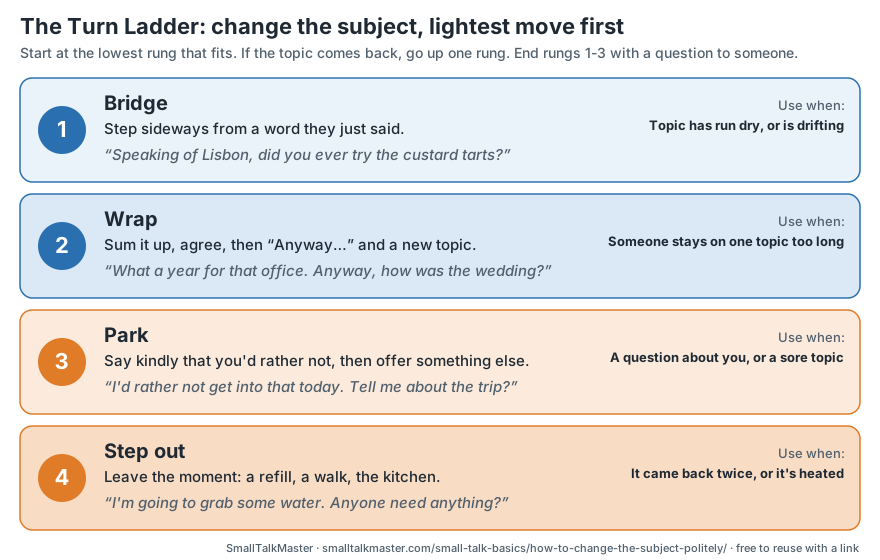
Use the lightest move that works, and end it with a question to someone. We call this the Turn Ladder:
- Bridge. Step sideways from a word they just said: "Speaking of Lisbon, did you ever try the custard tarts?"
- Wrap. Sum the topic up in one line, agree, then say "Anyway…" and start a new one: "What a year for that office. Anyway, how was the wedding?"
- Park. Say kindly that you'd rather not go there, then offer something else: "I'd rather not get into that today. Tell me about the trip?"
- Step out. Leave the moment: "I'm going to grab some water. Anyone need anything?"
Start at the lowest rung that fits. If the topic comes back, go up one rung. Most of the time rung 1 or 2 is enough, and nobody notices anything happened.
One exception: if someone is telling you about a worry or a loss, don't change the subject at all yet. See when not to change the subject.
This page: why gentle topic changes go unnoticed (the research), the four rungs with lines, a table by reason, what to do when it comes back, lines for the family table, work, dates and phone calls, what people actually ask about this, and a drill. For the holiday table specifically, our Thanksgiving guide has a three-beat move for politics.
What the research says about changing topics
None of the top guides we read for this search (Calm, Time, socialself, Talaera and Upworthy, all checked on November 9, 2026) cites research on how people actually change topics in conversation; Talaera links two linguistics sources about speaking a second language. The research exists, and it explains why the gentle moves work.
| Finding | Source | What it means for you | What it doesn't say |
|---|---|---|---|
| Generally, one topic "merges almost imperceptibly into the next" in a step-by-step drift. The clear changes the paper studies are different: obvious, and usually marked by the speaker. | Drew and Holt, "Figures of speech", Language in Society, 1998 (open full text), citing Jefferson and Sacks | A Bridge is how talk normally moves. Done from a word the other person said, it feels like conversation, not like a change. | It describes how topics move, not how to steer them on purpose. |
| When people do close a topic, they often follow a pattern: one person sums it up (often with an idiom like "had a good innings"), the other briefly agrees, and then one of them starts something new, often with "Anyway", "Okay", "Alright" or "Well". | Drew and Holt 1998, from about 15 hours of one British family's phone calls plus about 20 hours of other recorded calls, and some 200 instances of figurative expressions | This is the Wrap: summary, agreement, "Anyway…". People already recognise it as the signal that a topic is done. | The paper looks at idioms in particular; it says other summaries can close a topic too. The closing failed when the other person didn't agree with the summary. |
| A figurative summary can also work as a pivot: it connects to what came before and opens a different matter. | Holt and Drew, "Figurative pivots", Research on Language and Social Interaction, 2005 (abstract) | "What a saga" can end one topic and start the next in the same breath. | A description of real talk, not a tested technique. |
| In four studies, listeners often didn't notice when a speaker answered a similar but different question, and didn't rate them worse. They noticed when the answer was to an obviously different question, and then rated the speaker more negatively. Fluent answers to a similar question were rated better than halting answers to the real one. | Rogers and Norton, "The artful dodger", Journal of Experimental Psychology: Applied, 2011 (abstract) | A topic change that stays close to the old one goes down easily. A jump to something unrelated gets noticed. So bridge from their words, and say it with a smile, not an apology. | These were lab studies of listeners judging speakers' answers, not dinner tables. We use them for the lesson about attention, not as permission to mislead. |
| People who ask more questions, especially follow-up questions, are liked more by their conversation partners, and people don't expect this. | Huang, Yeomans, Brooks, Minson and Gino, "It doesn't hurt to ask", JPSP, 2017 (abstract) | Ending your change with a question hands the floor to someone and gives the new topic a reason to live. | It measured question-asking in get-to-know-you chats and speed dates, not topic changes. |
| Language that shows you're willing to engage with an opposing view, used early in a disagreement, helped keep it from escalating; on Wikipedia, receptive editors got fewer personal attacks. | Yeomans, Minson, Collins, Chen and Gino, "Conversational receptiveness", OBHDP, 2020 (abstract) | Before you Park a heated topic, one sentence that acknowledges the person ("You've clearly thought about this a lot") makes the turn feel less like a door slam. | It studied disagreements, not changing the subject. |
The short version: topics usually drift, people already know the "sum up, agree, anyway" signal, small steps go unnoticed while big jumps don't, and a question at the end makes the new topic stick.
The Turn Ladder, rung by rung
This is our own working method, built on the research above and on the top answers to real questions on Interpersonal Skills Stack Exchange. It hasn't been tested as a package.
Rung 1: Bridge (step sideways)
Pick one concrete word from the last thing said, and walk from it to somewhere nearby.
- Work stress → "Speaking of the office, are you still doing the Friday bakery run?"
- A complaint about traffic → "At least you got here. Did you come the coast way?"
- Someone's ex → "Wait, that was the year you lived in Leeds, right? What was that flat like?"
- Nothing usable → use what's in front of you: "Okay, important question. Who made this salad?"
Why it works: it follows the normal drift of talk, and the Rogers and Norton studies suggest a nearby step barely registers. One answer on Stack Exchange, about a mother who always returns to the same few topics, makes the same point from experience: change it gradually, starting from the topic she already likes.
Tip: bridge to them, not to you. "That reminds me of my holiday" can sound like a takeover. "That reminds me, how did your sister's move go?" sounds like interest.
Rung 2: Wrap (sum up, agree, "Anyway…")
When a topic has gone on too long and there's no easy bridge, close it before you open the next one.
- Sum it up in one line, ideally one they'll agree with: "What a saga." "Sounds like you've earned a quiet weekend." "Well, that's teenagers for you."
- Wait for the nod, the "Yeah, honestly" or the laugh.
- "Anyway…" and the new topic, with a question: "Anyway, are you still doing the pottery class?"
Why it works: it's the closing pattern Drew and Holt found in real phone calls. The summary tells the other person you heard them, the agreement closes the topic together, and "anyway" announces something new. Skip step 2 and it feels like a cut. And pick a summary they can agree with: in the paper, closings stalled when the other person didn't share the verdict.
Rung 3: Park (say it kindly, offer something else)
Use this when the topic is about you and you'd rather not discuss it, when it's sore, or when a Bridge didn't hold. Say it plainly, warmly, and briefly, then hand over a new topic so the other person has somewhere to go.
- "I'd rather not get into that today. But tell me about the trip?"
- "That one's a bit raw for me. How's the new job going?"
- "Ha, that's a long story, and not a dinner one. What are you reading lately?"
- "I'm sorry, I'd rather not think about that one; it makes me too sad. How are the kids?"
The last line is close to the advice in an answer to a question about dodging a painful family question: an "I'm sorry" plus a short reason is what keeps "I don't want to go there" from sounding dismissive.
If the person is close to you and it keeps happening, park it for good, outside the moment. The accepted answer to a question about a cousin who loves a topic the asker finds upsetting suggests three beats: acknowledge what they like, say how it makes you feel, and say you're not asking them to change, just to not talk about it with you.
Rung 4: Step out (leave the moment)
When it came back twice, or it's getting heated, stop working on the topic and change the scene.
- "I'm going to grab some water. Anyone need anything?"
- "I'll help with the dishes. Sam, come keep me company?"
- "I need some air. Anyone up for a quick walk before dessert?"
- At work: "I need to get back to this report, but good to catch up." One answer about a colleague who only talks about exercise points out that at work the job is a fair and honest exit.
Stepping out isn't losing. It ends the topic without anyone having to back down, and you can come back in a few minutes to a new conversation. For leaving altogether, see how to leave a conversation politely.
Which rung? A table by reason
| Why you want to change it | Start at | A line you can say | If it comes back |
|---|---|---|---|
| The topic has run dry | Bridge | "Speaking of coffee, have you tried the new place by the station?" | Nothing to escalate; ask a new open question. |
| Someone stays on one topic (or on themselves) | Wrap | "Sounds like a wild month. Anyway, Priya, how was Portugal?" | Wrap again, then the Catch lines from our talking-too-much study. |
| A personal question you'd rather not answer (age, pay, dating, kids, health) | A light answer plus a question back, or Park | "Oh, not at that stage yet. But what about you two, any trips planned?" | Park, a little firmer: "I'm really fine not talking about that. Tell me about yours?" |
| A comment that hurts (your body, your home, an old mistake) | Park, calm and short | "This is how we like it. Anyway, who wants coffee?" | Say it once, outside the moment: "Please don't comment on my weight." |
| Gossip about someone not there | Bridge to the person's good side, or to something else | "She was really kind to me when I started. Did you two ever work together on the launch?" | "I'd rather not talk about her when she's not here." Then a new topic. |
| Politics or religion heating up | One acknowledging line, then Bridge or Wrap | "You've clearly been following this closely. Speaking of following things, did anyone watch the match?" | Park, then Step out. At family meals, see Pass the Plate. |
| A question about a sad or scary possibility | Turn it gently back | "I've tried not to think about it. What do you think?" | "I'm sorry, I'd rather not go there; it makes me too sad." |
| Someone is telling you about a real trouble | Don't change it yet | "That sounds really hard. How are you doing with it?" | Let them lead you out. See below. |
The "sad possibility" line comes from an answer to a question about a relative asking what you'd do if a sick family member died: the asker may be worried and want to talk it through, so turning it back lets them, while you just listen.
When the topic comes back
It will, sometimes. Someone has a favourite subject, a grievance, or a question they really want answered. Three rules keep you calm:
- Go up one rung, not three. If your Bridge didn't hold, Wrap. If the Wrap didn't, Park. Jumping from a breezy bridge to "Can we NOT?" is what makes a scene.
- Two tries per rung, then climb. The same move a third time starts to look like a game, and people notice.
- The third time is information. If someone brings back a question you've parked twice, they're no longer making small talk. It's fine to say, warmly and once: "I've said I'd rather not. Let's leave it there." Then Step out if you need to.
"What do you mean?", asked with a puzzled look, is a useful pause between rungs. One answer to a question about an older man's remark on women and housework suggests it: it buys you time and asks the person to spell out a comment they may already regret.
When not to change the subject
Changing the subject is a kindness when the topic is stale, unkind or unwanted. It can feel like a brush-off when someone is sharing a worry, a loss or something they're proud of.
- Stay with a trouble for a while. Ask one follow-up question, reflect what you heard, and let them decide when the topic is done. Conversation researchers have written about how people move out of talk about a trouble step by step (Gail Jefferson's 1984 chapter "On stepwise transition from talk about a trouble…" is the classic). Often they will sum it up ("Anyway, it is what it is"), and that's your cue to say something warm and follow their "anyway".
- Let good news land. "That's wonderful. How did you find out?" before any bridge.
- If you can't listen right now, say so and come back to it: "I want to hear this properly. Can I call you tonight?"
When someone changes the subject on you
One question in our reading comes from the other side: a woman mentions her weight as a plain fact, and her friends quickly say "you're not fat" or change the subject. The accepted answer suggests the friends are probably trying to protect her, and that tone and word choice are the way to show them the topic isn't painful for her. When people keep changing a subject on you, it usually means they think it hurts, or it makes them uneasy, not that they don't care. If it matters to you, say so: "I'm actually fine talking about it."
Lines by setting
At the family table
- "Okay, gravy break. Grandpa, how did you learn to carve like that?"
- "We see that one differently, and that's okay. Who's playing cards after?"
- "I love you too much to do this over pie. Lily, settle something: pumpkin or pecan?"
For the full holiday version (acknowledge, bridge, pass the plate to someone else), use our Thanksgiving guide and the Christmas dinner guide. And if you're bracing for a fight: the surveys behind "most families argue at Christmas" don't agree with each other, as our trace of 16 surveys and polls shows.
Relatives asking personal questions
"When are you getting married?", "Are you two having kids?", "How much do they pay you?" A light, true answer plus a question back is usually enough. The top answer to a question from a young dad who keeps getting asked about his son suggests exactly that move: one short line about the present, then move on, along the lines of: it was years ago, and what matters is that he's here.
- "Oh, not on the calendar yet. How's the garden this year?"
- "Not right now. But tell me about your trip to the coast?"
- "Enough to keep me in coffee. How's your work going?"
- "Single and enjoying it. Now, who's this new dog I keep hearing about?" (A version of a cheerful reply one answer recommends for nosy questions about being single.)
For more on the questions themselves, we counted 70 real questions from people being asked personal things, and what the top-voted answers recommend: see how to answer nosy questions (coworkers were the most common askers, and a short, true answer was the most-backed move). For in-laws you see every year, see small talk with in-laws; for relatives you disagree with in general, see how to talk to relatives you disagree with.
At work
- "Ha, I'll leave that one to the experts. Did you end up going to the conference?"
- "I don't really talk money at work. How's the new project shaping up?"
- "Sounds like a lot. Anyway, are you around for the Thursday meeting?"
- In a meeting going off track: "Can we park that and come back to it at the end? I want to make sure we get to the budget."
On a date
- "That's a big topic for a first date. Ask me again on the third? What do you do on a free Sunday?"
- "Let's not do exes tonight. What's the best trip you've ever taken?"
- Bridging from something on the menu or the room is the easiest Rung 1 there is: "Okay, speaking of food, what's the best thing you've ever eaten?"
On the phone with a parent
The same topics every call? Plan one new thing to bring: a story, a question about their past, something you read. Then Bridge to it early: "Before I forget, Mum, what was your first job? I was trying to remember." Changing the menu of a regular call is easier with a ready topic than in the moment.
Over text or in a group chat
Text makes rung 1 easy: send a photo, a link, or a question. "Anyway! Who's in for Saturday?" is a full Wrap in a group chat. If a thread turns into an argument, step out by moving it: "Let's talk about this in person; it's going badly in text."
What people actually ask: a reading of 27 questions
We searched all 3,958 questions on Interpersonal Skills Stack Exchange (pulled November 3, 2026) for ones about changing, steering or avoiding a topic. A pattern search found 139 candidates; reading them by hand left 27 that are really about moving a conversation off a topic in the moment, with 211,469 views between them. That's a reading, not a study: too few to count with confidence. We grouped them by why the asker wanted out.
| Why they wanted to change the subject | Questions | Views | Example (paraphrased) |
|---|---|---|---|
| A question about themselves they'd rather not answer | 11 | 90,933 | A young dad asked about having a child at 20 (42,775); questions about old scars at parties (16,518); family holiday questions about their sexuality |
| An opinion they don't share | 2 | 52,718 | A neighbour's political speeches (35,095); an older man's comment about women as housewives (17,623) |
| A topic that hurts or criticises | 6 | 48,449 | In-laws who keep criticising their house (25,746); a cousin who loves a topic they find upsetting; parents commenting on their weight |
| Someone stays on one topic, or on themselves | 7 | 17,849 | Calls with a mother that always cover the same topics; a colleague who only talks about exercise |
| The other side: friends keep changing the subject on them | 1 | 1,520 | Friends who change the subject when they mention their weight |
What stands out: the biggest group is not politics. It's questions about the asker's own life, body or past (11 of 27). The two opinion questions have many views, but they're two posts. Most guides for this search are written for the political argument at dinner; most of the real questions here are about being asked something personal. That's why this page gives personal questions their own row and their own lines.
Method: regex search over titles and bodies of the full Interpersonal Skills census, then each candidate read by Bob (an AI) and kept only if the asker wants to move a live conversation off a topic. Questions about ending a conversation, confronting someone, or long-term relationship problems were left out. Views as of 2026-11-03. Stack Exchange content is CC BY-SA; questions and answers are linked and paraphrased, no usernames.
Three worked scenes
These are hypothetical scenes, written to show the rungs.
The colleague and the marathon (Wrap). At the coffee machine, Tom has been describing his training plan for ten minutes. Ana waits for the end of a sentence: "Honestly, that sounds like a part-time job." Tom laughs: "It is!" Ana: "Anyway, are you coming to Dana's leaving drinks on Friday?" Tom: "Oh, yes, where is it?" Topic closed together, new one open.
The aunt and the wedding question (Park, then a question back). "So when are you two getting married?" Kai smiles: "Not on the calendar yet, and we're happy. But I want to hear about your trip. Was it really snowing in April?" Ten minutes later the aunt asks again. Kai, one rung up and still warm: "I'm really fine not talking about that today. Did you get any photos of the snow?" The aunt laughs and gets her phone out.
The table that kept circling (Step out). At a birthday dinner, a cousin brings an election back for the third time. Mia tried a Bridge, then a Park. Now: "I'm going to get the cake ready. Leo, can you help me with the candles?" In the kitchen, she and Leo laugh about it. When they come back with the cake, the topic is gone.
A five-minute drill
Try this in your next two or three conversations. Nobody needs to know.
- Spot the drift (in any conversation): notice how the topic moves without anyone changing it. That's what Rung 1 copies.
- Practise a Bridge (once): when a topic slows, pick one word from the last sentence and ask a question about something next to it.
- Practise a Wrap (once): when a story ends, say a one-line summary, wait for the nod, then "Anyway…" and a question.
- Prepare one Park line for the question you dread most (your job, your love life, your plans), plus one topic you'd happily talk about instead. Say it out loud twice.
- Notice your exits: where are the water, the kitchen, the balcony? Step out is easier when you know where you'd go.
The one thing to remember
Change the subject with the lightest move that works: bridge from their words, or sum up, agree and say "anyway". If that doesn't hold, say kindly that you'd rather not, and offer something else. If it comes back twice, change the scene. End every turn with a question to someone, and don't change the subject on someone who's telling you about something hard.