
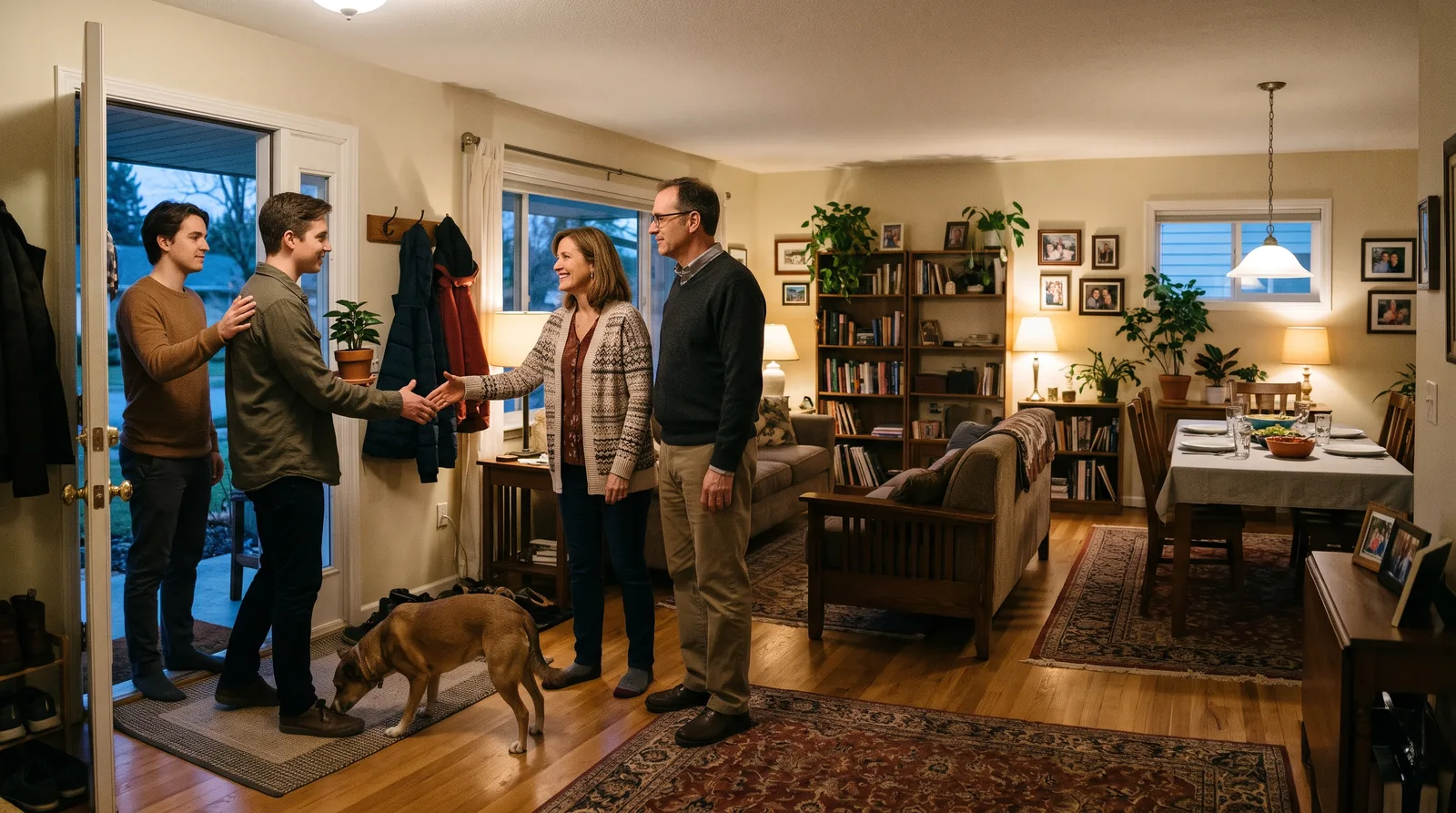
Quick answer: what to talk about when you meet your partner's family
Talk about the one thing you all have in common: the person who brought you. Then talk about what is in front of you (the home, the food, the dog, the photos on the wall), and only then about their lives: work, hometown, hobbies, family traditions. Ask one follow-up for every answer you get. Have three things ready about yourself: a short version of how you two met, a "what I do" answer that sounds like a person and not a résumé, and one small story from your week.
We call this the Three Rings: start in the middle with your partner, move out to the room, then out to their world. If a conversation stalls in the outer ring, step back in.
Before you go, ask your partner ten quick questions (below), so you know what to call people, what to avoid and how long you are staying. And after you leave, send a short thank-you. Below you will find openers for each type of relative, three worked conversations, a table for the moments that go wrong, and a pocket card.
Why this feels so big, and why it usually goes better than you think
Meeting the family is one of the few small-talk situations where you know the result matters. That is not in your head. Sociologists Susan Sprecher and Diane Felmlee surveyed 101 dating couples, mostly students, three times between 1988 and 1990. They found that the more approval people felt from family and friends, the more love, satisfaction and commitment they reported. The woman's sense of approval also helped predict whether the couple stayed together (the man's did not, in that sample). A 2015 follow-up by Colleen Sinclair, Felmlee, Sprecher and Brittany Wright, with a survey of 858 people plus two experiments, found the same "social network effect": approval from family and friends led people "to feel more love, more committed, and more positive about a partner." The earlier study also found no evidence for the "Romeo and Juliet" effect, the old idea that family opposition pulls a couple closer.
So yes, it matters. But read it the other way round too: the family wants this to go well as much as you do. Your partner's mother is probably also wondering what to ask you.
And you will likely be liked more than you think. Psychologists Erica Boothby, Gus Cooney, Gillian Sandstrom and Margaret Clark found that after a conversation, people systematically underestimated how much their partners liked them and enjoyed their company. They called it the liking gap, and found it between strangers in a lab, between new dorm mates, and among adults at a workshop. You will probably drive home replaying the one awkward pause. They will probably remember that you asked about the garden.
You do not need to impress anyone. You need to be warm, curious and easy to have around for a few hours.
Before you go: the partner briefing
The best preparation is a ten-minute talk with your partner. Most guides say "ask your partner about the family" and stop there. Here are the actual questions.
The partner briefing: 10 questions to ask before you go
- Names: Who will be there, and what should I call each of them?
- Greetings: Handshake, hug, cheek kiss? Shoes off at the door?
- Proud of: What is each of them proud of right now? (A new job, a garden, a grandchild, a marathon.)
- Into: What do they love talking about?
- Avoid: Which topics start fights, and is there anything sad going on that I should not walk into?
- What they know: What have you already told them about me?
- House rules: Grace before meals? Alcohol? Anything I should offer to help with?
- Food: Do they know what I do not eat? Will you tell them, or should I?
- Time: How long are we staying, and what is the plan if one of us needs a break?
- Signal: What is our quiet sign for "come rescue me"?
Question 6 saves more evenings than any other. If the family already knows you are a nurse who runs, you can skip the résumé and go straight to asking about them.
On what to call them: use whatever your partner tells you, and if they are not sure, start with the name the person uses when they introduce themselves. If they say "I'm Linda", say Linda. If they say "I'm Mrs. Okafor", or if the family is more formal, use that until you are told otherwise. "What would you like me to call you?" is also a perfectly good question, and most parents like being asked.
The Three Rings: what to talk about, in order
This is our own way of organizing the visit, not a tested method. It works because each ring is safer and easier than the one outside it, so you always have somewhere to step back to.
Ring 1: your partner
You and the family have exactly one thing in common, and they love that person. Questions about your partner are the easiest conversation in the room.
- "What was she like as a kid?"
- "Has he always been this competitive at board games?"
- "Is this the famous kitchen table where she did her homework?"
- "She told me you taught her to drive. How did that go?"
These questions invite the family to talk about what they know best, and there is a reason that feels good. In five studies, Diana Tamir and Jason Mitchell found that sharing one's own thoughts and experiences engaged the brain's reward system, and people were even willing to give up money for the chance to talk about themselves.
Two small rules. Ask for stories, not secrets. And if a story embarrasses your partner, laugh with them, not at them: "I would have done exactly the same thing."
Ring 2: the room
Everything in front of you is a topic: the house, the meal, the photos, the pets, the view, the neighborhood.
- "This smells amazing. Is this a family recipe?"
- "Who is the baby in the photo by the stairs?"
- "How long have you lived here? It feels very lived-in, in the best way."
- "What is the dog's name? He has clearly decided I am acceptable."
A compliment works best when it comes with a question, because it hands the turn back. "This is delicious" ends a conversation. "This is delicious, who taught you to make it?" starts one.
Ring 3: their world
Once things feel easy, move out to their lives: work, hometown, hobbies, trips, what they are looking forward to. This is where the partner briefing pays off.
- "Tom says you have been restoring a boat. How far along is it?"
- "Where did you grow up? Was it like here?"
- "What is keeping you busy these days, now that the kids have moved out?"
Then follow up on whatever they say. In three studies of live conversations, Karen Huang and colleagues found that people who asked more questions, "particularly follow-up questions", were better liked by the people they talked to. One good follow-up ("What made you pick a boat?") beats five new questions.
If Ring 3 stalls, step back in. "Did she ever come sailing with you?" brings the conversation back to Ring 1, where everyone has something to say.
Openers by who you are talking to
None of the top guides we read split their advice by relative. But what you say to a grandmother is not what you say to a 15-year-old brother. Pick the row that matches the person in front of you.
| Who | A good opener | One follow-up | Go easy on |
|---|---|---|---|
| Their mother | "Thank you for having me. What can I help with?" | "Is this a family recipe?" | Taking over her kitchen |
| Their father | "Sam says you are the one to ask about the garden." | "What is doing well this year?" | Forced banter or sports talk you cannot keep up |
| A quiet parent | "What has been the best part of your week?" | Ask about one thing they mention, slowly | Filling every pause for them |
| A sibling | "Okay, what should I know about her that she will not tell me?" | "What were you two like growing up?" | Trying to be their instant best friend |
| A teenage sibling | "What are you watching or playing at the moment?" | "Is it worth starting?" | Questions about school grades or the future |
| A grandparent | "How long has the family been in this town?" | "What was it like here back then?" | Talking fast, talking over them |
| Young kids, nieces, nephews | "Will you show me your favorite toy?" | Get on their level and let them lead | Ignoring them for the adults |
| The aunt asking about weddings | "Ha, we are enjoying where we are. How did you two meet?" | Let her tell her own story | Answering for both of you |
| A stepparent, or parents who have split up | Follow your partner's lead on who is who | Keep it light and equal | Asking about the divorce |
Kids and pets are underrated. Playing a round of a board game with a seven-year-old earns more goodwill from the adults than any compliment, and gives you a break from being the center of attention.
The questions they will ask you, and how to answer them
You will almost certainly be asked these. Have a short, warm version of each ready, then hand the question back.
| They ask | A short answer | Hand it back |
|---|---|---|
| "So how did you two meet?" | A 30-second version with one funny or sweet detail. Agree on it with your partner first. | "Did you two meet in a similar way?" |
| "What do you do?" | One sentence about the job, one about what you like about it. | "Sam says you were a teacher for years. What did you teach?" |
| "Where is your family from?" | Where, plus one small thing you love about it. | "Have you always lived around here?" |
| "What are your plans?" | Something true and light: "Right now we are planning a trip to the coast in spring." | "Where do you like to go when you get a break?" |
| "So when is the wedding?" or "Any kids planned?" | "Ha, we are enjoying where we are." Smile, do not explain. | Change rings: "How did you two know it was right?" |
The "hand it back" column matters more than the answer. A first meeting goes wrong when one side asks all the questions. When you return each question, the visit turns from an interview into a conversation.
Three worked conversations
These are hypothetical scenes, written to show the rhythm of a whole exchange, not just the opener.
Dinner with the parents. Maya is meeting her boyfriend Daniel's parents at their house. The briefing told her that his dad, Rob, has just started baking bread.
Rob: "So Maya, Daniel says you work in a lab?"
Maya: "I do, I test water samples for the city. Mostly very glamorous rivers. Daniel tells me you have become a bread person?"
Rob: "Guilty. Six months now. This one is a sourdough."
Maya: "It is really good. What made you start?"
Rob: "Honestly, I retired and needed something that told me when to get up."
Maya: "And the bread tells you?"
Rob: "The starter does. It is very demanding."
Daniel's mother: "He talks to it."
Maya: "Does it have a name?"
Maya answered the work question in two sentences and handed the conversation back within ten seconds. Everything after that came from one follow-up question.
The big family gathering. Alex is at his girlfriend Priya's family barbecue, with about fifteen relatives he has never met. He cannot have fifteen conversations, so he picks three: the host, one grandparent, and the cousin standing alone by the grill.
Alex (to the grandmother): "Hi, I am Alex. Priya says you are the reason everyone in this family can cook."
Grandmother: "She says that? Who taught her the apple cake?"
Alex: "You did, apparently. She makes it every birthday. What was the first thing you learned to cook?"
Grandmother: (a long story about her own mother's kitchen)
Alex: "I would love to learn that one sometime."
He did not need to be clever. He brought Ring 1 (Priya) into a question about the grandmother's own life (Ring 3), and then listened.
The cold reception. Jordan meets their partner Sam's father, who is polite but clearly reserved and answers in single words.
Jordan: "Sam says you built the deck yourself. That must have been a big job."
Father: "It was."
Jordan: "How long did it take?"
Father: "Most of a summer."
Jordan: "I would have given up after the first weekend. I can barely hang a shelf."
Father: (a small laugh) "The first weekend was the worst."
Jordan did not push for a long talk. Some people warm up slowly, and a quiet parent is not necessarily an unhappy one. A little self-deprecation and a question about something the father made himself were enough to get a smile. The next visit will be easier. Our guide to when someone gives short answers has more ways in.
When it goes wrong: what to do
People's real worries are often practical. On Interpersonal Skills Stack Exchange, a public Q&A site, people have asked whether it is rude to stay only an hour at a partner's family barbecue full of relatives, how to handle a family who greet everyone with a kiss when that is not your custom, and what to do when a relative opens with a political question before even saying hello. Here is a quick plan for those moments and a few others.
| What happens | What to do | A line you can say |
|---|---|---|
| A long silence at the table | Step back to Ring 2. The food is always there. | "Can I ask how you made this? I want to try it at home." |
| They tell an embarrassing story about your partner | Laugh with your partner, then trade a small one about yourself. | "I would have done exactly the same. I once locked myself out in my pajamas." |
| Someone brings up politics | Acknowledge, do not debate, move on. | "That is a big one. I am still making up my mind. Can I get anyone more water?" |
| A dish you cannot or do not eat | A quiet "no, thank you" and praise for what you can eat. Your partner can explain beforehand. | "I will pass on that one, but these potatoes are dangerous." |
| A prayer or ritual you do not know | Follow quietly, stay still and respectful. You do not have to join in words. | No line needed. Bow your head or wait. |
| A greeting that is not your custom | Go along if you are comfortable, offer a hand if not. Your partner can mention it before. | "Lovely to meet you" with a warm handshake. |
| A language barrier | Speak slowly, smile, and learn two words of their language beforehand. Let your partner translate the important parts. | "Thank you" and "delicious" in their language go a long way. |
| A pointed question about money, marriage or kids | Keep it light, do not explain, change rings. | "Ha, we are enjoying where we are. How did you two meet?" |
| You said something clumsy | Name it lightly once, then let it go. | "That came out wrong. What I meant was..." |
| You need a break | Take one. Help in the kitchen, take the dog out, step outside with your partner. | "Can I help clear the table?" |
If someone is truly hostile, that is not a small-talk problem, and it is not yours to fix in one evening. Stay polite, keep it short, and talk it through with your partner on the way home.
How long to stay, and what to bring
Let your partner decide. They know their family. For a first dinner, a few hours is normal. For a big gathering where you are one of many guests, an hour or two is often fine, as long as you say a proper hello and goodbye to the hosts. Agree on the plan before you arrive, so neither of you has to negotiate it in the hallway.
Bring something small: flowers, a plant, a dessert, or something from your hometown. Ask your partner whether the family drinks before you bring wine. A small gift is not about the gift. It is something to hand over in the first awkward ten seconds, and it starts Ring 2 for you ("This is a cake from the bakery near my flat, it's the one thing I know they do well").
After the visit: the thank-you
Within a day, send a short message to the hosts, or ask your partner to pass it on. "Thank you for a lovely evening. The bread was incredible, and I am still thinking about the boat." Mention one specific thing, so it reads as real.
People tend to underestimate how much a thank-you means. In three experiments by Amit Kumar and Nicholas Epley, people who wrote gratitude letters underestimated how positive the recipients would feel and overestimated how awkward the recipients would find it. A two-line message after a first meeting is cheap and almost always lands well.
If you are the one bringing someone home
Your job is to make the first hour easy for your partner. Most of it is in the briefing above, but four things help from your side:
- Tell your family a few good things about them in advance, including what they do and one thing they love. Then the family can start in Ring 3.
- Do not leave them alone in the first hour. Later, it is fine. At first, stay close.
- Throw them easy passes. "Mum, Maya also bakes. Tell her about the starter."
- Answer the pointed questions yourself. If someone asks about weddings or money, take it. "We will let you know. Who wants coffee?"
A five-minute drill before you go
Do this in the car or on the train.
- Say everyone's name out loud, with what you will call them.
- Pick one Ring 1 question about your partner, one Ring 2 question about the home, and one Ring 3 question for each parent, from the briefing.
- Practice your three answers: how you met (30 seconds), what you do (two sentences), and one small story from your week.
- Choose your break move: clearing plates, walking the dog, or your partner's rescue signal.
- Decide your thank-you line now, so you only have to fill in the detail later.
If one of the family has a passion you know nothing about, take ten minutes to learn the basics, not to pretend you are an expert but so you can ask better questions. "What happens to the starter when you go on holiday?" makes a much better follow-up than "Oh, cool." NerdSip, a learning app made by ai51, the company that publishes this site, writes a five-minute course on whatever subject you type in, which suits exactly this kind of homework.
For the general warm-up before any nerve-wracking evening, see our five-minute routine before a date, meeting or party.
The one thing to remember
You are not there to pass a test. You are there to meet the people who love the person you love, and to let them see why. Talk about your partner, talk about what is in front of you, then ask about their lives and listen. They are probably as nervous as you are, and they will probably like you more than you think.
If your first meeting is at a holiday dinner, see our guide to what to talk about at Thanksgiving instead of politics, and for any table of near-strangers, what to talk about at dinner with new people. If you are still early in the relationship, start with what to talk about on a first date.
Pocket card: meeting the family
- Ring 1, your partner: "What was she like as a kid?"
- Ring 2, the room: "This is delicious. Who taught you to make it?"
- Ring 3, their world: "Sam says you have been restoring a boat. How far along is it?"
- Answer short, hand it back: two sentences, then a question.
- Stuck? Step back one ring. Pointed question? "Ha, we are enjoying where we are."
Next day: a two-line thank-you that names one specific thing.