
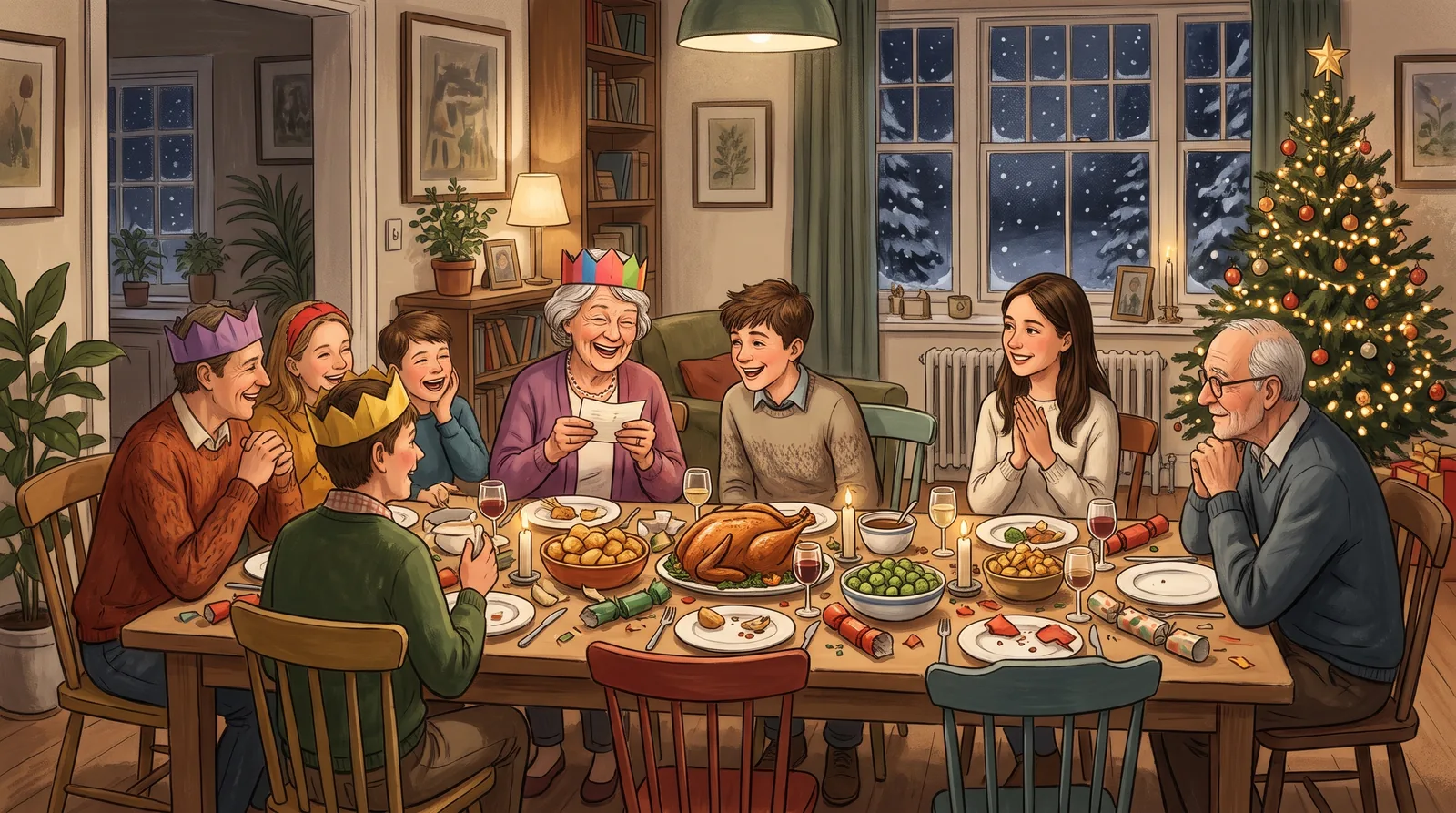
Quick answer: what to talk about at Christmas dinner
Talk about Christmases, not current events. Ask the oldest person at the table what Christmas looked like when they were ten. Ask the teenager which Christmas film is overrated. Ask the newest person what their family eats on Christmas Eve. Memory questions, food questions and small, silly questions carry a Christmas table better than anything in the news.
Then give the table a shape. Christmas dinner is longer than most meals and comes with built-in moments: the toast or grace, the crackers, the pause before pudding, the slump after it. Put one good question into each of those moments and the conversation mostly runs itself. Our favourite way to do that is a game we call Cracker Questions: one question per person, pulled out like a cracker joke, answered in under a minute, then passed on by name.
And relax a little. Most Christmas tables don't fight. In YouGov's 2025 Big Survey on Christmas, 65% of Britons who spend Christmas with family said there are never significant arguments on the day, and when people do expect a row, politics is far down the list.
Below: what families actually argue about at Christmas (with a chart), a table of flashpoints and what to say, the shape of the day, a grace or toast that works at a mixed table, 36 questions sorted by who is sitting there, the Cracker Questions rules, a five-minute drill and printable question cards. Christmas 2026 falls on a Friday, so Christmas Eve is Thursday, December 24.
What families really argue about at Christmas
The jokes say Christmas dinner is a debate stage. The surveys say something calmer, and more useful.
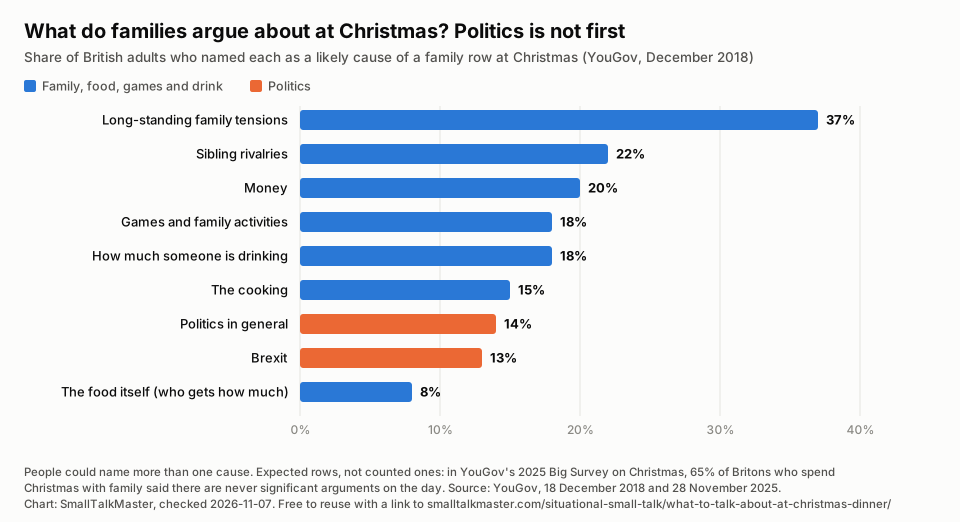
Chart: SmallTalkMaster, from YouGov, 18 December 2018. Free to reuse with a link to this page. Download the figures (CSV).
- Most families get through the day without a real row. YouGov's Big Survey on Christmas asked 4,243 British adults between November 19 and 24, 2025. Of those who spend Christmas with family, 65% said there are never significant arguments on Christmas Day, 23% said only sometimes, and 6% called arguments a Christmas staple.
- When people do expect a row, it is about the family, not the news. In a 2018 YouGov poll, 29% of Britons thought a family argument at Christmas was likely. The causes they named most were long-standing family tensions (37%) and sibling rivalries (22%), then money (20%), games (18%), how much someone is drinking (18%) and the cooking (15%). Politics came in at 14%, Brexit at 13%.
- The person you're most likely to snap at is sitting next to you. In an older YouGov poll from December 2010, 15% of Britons expected to argue on Christmas Day, and 46% of them expected it to be with their partner or spouse. Parents-in-law got 6%.
- The small stuff counts too. A 2011 Channel 4 survey of 2,000 people put money first (29.85%), then what to watch on TV (17.8%), the day's plan (13.65%) and drunk relatives (13.3%). Board games got 8.25%.
What this can't tell you. These are British online polls by YouGov and a TV channel's press release, not studies. They measure what people expect or remember, not what was said at real tables. The 2018 article does not give its sample size, and the Channel 4 figures come from a promotional release. Still, they agree on the useful part: at Christmas, the risk is less "Uncle Dave and the election" and more tiredness, old sibling stuff, a competitive game, the third glass of wine and whoever is stuck in the kitchen. Those you can plan for.
The "top 10 Christmas arguments" lists in the news each put something different first. We traced 16 of those surveys and polls, including the famous 10.13am "first row", in What Families Argue About at Christmas, Traced.
For the American side of the season, our Thanksgiving guide traces the US numbers on politics at the table and has a three-beat move for changing the subject.
The flashpoint table: what to say before it starts
Each of the common Christmas flashpoints has an early sign and a small move that usually defuses it. This is our own table, built from the survey list above, not a tested programme.
| Flashpoint | The early sign | Your move | A line you can say |
|---|---|---|---|
| Old family tension | Someone says "as usual" or "like last year" | Move the conversation to a different person and a different decade | "Grandad, what was Christmas like the year you moved here?" |
| Sibling rivalry | A story about who got what as kids | Make it a shared story, not a score | "Okay, both of you: what's the best present you ever gave each other?" |
| Money and presents | Prices, "you shouldn't have", comparing gifts | Turn to the story behind one present | "How did you even find this? I want the story." |
| A competitive game | Rule disputes in the first ten minutes | Mix the teams across generations and keep score lightly | "New rule: every team needs one person under 15 and one over 60." |
| Drinking | Voices louder, the same topic three times | Water on the table, a walk, food | "I'm doing a lap round the block before pudding. Who's coming?" |
| The cook is overwhelmed | Short answers from the kitchen | Take a job, then thank them in front of everyone | "Give me the sprouts. And everyone, a toast to whoever did the gravy." |
| The TV is winning | Half the table facing the screen | Don't fight it; ask one question about what's on | "Which Christmas film is actually the best? Defend it." |
| Politics | A headline, then a pointed look across the table | Acknowledge, bridge, pass to someone else | "You've been following that closely. Speaking of following, Mia, what are you watching this week?" |
The politics row is the Pass the Plate move from our Thanksgiving guide in one line: acknowledge the person, bridge from a word they said, pass a new question to someone else by name. If it comes back twice, stop redirecting and take a break instead. For personal questions at the table ("So when are you two getting married?"), see how to change the subject politely.
The shape of Christmas Day, and what talk fits each part
A Christmas dinner isn't one conversation. It is five or six, each with its own mood. Matching the question to the moment matters more than having clever questions.
| Moment | The mood | What works | A line |
|---|---|---|---|
| Arrival and drinks | Coats, kisses, too many people in the hallway | Short, warm, specific questions; no big topics yet | "How was the drive? Did the kids sleep?" |
| Sitting down: grace or toast | Everyone together for the first time | One short shared ritual (see below) | "To the cook, and to everyone who travelled." |
| Starter and main | Busy hands, lots of passing | Food and memory questions | "What did your family eat on Christmas Eve when you were small?" |
| Crackers | Paper hats, bad jokes, a pause | The Cracker Questions game | "I'll go first. Mine says..." |
| Before pudding | A slump; people are full | A lighter, sillier question or a toast | "Best and worst Christmas present you've ever had." |
| After dinner | TV, games, a walk, washing up | Side-by-side talk: two people, one task | "I'll dry. Tell me about the new job properly." |
A few things about the day vary by country, and they change where the talk happens. In Britain, YouGov's 2025 survey found 72% of those who spend Christmas with family open presents on Christmas morning, 64% pull crackers at some point over the holiday, and the King's Christmas broadcast is part of the day for 30% (40% of over-65s). The same survey notes that Germans typically open presents on Christmas Eve, so in German or German-style families, Christmas Eve dinner is the big conversation, not the 25th. In the United States, Pew's 2017 survey found about eight in ten Americans planned to gather with family and friends, and half planned to go to church on Christmas Eve or Christmas Day.
If your table mixes traditions, that itself is your best topic: "So in your house, is it presents on the 24th or the 25th?" gets everyone talking about their own childhood without anyone being wrong.
Grace or toast at a mixed table
Many Christmas tables now hold churchgoers and people who never go. In Pew's 2017 survey of 1,503 US adults, 55% said they celebrate Christmas as a religious holiday. Among Americans with no religion, 85% still celebrate it, and 69% of them see it as more cultural than religious. So the moment before eating can feel awkward from both directions: the believer who wants a grace, and the guest who doesn't know where to look.
A short shared ritual helps more than skipping the moment. In four experiments, Kathleen Vohs, Yajin Wang, Francesca Gino and Michael Norton found that a small ritual before eating made chocolate, lemonade and even carrots taste better, and that doing the ritual yourself worked better than watching someone else do it. Those were lab snacks, not family dinners, so treat it as a hint, not proof. The hint is useful though: a ritual that everyone joins in beats one person performing while the rest wait.
Lines that work for a mixed table, depending on who is hosting:
- A grace that includes everyone. "We're going to say a short grace. Join in however feels right to you." Then keep it to three sentences.
- A toast instead of a grace. "To the cook, to everyone who travelled, and to whoever is missing this year."
- The one-word round. "Before we eat: one word for your year. I'll start. 'Moving.'" It takes a minute, and the words are often the best conversation starters of the meal.
- A thanks with a target. "One thing someone at this table did for you this year." Specific thanks land better than "I'm grateful for my family", and the person being thanked may be hearing it for the first time.
If you're the guest and the family prays, you don't need to pretend. Sitting quietly and looking down for a moment is enough; afterwards, "Thank you for having me" is the only line you need.
Cracker Questions: the game
Christmas crackers started with a message inside. According to the V&A museum's history, the London confectioner Tom Smith first sold sugared almonds wrapped in paper with a small love motto added; the bang came later (his first cracker patent was in 1847), and the paper hats were added by his son Walter. By the 1920s the boxes promised "quips and jokes". Cracker Questions puts a message back in.
How to play:
- Before dinner, write or print one question per guest. Use the printable cards, or the list below. Roll each one up and slip it into a cracker, under a plate, or into a bowl.
- After the crackers are pulled, go round the table. Each person reads their question and answers it, in under a minute.
- Then pass it on, by name. The answerer picks one other person to answer the same question: "Same question, Auntie Jo." That's what makes it a conversation rather than a quiz.
- Everyone gets one pass. Anyone can swap their card for the joke instead. Nobody has to share anything they don't want to.
Why it works: it gives quiet people a script and a turn, it moves the spotlight around the table, and the pass-on step builds follow-up into the game. In studies of live conversations by Karen Huang, Michael Yeomans and colleagues, people who asked more questions, especially follow-up questions, were liked more by the people they talked to.
36 Christmas dinner questions, sorted by who is at the table
These are different from our Thanksgiving questions on purpose: they lean on Christmas itself, its memories, food, presents and small rituals. Memory questions are the strongest. In a set of seven studies, Tim Wildschut, Constantine Sedikides and colleagues found that nostalgia tends to bolster social bonds and lift mood, and that nostalgic stories usually feature the self with close others, often with a hard moment that turned out well. A Christmas memory is that kind of story.
For grandparents and older relatives
- "What did Christmas look like when you were ten? Who was there, and where did you sit?"
- "What was in your stocking as a child? Was there an orange?"
- "Which Christmas do you remember best, and why that one?"
- "What did your family eat on Christmas Eve back then?"
- "Was there a Christmas when everything went wrong? What happened?"
- "What did Mum (or Dad) want for Christmas when they were little?"
Number 6 is the gift of the list. The grandparent gets to tell a story, and the parent at the table gets gently teased.
For parents, aunts and uncles
- "What's one Christmas tradition from your childhood you dropped, and one you kept?"
- "Best present you ever gave someone. Not received: gave."
- "What's the most ridiculous thing you've done to get a present in time?"
- "If you could skip one part of Christmas and double another, which ones?"
- "Which Christmas song do you secretly love?"
- "What's the best thing that happened to you this year that we don't know about?"
For teenagers
- "Which Christmas film is overrated? Which one is underrated?"
- "If you designed the Christmas menu, what goes and what stays?"
- "What's the best present you could get for under ten pounds or dollars?"
- "What are you watching or playing over the break?"
- "Which family tradition would you keep when you have your own place?"
- "Rank the Christmas foods on this table. Be honest."
Skip "What do you want to do after school?" and "How are your grades?" Teens get those all December.
For kids
- "If Father Christmas needed a day off, who here should take his job?"
- "What would a reindeer want for Christmas?"
- "Which present would you give to the dog (or cat)?"
- "If you could add one new rule to Christmas, what would it be?"
- "Which grown-up here would be the worst elf?"
- "What's the best thing you made or learned this year?"
For a partner, a newcomer or a guest from another tradition
- "What does Christmas usually look like in your family? Presents on the 24th or the 25th?"
- "What's a Christmas food from home you'd miss today?"
- "Is there a tradition from your family you'd want to try here?"
- "What did you expect today to be like, honestly?"
- "If you don't usually celebrate, what's the holiday you'd be at instead? What happens there?"
- "How did you two meet? We've only heard one version."
Number 29 matters at mixed tables. It invites a guest who doesn't celebrate Christmas to talk about their own traditions instead of only answering questions about yours. If you're the newcomer, our guides to meeting your partner's family for the first time and small talk with in-laws, visit after visit cover the other side of the table.
For the whole table
- "One word for your year. Go round."
- "Best and worst Christmas present of all time."
- "What's a small thing someone at this table did this year that helped you?"
- "Which Christmas in this family would make the best film, and who plays whom?"
- "What's one thing you'd like to learn or try next year?"
- "If this family had a Christmas tradition nobody else does, what is it?"
The quiet uncle (and other quiet people)
Every Christmas table has one: the person who answers "Fine, thanks" and goes back to the roast. More questions across the table rarely help. A few things usually do:
- Ask about something he did or made. "How did you get the potatoes this crispy?" or "Is the car finally running?" A question with a handle is easier to answer than "How are you?"
- Ask him to show or teach something. "Can you show me how you carve this?" People who don't like talking often like explaining.
- Talk side by side. The washing up, a walk, fixing the lights, a jigsaw. Many quiet people talk more when they don't have to look at you.
- Give him a memory question with a time and place. "What was Christmas like in your first flat?" is easier than "Tell us about yourself."
- Let quiet be fine. Some people enjoy a table by listening. If he's smiling at the stories, he's having a good Christmas. Our guide to what to do when someone gives short answers has more.
Mixed families: beliefs, two households and an empty chair
"Mixed" can mean many things at Christmas. Some quick lines for the common ones:
- Believers and non-believers. Keep religion about traditions, not truth: "What did church at Christmas look like when you were a kid?" works for everyone. If someone asks why you don't go any more, a short and kind answer is enough: "It's not really my thing these days, but I love the carols. Which one's your favourite?" On Stack Exchange's Interpersonal Skills site, a question about telling parents you don't want to go to church over the holidays has more than 18,000 views, so you aren't the only one.
- Two households, two Christmases. Step-families and separated parents often do Christmas twice. Ask about the other one with interest, not as a contest: "What's the plan at your dad's? Anything we should steal?" Deciding whose family gets Christmas is a common question of its own; settle it before the day, not at the table.
- Someone who doesn't drink. Make sure there's something good in their glass and never ask why. "What are you having? There's elderflower or ginger beer."
- The personal questions. Christmas is when relatives ask about partners, babies, jobs and weight. A question on Interpersonal Skills about answering relatives' questions at holiday gatherings that touch on your sexuality without making the asker uncomfortable has more than 7,000 views. Our in-laws guide has short answers to the repeat questions; the trick is a short warm answer followed by a question back. Our count of 93 questions about nosy questions has lines by topic for the table. For requests rather than questions (stay longer, eat more, host next year), see how to say no politely.
- An empty chair. The first Christmas after someone has died, or can't come, is hard. Most families find it easier when someone names it once, gently, rather than everyone pretending: "I keep thinking Gran would have hated these crackers." A toast "to whoever is missing this year" makes room for it without making it the whole meal. Follow the lead of the person closest to the loss.
Stack Exchange question titles are paraphrased; posts are by their authors under CC BY-SA, linked above.
If you are hosting
- Plan the moments, not the topics. Decide who gives the toast, when the crackers come out and what happens after dinner (a walk, a game, a film). A day with a shape has fewer slumps.
- Put questions in the crackers. Print the cards, cut them out and slip one into each cracker or under each plate.
- Give people jobs. Carving, drinks, clearing, the music. A job is an easy exit for anyone who needs a break, and it shares out the kitchen load, which in YouGov's 2025 survey still fell mostly on women (27% of women did all the cooking of the main meal, against 12% of men).
- Seat with care. Storytellers in the middle; the two siblings who always compete at different ends; a newcomer next to someone kind.
- Choose the game for the room. Games and family activities got 18% of the "likely row" vote in 2018. Pick a cooperative or team game, mix ages in each team, and drop it if it gets tense.
- Leave room for the TV. It came second in Channel 4's list. Agree on one film together in advance, and the argument is over before it starts.
A five-minute drill before you go
Do this on the train or in the car.
- Name your two flashpoints. Look at the table above: which two are most likely in your family?
- Pick a move for each. One line, ready to say.
- Choose two memory questions from the list for the two oldest people there.
- Choose one silly question for the slump before pudding.
- Pick your break. Decide now: a walk, the washing up, ten minutes with the dog. Knowing your exit makes it easier to stay warm.
Bring one good story
A good story beats a good rule. Before the day, find one small thing worth telling: where your family's oddest tradition really came from, why crackers bang (see above), or something surprising you learned this year. If you like having that kind of story ready, NerdSip, a learning app made by ai51, the company that publishes this site, has a list of cool stories and facts to tell at parties.
Research behind this page
| Source | What it found | What it doesn't say |
|---|---|---|
| YouGov Big Survey on Christmas, Dylan Difford, published 2025-11-28 (4,243 GB adults, 19-24 Nov 2025) | 65% of those with a family Christmas say there are never significant arguments on the day; 72% open presents in the morning; 64% pull crackers; King's Speech part of the day for 30% | British only; self-report |
| YouGov, Victoria Waldersee, 2018-12-18 | 29% expect a family argument at Christmas; causes: family tensions 37%, siblings 22%, money 20%, games 18%, drinking 18%, cooking 15%, politics 14%, Brexit 13% | Sample size not given in the article; expectations, not actual rows |
| YouGov, Hannah Thompson, 2010-12-19 | 15% expect to argue on Christmas Day; 46% of them with a partner or spouse | Old; British only |
| Channel 4 press release, 2011-12-16 (2,000 people) | Money, TV choices, the day's plan and drunk relatives top the causes of Christmas arguments | Promotional survey; pollster not named |
| Pew Research Center, 2017-12-12 (1,503 US adults) | 9 in 10 celebrate; 55% as a religious holiday; 85% of the religiously unaffiliated celebrate; about 8 in 10 gather with family and friends | Plans, not behaviour; US only |
| Vohs, Wang, Gino & Norton, Psychological Science, 2013 | Small rituals before eating made food taste better, more so when people did the ritual themselves | Lab snacks, not family meals |
| Wildschut, Sedikides, Arndt & Routledge, JPSP, 2006 | Nostalgia bolsters social bonds and positive mood | Not about Christmas dinner specifically |
| Huang, Yeomans, Brooks, Minson & Gino, JPSP, 2017 | Asking more questions, especially follow-ups, increases liking | Conversations between strangers and speed dates |
| Fiese et al., Journal of Family Psychology, 2002 (review of 32 studies) | Family routines and rituals are linked to parenting competence, child adjustment and marital satisfaction | Mostly convenience samples; links, not causes |
All sources were opened and checked on November 7, 2026. The flashpoint table, the shape of the day and the Cracker Questions game are our own suggestions, built from these sources; none of them has been tested as a package.
The one thing to remember
At Christmas, the best topic is Christmas itself: the old ones, the food, the odd traditions, the people who aren't here. Give each part of the day one good question, pass the turn by name, and let the crackers do the rest.
Pocket card: Cracker Questions
- One question each, rolled up in a cracker or under a plate.
- Answer in under a minute.
- Pass it on by name: "Same question, Auntie Jo."
- One pass each: swap your card for the joke.
Flashpoint rising? Move it to another person and another decade. Print the cards and all 36 questions.