
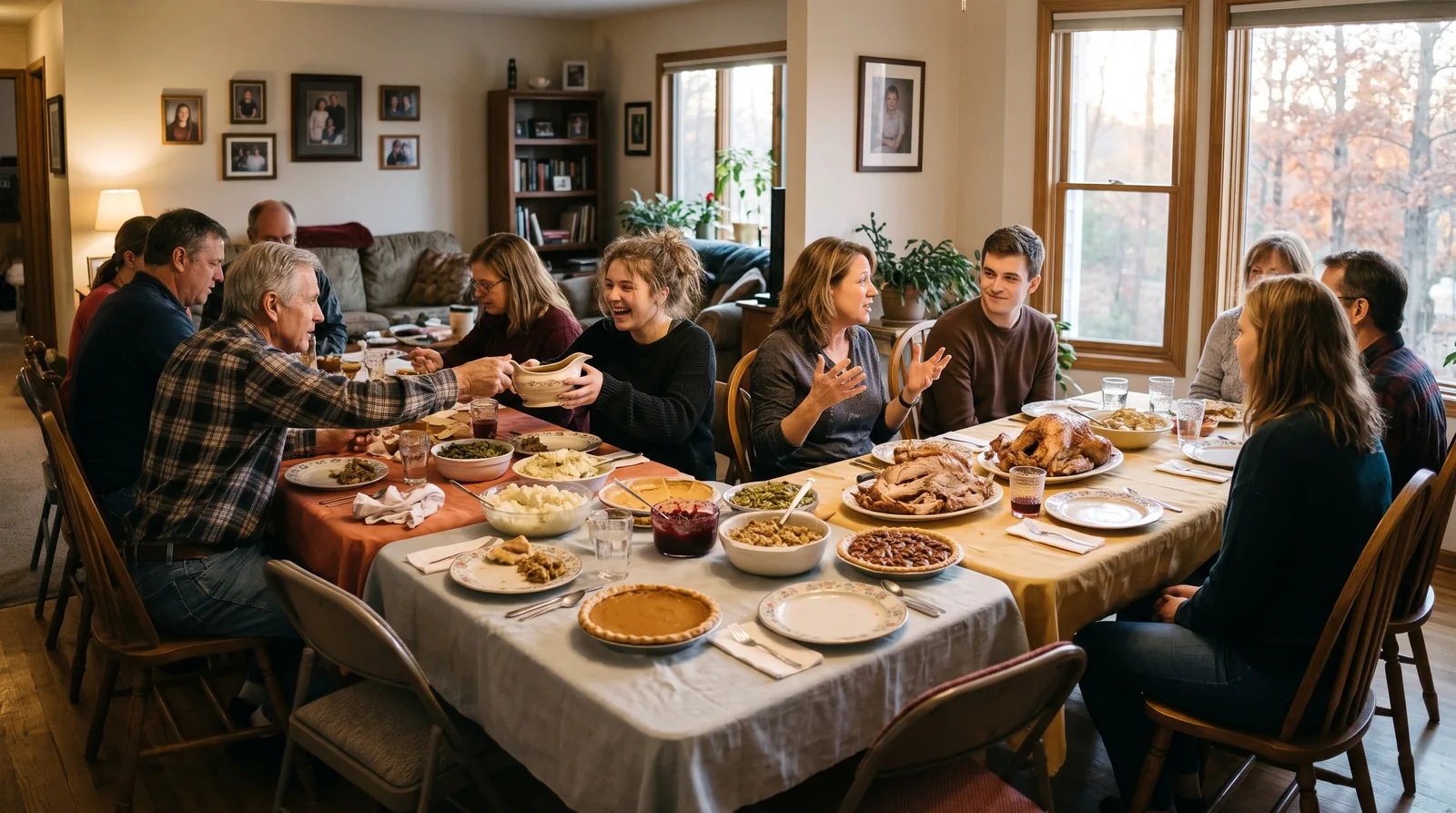
Quick answer: what to talk about at Thanksgiving instead of politics
Talk about the people at the table, not the people on the news. Ask grandparents what Thanksgiving looked like when they were ten. Ask the teenager what is overrated at their school. Ask the new partner what their family does differently. Specific, personal, easy-to-answer questions beat both politics and the stiff "what are you thankful for" round.
And when politics shows up anyway, use the Pass the Plate move: acknowledge the person in one sentence, bridge from a word they said to something safer, then pass the new topic to someone else by name. Three beats, about ten seconds, nobody gets shut down.
Below you will find the move with worked examples, a table for deciding when to redirect and when to step away, 36 questions sorted by who is sitting at the table, a five-minute prep drill, and printable question cards you can put next to the plates. Thanksgiving 2026 is on Thursday, November 26.
First, some good news: most tables do not fight
The "survive Thanksgiving" genre makes it sound as if every family dinner is a debate stage. The data says otherwise.
- Most people want to avoid it too. A CBS News/YouGov poll of 2,232 U.S. adults, taken November 19 to 22, 2024, found "a big majority" planned to avoid political discussions at the table. Just 1 in 10 said they had changed their plans to avoid people who voted differently.
- Arguments are rarer than the jokes suggest. A 2023 YouGov survey, summarized in this 2024 piece by James Coan and Imre Huss, found only 16% of U.S. adults who celebrate Thanksgiving had ever had a political argument at the dinner.
- The famous "shorter dinners" finding shrank on a second look. In a 2018 study in Science, economists M. Keith Chen and Ryne Rohla used anonymized smartphone location data from 2016. Thanksgiving dinners with guests from opposite-voting precincts were 30 to 50 minutes shorter than same-party dinners, out of an average of 257 minutes. When psychologists Jeremy Frimer and Linda Skitka tried to replicate it with survey data in 2020, their combined analysis found politically mixed dinners about 24 minutes shorter, roughly 6% of the meal, and wrote that their results favor the conclusion that politics is not straining family ties as much as previously thought.
So here is the useful takeaway. If someone starts on politics, the rest of the table is probably on your side about changing the subject. You are not the only one looking for an exit. You are just the one with a plan.
The Pass the Plate move: acknowledge, bridge, pass
This is our name for a three-beat redirect. We built it from two pieces of research: the "acknowledgment" step in Harvard Kennedy School researcher Julia Minson's work on disagreement, and studies showing that follow-up questions make people like the asker more. It has not been tested as a package in a study. Think of it as a practical recipe, not a proven cure.
1. Acknowledge the person, not the position
Say one short sentence that shows you heard how they feel. You are not agreeing with the view. You are telling them they are not being ignored.
- "Sounds like that has been on your mind a lot."
- "You have clearly been following this closely."
- "I can tell that one really matters to you."
Why it helps: in a 2024 Greater Good interview, Minson describes acknowledgment as restating what the other person cares about so they know you heard them. Her team's 2020 study of what they call conversational receptiveness (Yeomans, Minson, Collins, Chen and Gino) found that receptive language early in a conversation helps keep a disagreement from escalating later.
Skip the classic "I hear you, but...". In that interview, Minson gives "I hear you, but here is where I'm coming from" as the example of what not to do. The "but" swallows everything before it.
2. Bridge from a word they said
Grab one concrete, non-political detail from what they just said, and step sideways from it.
- Gas prices → "Speaking of driving, how bad was the traffic coming in?"
- Schools → "Speaking of school, Maya, I still want to hear about the robotics thing."
- A news story about a city → "Wait, you lived there in the eighties, right? What was it like?"
- No usable word at all → use the table: "Okay, important question. Who made this stuffing?"
A bridge does not have to be clever. It just has to be a real sentence, so the change of subject feels like a turn, not a slammed door.
3. Pass it to someone else, by name
End with an easy question aimed at a third person. This is the part most advice leaves out, and it does the heavy lifting. It moves the spotlight off the person who brought up politics, so nobody has to back down in front of everyone. It also gives the rest of the table something to join.
Pick someone who will happily take the plate: a grandparent with stories, a kid, the person who cooked.
Three worked examples
These are hypothetical scenes, written to show the rhythm.
The uncle and the election. Uncle Dave says, "Can you believe what happened with the election?" and leans toward your cousin, who already looks tense.
You: "You have been following that all month, huh. Speaking of things nobody can believe, Grandma, is it true you once drove to Ohio with a turkey in the back seat?"
The headline at the sink. Your mother-in-law brings up a news story while you are both rinsing plates.
You: "That one has been everywhere this week. Speaking of everywhere, Ben said you two are doing the Christmas market thing again this year. Ben, where are you going?"
The comment aimed at you. Your brother says, "I bet you voted for..." with a grin.
You: "Ha. You know I love you too much to do this over pie. Lily, settle something for us: is pumpkin or pecan the correct pie?"
Notice that none of these lines lecture anyone about not talking politics. They just move the table.
When to redirect, when to pause, when to step away
Not every political comment needs the same response. Use the lightest move that works.
| What is happening | Your move | A line you can say |
|---|---|---|
| A passing comment, and nobody picks it up | Let it go | Nothing. Pass the potatoes. |
| Two people are starting to spar | Pass the Plate | "Okay, gravy break. Grandpa, how did you learn to carve like that?" |
| It comes back after you redirected once | Name it, warmly, and offer a later slot | "I want to enjoy this pie with all of you. Politics on the porch after dessert, for anyone who wants it?" |
| Someone says something hurtful about a person at the table | Draw one calm line, then move on | "That one is about people I love, so I am going to ask us to leave it there." |
| It is heated and aimed at you | Pause and physically step away | "I am going to get some water. Anyone need anything from the kitchen?" |
| You actually want to understand their view | Not at the table. Ask for one-on-one time | "I would like to hear how you see that. Want to take a walk after we eat?" |
Two notes on that table. First, the "name it" line works best from the host or someone the table respects, said with a smile. Second, stepping away is not losing. A short walk to the kitchen gives everyone a reset, and the conversation that greets you on your return is often about something else.
If you do talk politics, use HEAR
Some families like a real debate, and that is fine if everyone is in. Minson's shorthand for it is HEAR, from the Greater Good interview:
- Hedge your claims: "sometimes", "maybe", "some people".
- Emphasize agreement: "We both want the kids to have good schools."
- Acknowledge their view: restate what you heard before you answer.
- Reframe to the positive: say what you are for, and avoid "no", "don't", "can't" and "won't".
In a March 2026 interview with Harvard Magazine, Minson named the most common mistake in disagreement in two words: "Trying to win." At Thanksgiving, nobody wins a debate. You can only win a nicer evening.
36 Thanksgiving questions, sorted by who is at the table
Generic lists fail because a question that delights a grandparent bores a teenager. These are sorted by who you are talking to. Each one is specific enough to get a story, not a one-word answer.
Why go a little deeper than "how's work?": in a 2021 set of twelve experiments with more than 1,800 people, Michael Kardas, Amit Kumar and Nicholas Epley found that people expected deeper conversations to be more awkward than they really were, and underestimated how interested the other person would be. And once someone answers, the follow-up question matters most: research by Yeomans, Brooks, Huang, Minson and Gino found that asking more questions, especially follow-up questions, made people like the asker more.
For grandparents and older relatives
- "What did Thanksgiving look like when you were ten? Who cooked, and where did you sit?"
- "What is a dish from your childhood that nobody makes anymore?"
- "What was your first job, and what did you spend the first paycheck on?"
- "Which house or apartment did you love living in most?"
- "What is something you were sure about at twenty-five that turned out to be wrong?"
- "Who here do you think was the most trouble as a kid?"
Number 6 is a gift. Grandparents love answering it, and it gets the whole table laughing at somebody's childhood instead of somebody's vote.
For parents, aunts and uncles
- "What is taking up most of your brain this month that is not work?"
- "What is the best thing you have eaten this year outside this house?"
- "If you had a free Saturday with zero obligations, what would you actually do?"
- "What is a skill you picked up as an adult that you are quietly proud of?"
- "What is the most useful thing you bought this year for under fifty dollars?"
- "What is a trip you still think about?"
For teenagers
- "What are you into right now that adults would not understand? Try me."
- "Which teacher is actually good, and what makes them good?"
- "What is overrated at your school?"
- "If you could add one dish to this table and ban one, what would they be?"
- "What are you watching or playing that I should know about?"
- "Pick one song for the drive home. Defend it."
Teens get asked about grades and college all day. Skipping those questions is half the trick.
For kids
- "If the turkey could talk, what would it complain about?"
- "If you were in charge of Thanksgiving, what would we eat?"
- "What was the funniest thing that happened at school this month?"
- "Which animal would be the worst dinner guest?"
- "What can you do now that you could not do last year?"
- "Who at this table would win a pie-eating contest?"
For a new partner, or anyone at their first Thanksgiving with the family
- "What does Thanksgiving usually look like for you? Anything we are doing wrong?"
- "Which dish would you be sad to miss?"
- "Is there a tradition from your family you would want to bring here?"
- "What is keeping you busy outside of work lately?"
- "Did anyone warn you about anything before today?"
- "How did you two meet? We have only heard one version."
Number 29 works because it lets the newcomer laugh at the family with the family. Number 30 hands the couple a story they already enjoy telling. If you are the newcomer, our guide to meeting your partner's family for the first time covers the other side of the table.
For the whole table
- "One good thing from this year that nobody here knows about yet. Go around."
- "Best and worst Thanksgiving food of all time."
- "What is something small someone at this table did this year that helped you?"
- "What is one thing you want to learn next year?"
- "What is the most 'us' moment in this family's history?"
- "If this family had a reality show, what would it be called?"
Number 33 is a gratitude question with a target. "What are you thankful for?" tends to produce "my health and my family" on repeat. Asking about one specific thing one specific person did gets real answers, and the person being thanked may be hearing it for the first time.
A five-minute drill before you go
Do this in the car or on the train. It turns the Pass the Plate move from a nice idea into something you can actually do with a mouth full of stuffing.
- Name the likely topics. Write down the two or three political subjects that tend to come up in your family.
- Find a bridge word for each. Look for one concrete, non-political detail inside each topic: a place, a job, a school, a food, a trip.
- Pick your pass targets. Choose two people who love to talk: a storytelling grandparent, an excited kid, the cook. Prepare one question from the list above for each of them.
- Say the three lines out loud once. Acknowledge, bridge, pass. Hearing yourself say it once makes it feel less strange when you need it.
- Choose your exit line. Decide now what you will say if you need to step away, so you do not have to invent it while annoyed.
Here is what a finished bridge map might look like for a hypothetical family:
| Likely topic | Bridge word | Pass to | Question |
|---|---|---|---|
| Prices and the economy | the food on this table | whoever cooked | "Okay, how long did this take you, honestly?" |
| A school board fight | school | the teenager | "Which teacher is actually good?" |
| A politician's latest scandal | (no good bridge) | Grandma | "Who here was the most trouble as a kid?" |
| Something on the news about a city | that city | the uncle who lived there | "What was it like living there back then?" |
If you are the host
The host sets the tone more than anyone else, and most of the work happens before the turkey comes out.
- Say the plan out loud, kindly. A short message the day before works: "This year I would love one politics-free meal. Porch debates after pie are fair game." Framing it as a wish, with a later slot, is gentler than a ban.
- Put a question card at each place. Print the cards, cut them out, and tell people they can play theirs whenever the table goes quiet. It gives shy guests a script and gives everyone a built-in redirect.
- Give people jobs. Carving, refilling water, running the dessert table. Moving around breaks up long standoffs and gives everyone a natural exit.
- Seat with care. Put your best storytellers in the middle and the two people most likely to clash at different ends.
- Plan one shared activity. A walk between dinner and pie, a game, or watching football together gives the afternoon a second center that has nothing to do with the news.
Bring one good non-political story
The easiest way to keep politics off the table is to bring something better to talk about. Before Thursday, find one small, surprising thing you learned this year: how a recipe in your family really started, a strange fact from a book or a podcast, something you finally understood about how a thing works. One fresh story, told well, does more than ten conversation rules. If you want ideas, NerdSip, a learning app made by ai51, the company that publishes this site, keeps a list of 50 random topics anyone can learn.
For more on that habit, see how to turn a weird fact into a good conversation.
If it still goes wrong
Sometimes a relative will not let it go, and no line fixes that. That is not your failure. A few things help:
- Stop redirecting after two tries. If acknowledge, bridge, pass has failed twice, switch to pausing or stepping away. Repeating the move a third time starts to feel like a game of whack-a-mole, and people notice.
- Leave the room, not the relationship. "I am going to get some air" is enough. You do not owe a closing argument.
- Repair later, one-on-one. A short text the next day ("I was glad to see you, even if we got a bit heated") often matters more than anything said at the table. When you are ready for the real conversation, away from the table, our guide to talking with relatives you disagree with walks you through it.
For harder cases, our guide to conversations with difficult people covers what to do when someone keeps pushing. And if you are dreading the whole day, read conversation anxiety before a social event first.
The one thing to remember
At Thanksgiving, the people at the table are more interesting than the people on the news. Ask about them, pass the plate when you need to, and let the pie do the rest.
Pocket card: the Pass the Plate move
- Acknowledge the person: "Sounds like that has been on your mind."
- Bridge from one word: "Speaking of driving..."
- Pass it by name: "Grandma, how did you learn to make this?"
Two tries, then pause or step away. Print this card and all 36 questions.