

Quick answer: how to join a group conversation
Walk to the open side of the group, listen until you know what they're talking about, then add one short line that fits. We call this Edge, Listen, Add:
- Edge: stand at the gap in the circle, where people can see you. Not behind anyone, not in the middle.
- Listen: show you're following (nod, laugh, look at whoever is speaking) for about as long as one story or one round of opinions.
- Add: when someone finishes a sentence, say one thing tied to their topic. A question to the person who just spoke works best: "Wait, you actually ran it in the rain? How far did you get?"
Then watch for the Shift Test: does anyone turn their shoulders, step back or look at you when you speak? That small shift means you're in. If no one shifts after two tries, nothing is wrong with you. Smile, say "Enjoy!" and try another group or someone standing alone.
If walking up to strangers isn't the problem, and getting a word in once you're there is, skip to Getting a word in. That turned out to be the bigger worry in the real questions we read (below).
This page: the moves for standing groups, seated tables, video calls and old friends with inside jokes, the lines to say, the research behind them, what to do when a group doesn't open, and how to let the next person in. For a whole party where you only know the host, see Bridge, Branch, Bow out.
What the research says about groups
None of the top guides we checked cites a single study about how conversation groups work. There is research, and it turns most of the usual tips into something you can see.
| Finding | Source | What it means for joining | What it doesn't say |
|---|---|---|---|
| Data from various settings suggest an upper limit of about four people who can share one spontaneous conversation; the limit seems to come from how speech is produced and heard. | Dunbar, Duncan and Nettle, "Size and structure of freely forming conversational groups", Human Nature, 1995 (abstract) | A group of two or three has room for you. A group of seven is really two conversations, and you'll end up in one of them. | It doesn't say a fifth person is unwelcome, only that bigger groups tend to split. |
| People in a conversation arrange themselves so they share a space between them and keep it together with their position and the way they face. Kendon called this an F-formation. | Kendon, "Spacing and orientation in co-present interaction", 2010 (abstract); computer scientists now detect these groups from distance and body orientation alone (Hung and Kröse, 2011) | The shape of a group is a signal. A gap in the circle is a door; a tight ring is the group protecting its conversation. | It describes how groups hold together, not how outsiders should enter. The "stand at the gap" advice is practice, not a tested rule. |
| Conversation runs on "one speaker at a time". The floor changes hands at points where a turn could end, either because the speaker picks the next person or because someone picks themselves. | Sacks, Schegloff and Jefferson, "A simplest systematics for the organization of turn-taking for conversation", Language, 1974 (abstract; summary of the rules from the 2015 Russian edition) | Speak at the end of a sentence, a laugh or a story, not in the middle of one. And if you want in, a question to someone makes them hand you the next turn. | It's a description of how talk works, not etiquette advice. |
| Across 10 languages, people avoid overlapping talk and keep the silence between turns short; the average gap differs between languages only within about 250 milliseconds. | Stivers and colleagues, "Universals and cultural variation in turn-taking in conversation", PNAS, 2009 (abstract) | The window for getting in is short everywhere. Waiting for a long, clear pause often means waiting forever, so start on the end of a sentence instead. | The study timed answers to questions, not people joining groups. |
| Turn changes between the same pairs of people averaged 135 ms face to face and 487 ms over Zoom; yes/no answers took 297 ms locally and 976 ms over Zoom. | Boland, Fonseca, Mermelstein and Williamson, "Zoom disrupts the rhythm of conversation", J. Exp. Psych.: General, 2021 (abstract) | On video calls the usual timing breaks, which is why people talk over each other and then both stop. Use a name, the hand button or the chat instead of a pause. | Pairs, not large calls. |
| After small-group conversations, people underestimate how much the others liked them; the same "liking gap" showed up in work teams. | Mastroianni, Cooney, Boothby and Reece, "The liking gap in groups and teams", OBHDP, 2021 (abstract) | The feeling that you came across badly in a group is a poor guide. The authors' summary: "people are liked more than they know." | It measured people who were already in the conversation, not newcomers walking up. |
| Listeners enjoyed stories about experiences they had had themselves more than stories about new ones, though both speakers and listeners predicted the opposite. | Cooney, Gilbert and Wilson, "The novelty penalty", Psychological Science, 2017 (abstract) | When you join, building on what the group is already talking about lands better than bringing in your own unrelated story. It may also help explain why old friends drift back to shared memories. | The studies were about stories, not about groups or newcomers. |
| Across 120 studies (11,869 people), being left out of a simple online ball-tossing game by strangers had a large effect on how people felt. | Hartgerink, van Beest, Wicherts and Williams, "The ordinal effects of ostracism", PLOS ONE, 2015 | If a group not opening stings, that's a normal human reaction, not a sign you're oversensitive. It's also why letting the next person in matters. | A lab game is not a party. It shows how much small exclusions hurt, not how often they happen. |
| People's fears before talking to a stranger are overblown: conversations go better than expected (seven studies, 2,304 people). | Sandstrom and Boothby, "Why do people avoid talking to strangers?", Self and Identity, 2020; see also Epley and Schroeder, "Mistakenly seeking solitude", 2014 | The dread before walking over is a bad forecast of how it will go. | One-on-one conversations, not groups. |
The short version: groups are small, their shape tells you whether they're open, the floor changes hands at the end of sentences, and you're probably doing better than you feel.
Edge, Listen, Add: the three moves
This is our own working method, built on the research above and on the top answers to real questions about joining groups. It isn't a tested program.
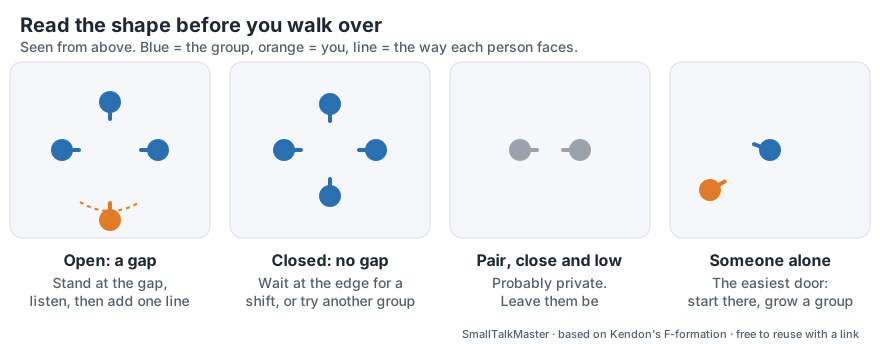
Edge: pick the group, then stand at the gap
Choose before you walk. The easiest groups, in order:
- Someone alone. No group to break into. Start a conversation and others will often join you.
- Two or three people standing in a loose "C" or semicircle. There's a gap, and by the research there's room for a fourth voice. The answer on Interpersonal Skills Stack Exchange that matches this most closely says it plainly: the easiest groups to get into are semicircles, not tight circles; go and stand so you're already physically part of the shape.
- A group doing something: queuing for food, looking at a view, playing a game. The activity gives you something to say.
Leave for later: two people close together talking low (probably private), and a big tight ring with everyone facing in.
Walk in from where they can see you. Come toward the gap, not from behind someone's shoulder. Stop at the edge, at about the same distance the others stand from each other. Holding a drink or a plate helps: it gives your hands a job and a reason to be there.
Catch one pair of eyes. A small smile and a nod to the nearest person is your knock on the door. If they smile back or shift a little, that's an invitation. Some people say a quiet "Mind if I join you?" here. At a networking event or a work do, that's normal; in a lively group of friends it can be better to just listen first and save your voice for the Add.
Listen: follow before you speak
Give it roughly one story's worth of time. You're doing two things:
- Learning the topic, so your first line fits. Joining with an unrelated topic feels like a hijack; joining with a line about their topic feels like a contribution.
- Showing you're with them. Look at whoever is speaking. Laugh when they laugh. Nod. Listening visibly is how a group starts to count you in before you've said a word.
Don't stand there forever, though. A few minutes of silent hovering gets harder, not easier. If the topic is one you know nothing about, that's fine: your Add can be a question.
Add: one line, tied to their topic, at the end of a sentence
Wait for a point where a turn could end: the end of a sentence, the punchline, the laugh after it. Then come in with one short line, ideally a question to the person who just spoke. A question makes them hand you the next turn, which is exactly how the floor normally changes hands.
Good first lines are about the last thing said:
- "Wait, you actually did the whole thing in the rain? How far did you get?"
- "Sorry, I just caught the end of that. Which bakery is this? I need to know."
- "That's the second person tonight saying that about the new manager. What happened?"
- "I've never watched it, but I keep hearing about it. Is it worth starting from season one?"
- "Hi, I'm Sam, I'm a friend of Priya's. Are you all talking about the marathon?"
The fourth line is a version of a tip from an accepted answer on Interpersonal Skills: when the topic is one you don't know, use the little you do know to ask a real question, not one that can be answered in a word. Another answer suggests asking right after an unfamiliar thing comes up ("Could you explain the encrypted drive thing?"), because a genuine need softens the interruption, and doing it at most once or twice.
Introduce yourself when there's a natural point, usually right after your first exchange: "I'm Sam, by the way." Don't stop the conversation for a round of names.
The Shift Test: are you in?
After your first line, watch the shape:
| What you see | What it means | Next move |
|---|---|---|
| Someone steps back or turns to make the circle wider | You're in | Keep listening, add again when it fits |
| People answer you and look at you as they talk | You're in | Ask one follow-up, then let the talk move on |
| A polite one-word answer, then back to each other | Not yet | Try once more later in the conversation |
| No one looks at you, twice | It isn't opening | "Enjoy your evening!" and go find someone alone |
| One person turns to you and starts a side chat | Half in | Enjoy it: you now know someone in the group |
Two tries, then move on. Beaumont Etiquette's guide gives the same advice: if the group stays closed, leave graciously rather than trying harder. A group that doesn't open is often mid-way through something private, or a cluster of old friends who haven't noticed you. It's information, not a verdict.
Lines to say, by situation
| Situation | Edge | Add |
|---|---|---|
| Party, you know one person in the group | Stand next to the person you know | "Hey! Don't let me interrupt, what were you saying about the flat?" |
| Party, you know no one | A semicircle of two or three | "Sorry, I just caught 'Lisbon'. I'm going in March. Was it good?" |
| Networking or conference | Groups near the coffee or after a talk | "Mind if I join you? I'm Ana, from the logistics side. What did you make of the keynote?" |
| Work, kitchen or break room | Make your coffee next to them | "Is this the quiz from last night? Who won?" |
| After a class, club or church service | Arrive early and talk to one person before the circles form | "I'm new. Is it always this busy after the service?" |
| Your partner's or friend's old friends | Sit or stand next to the friendliest one | "Okay, I need the backstory. How did you all end up in the same flat?" |
| A group outside, smoking or waiting | Join the line or the shelter | "Is this the queue for the shuttle, or just the best spot to wait?" |
| Family gathering, cousins you rarely see | Bring something: a plate, a drink, a game | "Who wants the last spring roll? And what did I miss?" |
The church line comes from an accepted answer to a question about joining circles after a service: introduce yourself to one friendly person before it starts and mention you're new; now you know someone, and joining their circle afterwards is easy.
At a table: seated groups
Tables are harder in one way (you can't drift in and out) and easier in another (once you sit down, you're in).
- Ask the seat, not the group: "Is this seat free?" or "Mind if I sit here?" Nobody has to decide whether you're welcome in the conversation; they only answer about a chair.
- Talk to your neighbours first. At a long table, the conversation splits into pieces of three or four, just as the 1995 research would predict. Your real group is the two or three people nearest you.
- Use the table itself. Food, the menu, the wine, the noise: "Has anyone tried the soup? It looks amazing."
- Pass things. Offering the bread or the water is a small, wordless way of joining in. Then speak.
For a whole dinner with people you don't know, see what to talk about at dinner with new people.
On a video call
The research is clear that video breaks the usual timing: turn changes took more than three times as long over Zoom in one study, so the "speak at the end of a sentence" trick fails. Two people start at once, both stop, and the quieter one gives up.
- Use names: "Can I add something to what Leo said?" A name claims the turn more clearly than a pause.
- Use the hand button or the chat in bigger calls: "Quick question when there's a moment."
- Turn on your camera and react (nod, smile) while others speak, the video version of Listen.
- If you collide, say so and hand it on: "Sorry, go ahead, then I'll jump in." Then do jump in.
- Ask the host beforehand, for small online events: "Could you bring me in when you get to the budget? I've got one thing to say."
Getting a word in once you're in
When we read the real questions (see the next section), most of the views went not to "how do I walk up?" but to "I'm standing there and can't get in." That's a different problem.
Use the end of a laugh. After a laugh there's a short reset, and the first person to speak usually gets the floor. "Oh, that reminds me…" or "Okay, but the best part…"
Ask the quietest person something. It changes the rhythm and gives two people a turn, not one: "Mira, you've been there, haven't you?"
Start with the person next to you. The highest-voted answer to a question about fast-moving groups suggests talking to one person near you rather than the whole group; it's easier to get one person's attention, and the side chat often pulls the group back in. Pick someone who seems quieter, not someone hanging on every word.
Speak a little louder, a little earlier. The accepted answer to the same question found that when the asker started soft and hesitant, they were talked over; when they spoke with more confidence, it worked more often. Lift your voice for the first three words, then relax.
Claim the turn kindly. If you get cut off: "Sorry, just to finish my thought…" The Catch lines from our over-talking study work in groups too: use their name and a short summary, then speak.
Old friends with inside jokes. The most-read question in our reading is from someone whose partner's friends keep reminiscing about college. The top answer suggests swapping clarifying questions ("which guy?") for open questions about the part you're curious about, which invite a story instead of a quick "yep". Another suggests doing something together (cards, cooking, building furniture), because shared activities keep talk on the present and start new memories, and finding the other partners who are left out too.
- "Okay, I have to know. What was the worst flat you all lived in?"
- "Was that before or after the camping trip I keep hearing about?"
- "Who wants to play something? I brought cards."
When the topic bores you, you can still be in the group: listen, react, and when the topic shifts, be the one who asks a question. A good group conversation doesn't need everyone to talk equally all the time.
What people actually ask: a reading of 16 questions
We read all 3,958 questions on Interpersonal Skills Stack Exchange (pulled 2026-11-03) for ones about joining or getting into group conversations. A pattern search found 81 candidates; reading them by hand left 16 that are really about group conversations, with 32,012 views between them. That's a reading, not a study: too few to count with confidence. We grouped them by what the asker was stuck on.
| What they were stuck on | Questions | Views | Example (paraphrased) |
|---|---|---|---|
| Getting a word in once they're there | 5 | 14,486 | Partner's college friends keep reminiscing (5,829); fast-moving group at a games night (3,170); the only one who says nothing |
| An established group or clique | 4 | 11,187 | Joining a friend's group of friends (5,640); a nurse on a new floor who eats lunch alone (4,353) |
| Hearing, language or volume | 3 | 3,850 | Cochlear implants in a noisy group; understanding 10-20% in a bar |
| Walking up to a group | 3 | 1,894 | A room of strangers in small groups; circles after a church service |
| The other side: someone joins you | 1 | 595 | A newcomer asks what you just told everyone |
What stands out: the walk-up, which most guides focus on, draws the fewest readers here (3 questions, 1,894 views). The questions people read most are about staying in, especially with groups whose members already know each other. That's why this page gives "getting a word in" and "old friends" as much room as the approach.
Method: keyword search over titles and bodies of the full Interpersonal Skills census, then each candidate read by Bob (an AI) and kept only if the question is about taking part in a group conversation. Views as of 2026-11-03. Stack Exchange content is CC BY-SA; questions are linked and paraphrased, no usernames.
When you need the group to meet you halfway
Three of the 16 questions are about access: hearing, a second language, or a voice that carries too far. The top answers share one idea: tell one person, not the whole group.
- Hearing: one answer suggests telling one or two people ahead of time; the accepted answer adds asking to be seated where you can face more of the group. A line: "I hear best when I can see people talk. Mind if I sit at this end?"
- A second language: an answer suggests asking for help when you hit a wall instead of smiling through it: "Sorry, I lost that. What's the joke?" Being briefly awkward beats being quietly lost all evening. Smaller groups of three or four are much easier than a whole table in a loud bar.
- A loud voice: an answer suggests imagining you're wearing headphones, speaking lower than your ears tell you to.
When someone joins your group
You'll be on the other side of this too, and it's where you can make someone's evening.
- Open the shape. Step back half a pace so the circle has room. That's the wordless "come in".
- Give a ten-second catch-up: "We're arguing about whether pineapple belongs on pizza. Where do you stand?" A catch-up plus a question hands them their first turn.
- Retell in short. If they ask about something you just told everyone, one answer suggests a short digest, and another a little hedge: "As I was just telling these guys…", then the short version.
- Introduce them to one person: "Have you met Tom? He's the one who did the marathon."
When a group doesn't open
Sometimes you do everything right and the group carries on without you. One question from someone who had moved abroad describes it exactly: a glance, a nod, and the talk carries on. That stings, and the ostracism research says the sting is normal.
What usually helps:
- Try two groups, then go for a person alone. Someone by the food or the bookshelf is often glad of company.
- Build one connection, not a group entry. The accepted answer to the "wallflower" question argues it's better to be invited into a group than to break into it, and the way in is one person at a time. Next time that person is in the circle, you'll be in it too.
- For a group you see every week (a team, a club), get to know members one by one over coffee or a walk, then invite them to something yourself. Start a plan instead of waiting to be asked.
- Leave on purpose. "I'm going to grab some food. Nice to meet you!" See how to leave a conversation politely.
Three worked scenes
These are hypothetical scenes, written to show the moves.
The work drinks. Leila doesn't know anyone from the other team. Three of them stand by the window in a loose semicircle. She walks to the open side with her drink, smiles at the nearest man, and listens. They're talking about a cycling holiday. When one of them laughs at the end of a story about a puncture, she says: "Wait, you fixed it on the side of a mountain? Was it your first time?" The woman next to her steps back a little and says, "Oh, he's done it about forty times." Leila is in. Shift Test passed.
The old friends. Marco is at a dinner with his girlfriend's university friends, and the talk has been about their old flat for twenty minutes. Instead of asking "which flat?", he asks: "Okay, what was the worst thing that ever happened in that flat?" Three people start talking at once, and one of them turns to explain the story to him. Later, he suggests a card game, and the evening finds new stories.
The call that didn't open. On a video call with eight people, Jo tries twice to speak and collides with someone both times. She types in the chat: "Have a quick idea for the launch date when there's a moment." The host sees it: "Jo, go ahead." Next time she'll ask the host before the call.
A five-minute drill
Try this at your next event, or even in a café while watching people.
- Spot the shapes (1 minute): find one open group, one closed group and one person alone. Just look; don't move.
- Edge (1 minute): walk to the open side of one group with a drink or plate. Smile at one person.
- Listen (2 minutes): find out what they're talking about. Prepare one question about it.
- Add (30 seconds): say it at the end of a sentence or a laugh.
- Shift Test (30 seconds): did anyone move or look at you? If yes, stay. If no, try once more, then go to the person alone.
Do it three times at one event and it stops feeling like a performance.
The one thing to remember
Groups are small, their shape tells you whether they're open, and the floor changes hands at the end of sentences. Walk to the gap, listen until you know the topic, add one line about it, and watch for the shift. Two tries, then find someone alone. And when it's your turn to be in the circle, step back half a pace for the next person.