

Quick answer: small talk phrases that sound confident
A confident small talk phrase is short, finished, and ends with something the other person can pick up. It doesn't apologise for existing, it doesn't hedge every word, and it doesn't need to be clever.
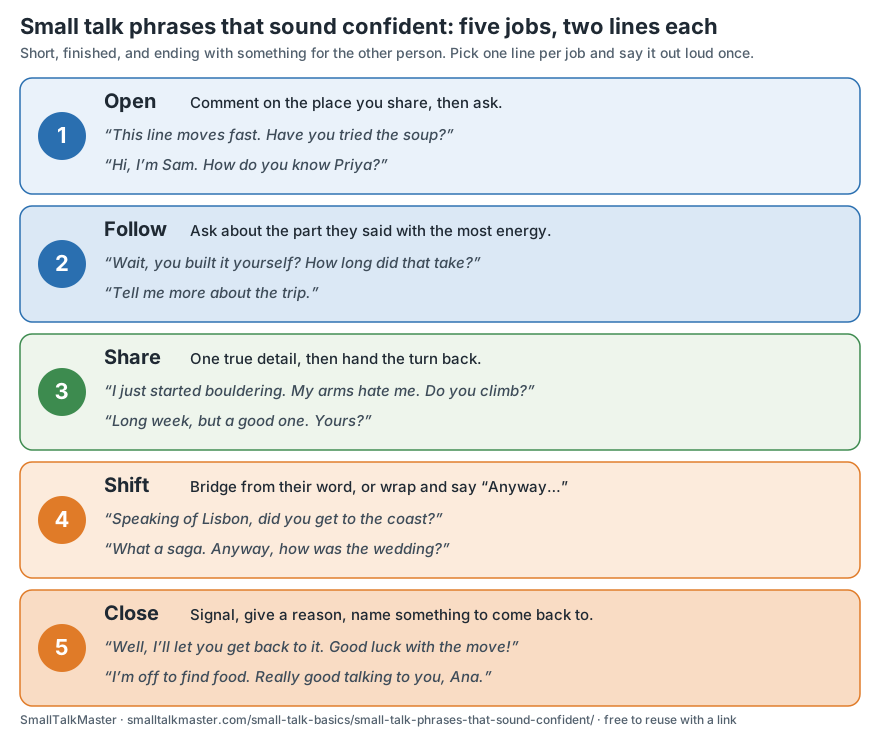
Every chat has five jobs. We call them Open, Follow, Share, Shift, Close (our name for it). Keep one line ready for each:
- Open: comment on the place you share, then ask. "This line moves fast. Have you tried the soup?"
- Follow: ask about the part they said with the most energy. "Wait, you built it yourself? How long did that take?"
- Share: one true detail, then hand the turn back. "Long week, but a good one. Yours?"
- Shift: bridge from a word they said. "Speaking of Lisbon, did you get to the coast?"
- Close: signal, give a reason, name something to come back to. "Well, I'll let you get back to it. Good luck with the move!"
The confidence part is easier than it feels: in studies, people walk away from a first conversation liked more than they think, and strangers turn out to be more interested in talking than people predict. The research is below.
This page: what the research says makes a phrase land, 45 lines sorted by job, ten hesitant habits and what to say instead, lines by setting, a made-up scene and a five-minute drill. Each job has its own full guide on this site if you want to go deeper; the links are in each section.
What the research says makes a phrase land
The top guides for this search (Upworthy, AOL, Entrepreneur and the British Council's English blog, read on November 12, 2026) give good lists. A few mention research in passing, and none says which study stands behind which phrase, or when a phrase can backfire. Here is what we found when we opened the studies.
| Finding | Source | What it means for your phrases | What it doesn't say |
|---|---|---|---|
| After a conversation with someone new, people underestimate how much the other person liked them and enjoyed their company. The gap showed up in the lab, in student dorms over months, and at a workshop. | Boothby, Cooney, Sandstrom and Clark, "The liking gap in conversations", Psychological Science, 2018 | Your opener is not an exam. A plain line is enough, because the other person is judging you more kindly than you are. | It doesn't say any particular line works best. |
| Commuters told to talk to a stranger had a more positive ride than those told to sit alone, though others predicted the opposite. People underestimated how interested strangers were in talking. | Epley and Schroeder, "Mistakenly seeking solitude", Journal of Experimental Psychology: General, 2014 | A light opener to a stranger is usually welcome. You don't need a perfect line, just a first one. | Trains, buses and a waiting room; not every setting or every mood. |
| In live get-to-know-you chats and speed dates, people who asked more questions, especially follow-up questions, were liked more. Responsiveness (listening, understanding, care) explained it. | Huang, Yeomans, Brooks, Minson and Gino, "It doesn't hurt to ask", Journal of Personality and Social Psychology, 2017 | Follow lines ("Wait, how did that happen?") are the strongest phrases on this page. They show you heard the last thing. | More questions is not always better; it doesn't test rapid-fire quizzing. |
| Strangers' deeper conversations felt less awkward and more connecting than people expected. People expected others to care less about what they shared than others actually did. | Kardas, Kumar and Epley, "Overly shallow?", Journal of Personality and Social Psychology, 2021 | A Share line with one real detail ("My arms hate me after bouldering") goes over better than you'd guess. | The experiments compared deep and shallow conversations between strangers; a first chat at a bus stop is lighter. |
| People who wrote genuine compliments underestimated how good recipients would feel and overestimated how awkward it would be, which made them hold back. | Zhao and Epley, "Insufficiently complimentary?", Journal of Personality and Social Psychology, 2021 | If you notice something you like, say it. "That was a great question you asked in the meeting" lands better than you fear. | Genuine compliments only; it doesn't cover flattery or comments on looks. |
| People who wrote gratitude letters underestimated how surprised and happy recipients would be and overestimated how awkward they'd feel. | Kumar and Epley, "Undervaluing gratitude", Psychological Science, 2018 | A specific thank-you ("Thanks for saving me a seat, that was kind") is a strong line, not filler. | Letters, not spoken small talk. |
| An apology for something that isn't your fault ("I'm sorry about the rain") increased trust in four studies, through showing concern. | Brooks, Dai and Schweitzer, "I'm sorry about the rain!", Social Psychological and Personality Science, 2013 | "Sorry you got stuck in that traffic" is warm, not weak. The weak kind is apologising for yourself ("Sorry, this is probably stupid"). | It tested apologies for circumstances, not apologies for talking. |
| After a service failure, saying "thank you" (for patience) often worked better than saying "sorry", because it put the other person's contribution in focus. | You, Yang, Wang and Deng, "When and why saying 'thank you' is better than saying 'sorry'", Journal of Marketing, 2019 | "Thanks for waiting" instead of "Sorry I'm late" is worth trying when you're a few minutes late. | The studies were about companies and customers, not friends. |
| In a written argument, hedges on data statements made readers judge the writer and the argument more negatively; casual hedges on the conclusion also hurt, professional ones didn't. | Durik, Britt, Reynolds and Storey, "The effects of hedges in persuasive arguments", Journal of Language and Social Psychology, 2008 | Say the fact plainly ("It opened in 2016"). Keep "I think" for real opinions, where it is honest and friendly. | Written editorials, not chat. Hedges "can, but do not always" undermine, in the authors' words. |
| In recorded phone calls, people start an ending with a short "We-ell…" or "O.K…" on its own; if the other person answers "O.K." too, the goodbye begins. A common polite version gives the other person's interests as the reason: "Well I'll letchu go." | Schegloff and Sacks, "Opening up closings", Semiotica, 1973 (open full text) | Close lines can be tiny: "Well…" plus a reason and a kind wish. "I'll let you get back to it" is a very old, very normal move. | Mostly phone calls from decades ago; it describes what people do, not what is rated best. |
| In 932 conversations, talk almost never ended when both people wanted it to; on average the gap between wanted and actual length was about half the conversation. | Mastroianni, Gilbert, Cooney and Wilson, "Do conversations end when people want them to?", PNAS, 2021 | Having a ready Close line is a kindness. The other person may want to go too, and can't tell that you do. | It doesn't test which closing lines feel best. |
The short version: the studies don't crown magic words. They say the same thing in different ways: people are kinder judges than you expect, follow-up questions and real details make you likeable, and small warm extras (a compliment, a thank-you, sympathy about the rain) cost little. Confidence in a phrase is mostly about not shrinking it.
The 45 phrases, by job
1. Open: say something about the place, then ask
Openers work best when they come from what you both see. The first-conversation guide goes deeper on the first minute, and what to say instead of "How are you?" has alternatives to the stock greeting.
- "This line moves fast. Have you tried the soup?"
- "Hi, I'm Sam. How do you know Priya?"
- "Is this your first time at one of these?"
- "That looks good. What did you order?"
- "How's your week going so far?"
- "I like your jacket. Where's it from?"
- "Mind if I join you? I don't know anyone here yet."
- "What brought you here tonight?"
- "Have you been to this place before? What's good?"
Why they sound confident: each is a full sentence with a question at the end. None starts with "Sorry to bother you".
2. Follow: ask about the part with the most energy
This is the job the research backs most strongly (Huang and colleagues, above). Listen for the word they stressed, the detail they added that nobody asked for, or a smile. Then ask about that. Our guide to better follow-up questions has more.
- "Wait, you built it yourself? How long did that take?"
- "Tell me more about the trip."
- "How did you get into that?"
- "What happened next?"
- "What was the best part?"
- "So you moved for the job and stayed for the lake?"
- "Is that harder than it sounds?"
- "What would you do differently next time?"
- "How did they take it?"
Why they sound confident: they show you were listening, and they keep the light on the other person. "So you moved for the job and stayed for the lake?" is a reflection: say back what you heard as a question and they'll correct or expand it.
3. Share: one true detail, then hand the turn back
A conversation that is only questions starts to feel like an interview. Give something real, keep it short, and end with a hook back to them. How to share about yourself without taking over covers the balance.
- "Long week, but a good one. Yours?"
- "I just started bouldering. My arms hate me. Do you climb?"
- "I'm in logistics. Basically I make sure the cheese gets to the shop. What about you?"
- "I'm reading a book about the history of salt. It's better than it sounds."
- "Honestly, I'm a bit tired today. Up late with a project. How's yours going?"
- "Same here! I grew up two streets from there."
- "I'm terrible at this game, but I love watching it. Who are you rooting for?"
- "Not much, just a quiet weekend. I finally fixed my bike. Did you get out at all?"
- "I've never been, but it's on my list. Would you go back?"
Why they sound confident: one detail is specific enough to talk about. "It's better than it sounds" or "my arms hate me" shows you can laugh at yourself without putting yourself down.
If your answer to "Anything fun lately?" is always "Not much", it helps to have one small thing you learned this week. This NerdSip guide to stories and facts for parties has ideas. NerdSip is a learning app made by ai51, the company that publishes this site.
4. Shift: bridge from their word, or wrap and say "Anyway…"
When a topic runs dry, step sideways from a word they just said. If it's run long, sum it up in a line, let them agree, then move. Our guide to changing the subject politely lays out the full ladder and the research on how topics change.
- "Speaking of Lisbon, did you get to the coast?"
- "What a saga. Anyway, how was the wedding?"
- "That reminds me, are you still doing the Friday bakery run?"
- "Can I ask you something totally different?"
- "Okay, new topic: best thing you've eaten this month?"
- "Before I forget, how did the interview go?"
- "Enough about work. Any plans for the holidays?"
- "You mentioned your sister earlier. Is she the one in Berlin?"
- "I'd rather not get into that today. Tell me about the trip?"
Why they sound confident: they move the talk on in the open. No long silence, no mumbled "Soooo…".
5. Close: signal, reason, something to come back to
In Mastroianni's study, conversations rarely ended when even one person wanted them to. A kind Close line takes the guessing out of it for both of you. Our guide to ending a conversation politely has exits for groups, phone calls and people who keep talking.
- "Well, I'll let you get back to it. Good luck with the move!"
- "I'm off to find food. Really good talking to you, Ana."
- "I should say hi to the host before she disappears. Catch you later?"
- "Let's pick this up at lunch on Thursday."
- "I won't keep you. Hope the presentation goes well."
- "This was fun. I'll send you that podcast."
- "I'm going to grab a refill. Enjoy the rest of the party!"
- "Okay, I need to run, but I want to hear how it ends."
- "Thanks for the tip about the bakery. I'll report back."
Why they sound confident: "Well…" or "Okay…" marks the end the way people have done it for decades, the reason is short, and the last words are warm and about them.
Ten hesitant habits, and the confident version
These are the small habits that make a good line sound unsure. The fix is usually to cut a few words, not to add any.
| Hesitant version | Confident version | What changed |
|---|---|---|
| "Sorry to bother you, but is this seat taken?" | "Hi, is this seat free?" | No apology for existing. |
| "This is probably a stupid question, but…" | "I'm curious: how does that work?" | No running yourself down first. |
| "Sorry I'm late, sorry, the train, sorry." | "Thanks for waiting. The train was slow." | One reason, then thanks (You and colleagues, 2019). |
| "I think maybe it opened in, like, 2016 or something?" | "It opened in 2016, I think." | The fact first; one honest "I think" at most (Durik and colleagues, 2008). |
| "Oh, I'm boring, nothing much really." | "Quiet week. I finally fixed my bike. You?" | One true detail and a hand back. |
| "Cool." (and silence) | "Cool. How did you get into that?" | A follow-up after the reaction (Huang and colleagues, 2017). |
| "Does that make sense? Sorry, I'm rambling." | "Anyway, that's the short version. What about you?" | Close your own turn and pass it. |
| Thinking "nice shoes" and saying nothing. | "Great shoes, by the way." | Say the compliment you were going to swallow (Zhao and Epley, 2021). |
| "Um, so, yeah… I guess I should maybe go?" | "Well, I'll let you get back to it. Good to meet you!" | Signal, reason, warm wish (Schegloff and Sacks, 1973). |
| "Sorry, I didn't catch your name, sorry." | "Remind me your name? I want to get it right." | A request with a kind reason. |
One "sorry" is fine. "I'm sorry you got caught in the rain" is a warm line in Brooks and colleagues' study. It's the stack of apologies about yourself that makes a sentence shrink.
Lines by setting
| Setting | Open | Follow | Close |
|---|---|---|---|
| Coffee machine at work | "Survived the Monday meeting?" | "What's keeping you busy this week?" | "Back to the inbox. Good luck with the launch." |
| Party where you know one person | "Hi, I'm Sam. How do you know Priya?" | "Oh, from the choir? How long have you sung?" | "I'm going to find Priya before she vanishes. Great to meet you." |
| Waiting in a line | "This line moves fast. Have you tried the soup?" | "What else is good here?" | "Enjoy your lunch!" |
| Neighbour in the hallway | "Your plants on the balcony look great." | "Do you grow anything to eat?" | "I'll let you get inside. Have a good evening." |
| Before a video call starts | "Where are you calling from today?" | "Is it as cold there as here?" | "Looks like everyone's here. Shall we start?" |
| Networking event | "What brought you here tonight?" | "What part of that do you enjoy most?" | "I'd love to keep in touch. Are you on LinkedIn?" |
For the office in particular, our count of 1,985 real questions about what to say at work shows which moments people struggle with most.
A made-up scene: the coffee shop, before and after
This is an invented example to show the phrases at work, not a real event.
Leo is waiting for his drink next to a woman in a green coat. His old habit: stare at his phone, then, as she turns to go, "Sorry, um, is the… sorry, never mind."
With a line ready, it goes like this:
Leo: "This place is busy for a Tuesday. Is it always like this?"
Her: "Only since they started the cinnamon buns. I come for those."
Leo: "Wait, are they that good? What makes them different?"
Her: "Cardamom. And they're huge."
Leo: "I'm sold. I'm more of a plain-croissant person, but I'll try one. Are you nearby?"
Her: "Two streets over. I work at the library."
Leo: "Well, I'll let you get to work. Thanks for the bun tip!"
Open, Follow, Share, Close. Under a minute, nothing clever, and the last line gives both of them a reason to say hello next time.
A five-minute drill
- Pick one line per job from the lists above, the ones that sound like you. Change any word that doesn't.
- Say each one out loud three times, so the words feel familiar when you need them. For a longer speaking drill, try the 3-2-1 rule.
- Write your Share line for "What have you been up to?" in two short sentences plus "You?".
- Use one Open line today, with a barista, a neighbour or a colleague. Just one.
- Notice how it went, then remember the liking gap: they probably liked it more than you think.
The one thing to remember
Confident small talk isn't louder or wittier. It's a short, finished line that ends with something for the other person. Keep one ready for each job, Open, Follow, Share, Shift, Close, and say it without the apology in front.