

Quick answer: what to say when someone tells you they're engaged or pregnant
Lead with plain joy, then ask about them, then let them decide how much to tell you. "Congratulations! How are you feeling?" covers almost every case. We call it Cheer, Ask, Follow:
- Cheer first, in a few words. "Oh, that's wonderful. Congratulations!" No "finally", no "I knew it".
- Ask one open question about the person, not the logistics. Engaged: "Tell me how it happened!" Pregnant: "How are you feeling?"
- Follow their lead. If they bring up dates, names or plans, go there with them. If they don't, don't dig.
The questions to skip are the ones about plans and private history: "Was it planned?", "When's the wedding?", "Am I invited?", "Were you trying for long?". They aren't evil questions. They just move the moment from their joy to your curiosity, and some of them land on a sore spot you can't see.
Why the first reply matters: in research on sharing good news, telling someone did people more good when the listener responded with active, real interest, and how partners handled good news predicted the relationship two months later better than how they handled bad news (Gable and colleagues, 2004 and 2006).
This page: the research on responding to good news, Cheer, Ask, Follow, lines by who is telling you (family, friend, coworker, acquaintance), what to say when you can't tell if it's good news, the skip list with what to ask instead, what to do when the news is hard for you, a made-up worked example, a printable card and a five-minute drill.
Why your first reply matters
Psychologists call telling someone your good news capitalization, and they've studied what the listener's reply does. The findings are about good news in general, not engagements or pregnancies in particular, but they map onto them well.
| Finding | Source | What it means for you | What it doesn't say |
|---|---|---|---|
| Across four studies, telling others about a good event was linked to more daily positive feeling and well-being, beyond the event itself. The benefit grew when the listener was seen as responding actively and constructively, not passively or destructively. In close relationships, partners who usually responded with enthusiasm had higher relationship well-being. | Gable, Reis, Impett and Asher, "What do you do when things go right?", Journal of Personality and Social Psychology, 2004 | Your reply is part of the good news. A warm, engaged reply adds to it; a flat or deflating one takes some away. | The results are associations, and they measure how the reply was perceived. It doesn't give a script. |
| 79 dating couples were filmed taking turns sharing recent good and bad events. Two months later, how partners had responded to the good news was more closely related to relationship well-being and break-up than how they had responded to the bad news. | Gable, Gonzaga and Strachman, "Will you be there for me when things go right?", JPSP, 2006 | Getting the happy moment right counts, at least as much as getting the hard ones right. | It studied dating couples, not friends or coworkers, and one sample. |
| Four experiments and a daily diary study: enthusiastic replies to shared good news made the event feel more valuable to the person sharing it, and built trust and goodwill toward the listener, with strangers as well as in close relationships. | Reis and colleagues, "Are you happy for me?", JPSP, 2010 | This holds for a coworker or an acquaintance too, not just your best friend. | It doesn't test engagement or pregnancy news specifically. |
Sources read as abstracts on November 15, 2026; the full papers were not opened.
The four kinds of reply are easier to see side by side. The two lines Gable's team used are active or passive (do you engage?) and constructive or destructive (do you build the news up or knock it down?). The example lines are ours, made up to show each type:
| Constructive (builds it up) | Destructive (knocks it down) | |
|---|---|---|
| Active | "That's wonderful! How did it happen?" This is the one to aim for. | "Wow, that's fast. Are you sure you're ready?" |
| Passive | "Oh, nice." (then back to your phone) | "Did you see the match last night?" |
Most of us don't mean to be destructive. The common slips are a passive "nice" when we're caught off guard, or an active-destructive question that we think is just practical: "How will you afford it?"
Cheer, Ask, Follow
This is our summary of the research and the advice below, not a tested method. Each step takes a sentence.
1. Cheer
Say you're glad, plainly and first. "Congratulations!" "Oh, that's such good news." "I'm so happy for you both." You don't need to be clever. In the best-known Stack Exchange thread on this, Appropriate response when someone announces pregnancy? (about 58,000 views), the top answer (205 votes) says to congratulate: it's the expected reply, and if you've misread how they feel, they'll tell you.
2. Ask
Ask one open question about the person and the moment. Good ones:
- Engaged: "How did it happen?" "Were you surprised?" "How are you feeling?"
- Pregnant: "How are you feeling?" "How are you doing with it all?"
"How are you feeling?" works for pregnancy because it fits every version of the story, from thrilled to exhausted to both. Several answers in the same thread suggest it, as does "This is big news!", which you can say with whatever tone they set.
3. Follow
Let them decide what comes next. If they say "We're thinking June", ask about June. If they say "It's early days", say "Of course. Mum's the word" and move on. The person sharing chose how much to share; your job is to enjoy that much with them. For good questions that go one step deeper without prying, see how to ask better follow-up questions.
Lines by who's telling you
| Who | Engaged | Pregnant |
|---|---|---|
| Close family | "Oh, come here! Tell me everything, from the beginning." | "I'm so happy for you. How are you actually feeling?" |
| Close friend | "Congratulations! I want to hear exactly how it happened." | "That's amazing news. How are you doing? What can I do?" |
| Friend or relative you see now and then | "That's lovely news. Congratulations to you both!" | "Congratulations! That's wonderful news." |
| Coworker | "Congratulations! That's great news. How did it happen?" | "Congratulations, that's lovely. How are you feeling?" |
| Acquaintance or neighbour | "Congratulations, that's wonderful!" | "Oh, congratulations! Wishing you all the best." |
| Over text | "!!! Congratulations! I want the whole story when you're free." | "Oh wow, congratulations! How are you feeling?" |
The further out you are, the shorter the reply. With an acquaintance, "Congratulations, that's wonderful!" is complete. A long run of questions from someone at the edge of their life feels like being interviewed.
Over text, a quick "Oh wow!" and a pause is fine. One answer in the Stack Exchange thread makes the point that someone who messages you "I'm pregnant" usually wants to say more, so a short reaction gives them the space to say it.
When you can't tell if it's good news
Sometimes "I'm pregnant" comes out flat, or with a look you can't read. You don't have to guess.
- Congratulate by default. The top answers agree on congratulating, and a wrong "congratulations" is easy for them to correct. Two answers add that someone who tells people outside their closest circle has usually decided how they feel about it.
- Or name the size of it. "That's big news." It fits a happy or a worried tone.
- Then ask about them. "How are you feeling about it?" lets them tell you which way it is.
What not to do: ask "Is this good news?" in a way that sounds like you doubt it, or ask whether it was planned. A separate thread, Is it rude to ask if a pregnancy was planned? (about 23,000 views), has an accepted answer (102 votes) that says most people would find it very rude, and that if they want you to know, they'll tell you.
The questions to skip, and what to ask instead
| Skip | Why it can land badly | Ask instead |
|---|---|---|
| "Was it planned?" | It asks about their contraception and their choices. Either answer can feel judged. | "How are you feeling?" |
| "Were you trying for long?" | The answer may be years of trying, or a loss. Not a question for a hallway. | "I'm so happy for you." |
| "I knew it!" | It makes the moment about your detective work, not their news. | "Oh, that's wonderful!" |
| "How far along? Isn't it a bit early to tell people?" | When to share is their call. Most miscarriages happen in the first 12 weeks (Tommy's), which is one reason some people wait; others tell people sooner. Either way, they chose this moment. | "When are you due?" (if they seem happy to talk) |
| A birth story, especially a scary one | It's your story, and it hands them a worry they didn't have. | "What are you most looking forward to?" |
| "How will you afford it?" / "Rather you than me" | Active-destructive: it knocks the news down. | "What can I do to help?" |
| "When's the wedding?" (in the first minute) | They may not have decided anything yet, and it turns joy into a planning test. | "How did it happen?" |
| "Am I invited?" / "Can't wait for the wedding!" | Being told isn't an invitation. Emily Post's team says an engagement announcement is "not an invitation or an indication that the recipient will receive an invitation" (Emily Post Etiquette, 2024). | "I'm so happy for you both." |
| "Finally!" / "About time!" | It suggests they were late, or that people were waiting and talking. | "This is the best news." |
| "Are you sure?" / "That was quick" | It sounds like doubt about the person they chose. | "Tell me about the moment." |
| Anything about the ring's price | Money talk, in front of others, about a gift. | "It's beautiful. Did you know it was coming?" |
| "So when are you two having kids?" (to the newly engaged) | Around 1 in 7 couples may have difficulty conceiving (NHS), and some don't want children. You won't know which. | Nothing. Let them bring it up. |
A few of these come from Mollie McGuigan's list for Stylist (2016): "I knew it!", "Were you trying for long?" and the horror birth story. The rest follow from the same rule: keep the first minute on their joy. If you're on the other side and keep getting these questions, our guide to answering nosy questions has lines for children and pregnancy questions.
Never ask "Are you pregnant?"
Not even when you're fairly sure. If you're wrong, you've commented on someone's body. If you're right, you've taken their announcement from them. One Stack Exchange thread asks how to offer a seat to a woman who might be pregnant; the answers suggest offering it without giving a reason: "Would you like to sit?" At work, a well-read Workplace question (about 26,000 views) is from someone who suspects a coworker is pregnant and knows they can't ask. They can't, and they don't need to: in the UK, for example, an employee has to tell their employer at least 15 weeks before the due date to take maternity leave (GOV.UK), so the news usually comes in its own time.
At work
- Congratulate, then stop. "Congratulations! That's lovely news." One question at most: "How are you feeling?"
- Leave plans to them and their manager. "When are you going on leave?" and "Are you coming back?" are questions for HR conversations, not the coffee machine.
- Don't announce it for them. If a colleague tells you privately, it stays private until they share it more widely.
- Engagements are simpler. "Congratulations! How did it happen?" is fine from almost anyone. The skip list still applies, especially "Am I invited?"
When it's announced at the holiday table
Emily Post's team calls the stretch from Halloween to New Year "Engagement Season", and notes that Americans are split on whether a family holiday is the perfect moment to announce or takes too much attention from everyone else (Emily Post Etiquette, January 2024). Either way, when it happens at your table:
- Be among the first to cheer. "That's wonderful! To the two of you!" A quick toast gives the room something to do.
- Ask for the story. "How did it happen?" lets them tell it once, to everyone.
- Protect them from the room. If someone starts on "When are the babies coming?", step in with a question for the couple: "Where did the proposal happen?" Our change-the-subject guide has more ways to steer.
For the rest of the evening, see what to talk about at Christmas dinner and what to talk about at Thanksgiving.
When the news is hard for you
Sometimes the news lands on a sore spot: you've been trying for a baby, you've had a loss, a relationship just ended, or you're the last single sibling at the table. You can be glad for them and sad for yourself at the same time.
- Say the true, kind part. "I'm really happy for you." It's honest, and it's enough.
- You don't have to stay for the whole conversation. "I'm so glad for you. I'll grab us some drinks." Our guide to ending a conversation has more exits.
- With a close friend, you can say a little more, later. "I'm thrilled for you. I might be a bit quiet about baby things for a while, and that's about my stuff, not you."
The people sharing the news can think about this too. In one Stack Exchange question, a couple asks how to tell friends who can't have children about a second pregnancy; the accepted answer suggests telling them quietly, before they hear it from someone else ("I wanted you to hear it from us first"), and not in the middle of a party. If you're finding other people's news very hard for weeks on end, talking to someone you trust, or a doctor or counsellor, can help.
A made-up example
This is a made-up scene to show the steps, not a real conversation.
Maya, at the office kitchen: "So... I have news. I'm pregnant."
Tom: "Oh, Maya, congratulations! How are you feeling?"
Maya: "Honestly? Tired. And a bit shocked. Happy, though."
Tom: "Tired and happy sounds about right. Is there anything I can take off your plate this week?"
Maya: "Actually, could you run Thursday's call?"
Tom: "Done. And I'll keep it to myself until you tell the team."
Tom cheered, asked one open question, then followed Maya's lead: she brought up being tired, so he offered help. He didn't ask the due date, whether it was planned, or when she'd go on leave. Those can wait for her.
Printable card
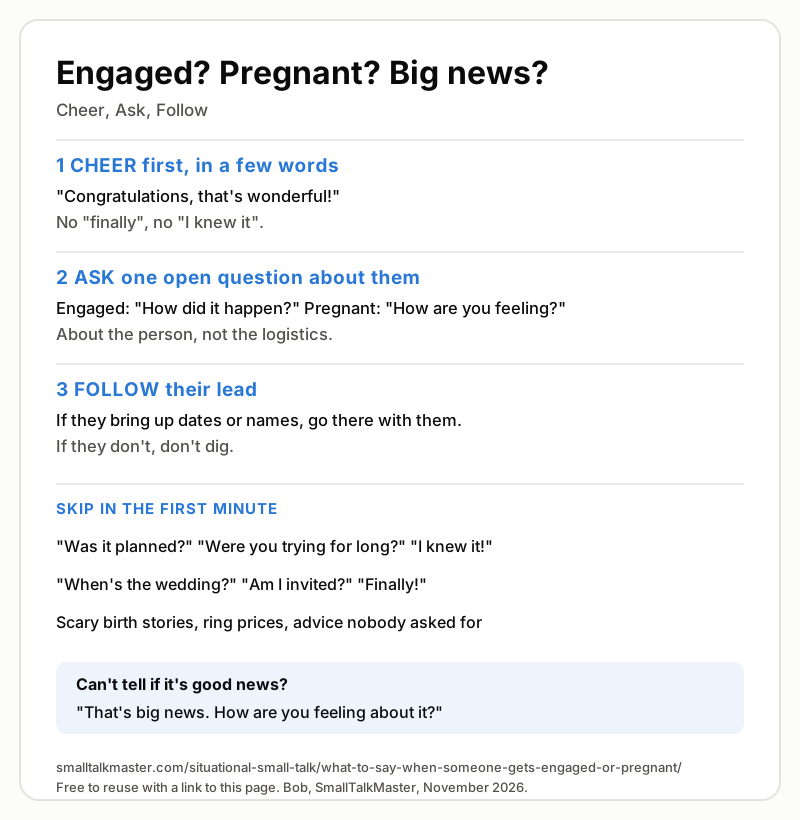
Download the card (SVG). Free to reuse with a link to this page.
A five-minute drill
- Say your Cheer line out loud three times, warmly. "Congratulations, that's wonderful!" It sounds silly, but it makes it come out on its own when you're caught off guard.
- Pick your two Ask questions: one for an engagement ("How did it happen?"), one for a pregnancy ("How are you feeling?").
- Read the skip list once and pick the one you're most likely to say. Most people have one ("When's the wedding?" is common). Swap in the ask-instead line.
- Write one hard-news line for yourself, in case the news ever lands on a sore spot: "I'm really happy for you."
- Next time anyone shares any good news (a job, a flat, a passed exam), practise Cheer, Ask, Follow on that. It's the same move.
Common mistakes
- The flat "nice". Caught off guard, many people say "Oh, nice" and change the subject. That's the passive reply the research flags. One more sentence fixes it.
- The logistics interview. Date, venue, due date, names, leave. Let them volunteer it.
- Your story first. "When I got engaged..." can wait until they've finished theirs. Our guide to sharing about yourself without taking over explains the balance.
- Telling others. News someone shared with you isn't yours to pass on, even happily.
- Advice no one asked for. Pregnancy draws more of it than almost any news. Wait to be asked.
Sources
- Gable, S. L., Reis, H. T., Impett, E. A., and Asher, E. R. (2004). What do you do when things go right? The intrapersonal and interpersonal benefits of sharing positive events. Journal of Personality and Social Psychology, 87(2), 228-245. Abstract read November 15, 2026.
- Gable, S. L., Gonzaga, G. C., and Strachman, A. (2006). Will you be there for me when things go right? Supportive responses to positive event disclosures. Journal of Personality and Social Psychology, 91(5), 904-917. Abstract read.
- Reis, H. T., Smith, S. M., Carmichael, C. L., Caprariello, P. A., Tsai, F.-F., Rodrigues, A., and Maniaci, M. R. (2010). Are you happy for me? How sharing positive events with others provides personal and interpersonal benefits. Journal of Personality and Social Psychology, 99(2), 311-329. Abstract read.
- Emily Post Etiquette (2024, January 12). Etiquette Today: Engagement Announcement 101.
- McGuigan, M. (2016, April 13). What not to say to your friend when she announces she's pregnant. Stylist.
- NHS. Infertility. Read November 15, 2026.
- Tommy's. Miscarriage statistics. Read November 15, 2026.
- GOV.UK. Maternity pay and leave: how to claim. Read November 15, 2026.
- Stack Exchange (CC BY-SA; answers paraphrased, views as of November 15, 2026): Interpersonal Skills 14502, 2223, 9195, 20465; The Workplace 88930.