
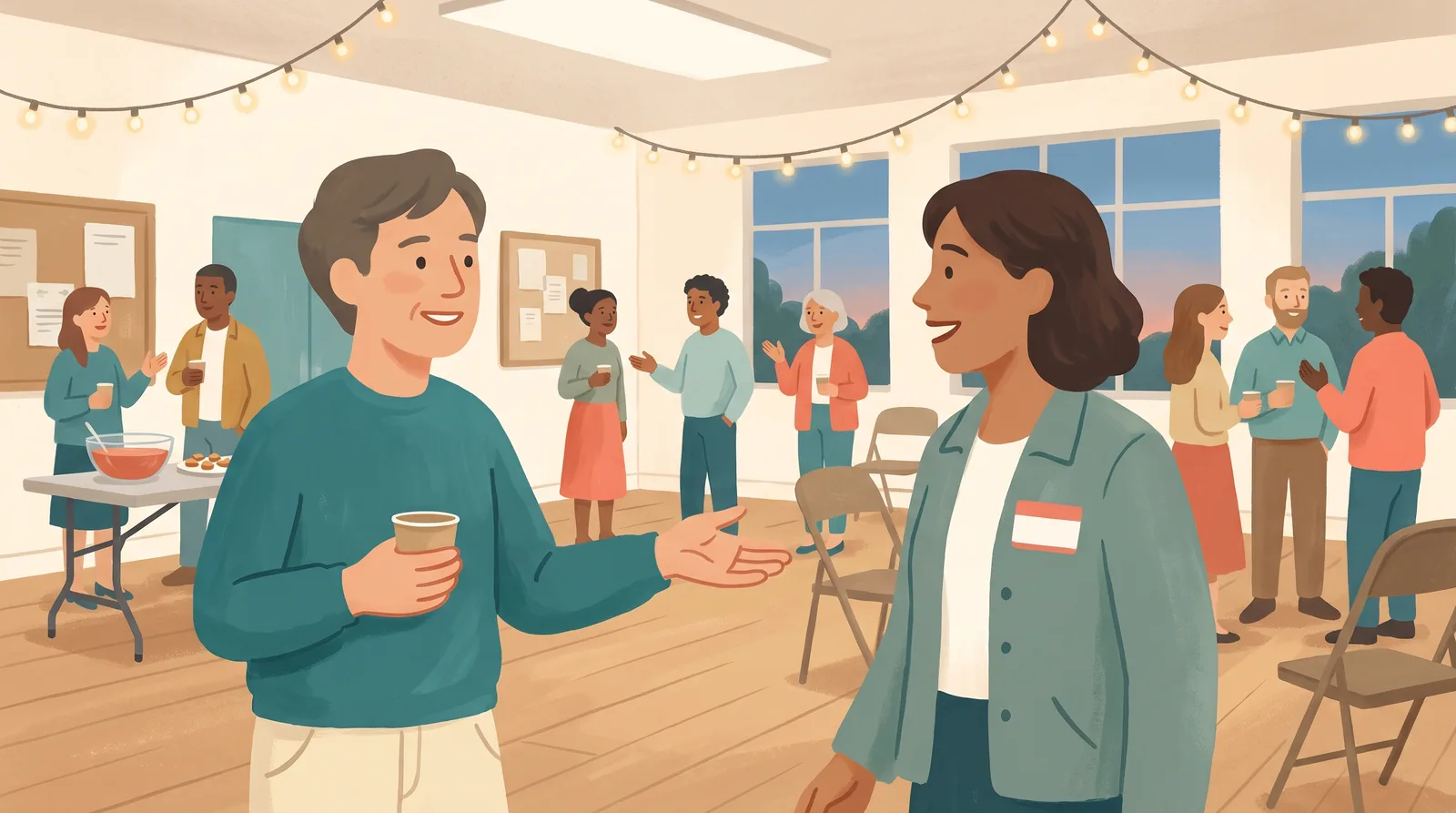
Quick answer: how to introduce yourself
Say three things, in one or two breaths: your name, your link to this place or these people, and one thread the other person can pull. Then hand it back with a question.
- At a party: "Hi, I'm Sam. I'm Lena's neighbour, the one with the very loud dog. How do you know Lena?"
- At a networking event: "I'm Priya. I work on the train timetables for the city, so if your bus was late, I'm sorry. What brings you here?"
- On your first day: "Hi, I'm Tom, I just joined the data team, I'm sitting by the window. What do you work on?"
We call this Name, Link, Thread. It is short on purpose. An introduction isn't a summary of you. It's the first move in a conversation, and its only job is to make the second move easy.
Below: why the résumé version falls flat, 21 introductions sorted by setting, a table of how much to say where, answers to "So what do you do?" when your job title doesn't help, what to do about names (yours and theirs), how to re-introduce yourself to someone you've already met, what people ask about introductions on Stack Exchange, the research, a 5-minute drill and a pocket card.
Name, Link, Thread (and the hand-back)
| Part | What it is | Why it helps | Example |
|---|---|---|---|
| Name | Your first name, said clearly. Add a surname only where people will need it (work, formal events). | People need a handle for you. Names are the hardest part to remember, so keep it simple. | "I'm Ana." |
| Link | How you're connected to this place, event or person. | It answers the question everyone is silently asking: why are you here? It also gives them a way to place you later. | "...Lena's neighbour." / "...new on the data team." / "...here for the 10k on Sunday." |
| Thread | One small, specific, slightly human detail. | It's the thing they can ask about. A title closes a conversation; a detail opens one. | "...the one with the loud dog." / "...I'm sitting by the window." |
| Hand-back | A question about them, usually built from the same link. | It gives them a turn and shows you're curious, not presenting. | "How do you know Lena?" |
The thread is easy to leave out, and it's the part that does the work. "I'm in finance" gives the other person nothing to hold. "I'm in finance, which mostly means I'm the person who asks for receipts" gives them a smile and three questions.
Why the résumé version falls flat
Most advice for networking events teaches an "elevator pitch", for example Robert Half's 30- to 60-second summary of your value, your expertise and your goals. That's useful when someone has asked for exactly that. As a first line to a stranger with a drink in their hand, it's a speech, and speeches make the listener an audience.
Three findings explain why shorter and more specific works better:
- People will forget your name and remember your link. In a 1987 experiment, people learned the surnames and jobs of 16 unfamiliar faces. Names were much harder to recall than jobs, even when the same word could be either: it is harder to remember that someone is called Baker than that someone is a baker (McWeeny, Young, Hay and Ellis, British Journal of Psychology). So give them something to remember you by, and say your name again when you part.
- Asking beats telling. In three studies of live get-to-know-you conversations, people who asked more questions, especially follow-up questions, were liked more, and in speed-dating data they got more second dates (Huang and colleagues, 2017). People didn't predict this. That's why the hand-back matters more than the polish of your first line.
- Say good things plainly. Across nine studies, "humblebrags" (a boast dressed as a complaint, like "Ugh, I'm so tired from all the award dinners") made people less liked and seen as less competent than a plain brag, because they came across as insincere (Sezer, Gino and Norton, 2018). If your thread is something you're proud of, just say it.
You'll also read that you have "seven seconds" to make a first impression. We traced that number and found no study behind it. Nobody is timing you.
21 introductions, by setting
Most lines below follow Name, Link, Thread, and most end with a hand-back. Swap in your own details; the shape is what matters.
At a networking event or conference
- "Hi, I'm Jonas. I came for the panel on hiring, mostly because we're doing too much of it. What brought you?"
- "I'm Mei. I run a small bakery, so I'm here to find out what everyone else means by 'scaling'. What do you do?"
- "Mind if I join you? I'm Kofi, and I don't know a single person here yet. Is this your first one too?"
Number 3 is the shy person's best friend: admitting you know nobody is a link, a thread and a question at once. If the whole idea of networking makes you uneasy, see how to network without sounding transactional.
At a party
- "Hi, I'm Sam, Lena's neighbour. I'm the reason her hedge is so short. How do you know her?"
- "I'm Ines. I work with Marco, so I've heard about this famous lasagne for weeks. Have you tried it yet?"
- "We've been standing by the snacks long enough that I should say hi. I'm Chris."
"How do you know the host?" is the best hand-back at any party: everyone has an answer, and it often comes with a story. If the host is the only person you know, this guide has the whole evening planned.
First day at a new job
- One-to-one, at someone's desk: "Hi, I'm Tom. I've just started on the data team, I'm the new face by the window. I'll be asking a lot of questions this week, so I thought I'd say hello first. What do you work on?"
- Round the table at the team meeting: "I'm Ana, I've joined as the new designer, mostly on the app. Before this I was at a small agency in Leeds. Outside work I'm learning to sail, badly."
- By chat or email to the wider team: "Hi all, I'm Ana, the new designer on the app team (working with Raj). I'm on the third floor by the kitchen. If you see me looking lost, please say hello. I'd love to hear what you're working on."
On a first day, the most useful link is who you work with, because that's how people will place you. An answer on Workplace Stack Exchange made the same point: people forget most of a first introduction, so keep it to your first name and where you sit in the company, and let the rest come out in conversation. For the weeks after, see how to talk to coworkers you barely know.
Video calls
- "Hi everyone, I'm Kai, joining from the Lisbon office, where it's sunny, sorry. I'm on the payments side."
- "I'm Dana, I'll be the one taking notes today. Quick thing about me: my cat may walk across the keyboard."
On video, say your link first, because people can see you but can't see where you fit.
New neighbours
- At the door, briefly: "Hi, we've just moved into number 12. I'm Rosa, this is Ben. We wanted to say hello before we start drilling holes in walls."
- Over the fence or in the hallway: "I'm the new one upstairs, Leo. Is the bin day really Tuesday, or is that a myth?"
Asking a neighbour a small local question is a gift: it lets them be the expert. On Interpersonal Skills, a family about to move asked whether to knock on doors; the top answer described inviting the nearest neighbours to a small, casual get-together with a card in the letterbox, and a German reader added that a short "we're the new neighbours" at the door is expected in many smaller towns there.
A class, club or sports team
- "Hi, I'm Femi. First time here. Is it always this many people, or did I pick a busy night?"
- "I'm on the list as William, but everyone calls me Alex. Middle name, long story."
- "I'm Noor, I just moved here, and this is my plan to meet people who aren't my landlord."
A friend of a friend
- "I'm Jo. I think we both know Hannah? I went to school with her."
- Use the friend: "Hannah, I don't think you've introduced me to your friend!" Then, to them: "Hi, I'm Jo. How do you two know each other?"
Line 18 comes from a question about exactly this (about 28,000 views): someone ignored a stranger all evening because nobody introduced them. The two best-voted answers: walk over, offer a hand and a name, and ask how they know your friend; or ask your friend to do the introducing.
When you're asked to "say something about yourself"
- "I'm Lucia. I work in logistics, which means I know far too much about pallets. Ask me anything about pallets."
- "I'm Ben. I'm new to the city, I make terrible bread, and I'm looking for a good running route."
- "I'm Ravi. One thing about me: I've been to every county in Wales and I'll tell anyone who asks."
Pick one fact you'd enjoy being asked about. That's your thread for the evening.
How much to say, where
This is our own rule of thumb, not a finding.
| Setting | How long | Include | End with |
|---|---|---|---|
| Passing someone (hallway, lift, queue) | One sentence | Name, maybe link | "Nice to meet you" |
| A party | One or two sentences | Name, how you know the host, one thread | "How do you know [host]?" |
| A networking event | Two sentences | Name, what you do in plain words, why you came | "What brought you here?" |
| First day, one-to-one | Two or three sentences | Name, team, where you sit, that you're new | "What do you work on?" |
| Round the table at work | Three sentences, about 20 seconds | Name, role, one past job or place, one personal thread | Nothing; pass it on |
| A class, club or team | One or two sentences | Name, first time, one thread | A question about the group |
| An interview ("tell me about yourself") | A planned minute or two | That's a different job: the pitch | — |
The last row is the one place a résumé-style answer belongs. Everywhere else, shorter wins.
"So what do you do?" when the job title doesn't help
This question is the second line of almost every introduction, and it's hard when the honest answer is "nothing right now" or "it's complicated". The move is the same each time: answer what you do, not what you're called, and add a thread.
| Your situation | Try | Why it works |
|---|---|---|
| Between jobs | "I'm between jobs, actually. I was in marketing for six years and I'm working out what's next. Right now that mostly means long walks and job ads." | Honest, short, and it ends on something human. |
| Student | "I'm studying geography, final year. Ask me about rivers at your own risk." | The subject is the thread. |
| Parent at home | "Right now I'm at home with our two kids. Before that I was a nurse." | A past job gives people an easy question if they want one. |
| Retired | "I'm retired from teaching. These days I'm mostly in the garden and on the allotment waiting list." | "These days" moves it to the present. |
| A job nobody understands | "I write the software that tells the trains when to go. When it works, nobody knows I exist." | Plain words, then the effect on normal life. |
| A job you don't love | "I work in insurance. It pays for the climbing, which is what I'd rather talk about." | You choose the thread. |
| A senior title | "I run the operations side at a logistics firm, which means a lot of spreadsheets and a lot of phone calls." | Plain description, no title. Say it straight; no humblebrag. |
The same idea came up on Workplace Stack Exchange from someone who didn't want to be boxed in by their job title at a business event: the answer was to describe the work you do in plain words, not the title on your badge.
And flip it: when you ask, "What keeps you busy these days?" is kinder than "What do you do?", because it works for everyone in the table above.
Names: yours and theirs
Why you forget their name the second you hear it
If you've ever done a round of introductions and remembered nothing about the person just before you, that has a name: the next-in-line effect. Malcolm Brenner described it in 1973: when people take turns performing in front of others, they recall less of what was said just before and just after their own turn than people who only listen.
The good news is that it can be fixed. In Charles Bond's experiments, people who were told beforehand to make a special effort to remember the events before their turn didn't just lose the deficit, they recalled those events better (1985). A later study found that elaborating on what you heard, in words, removed the effect, while eye contact did not (Bond, Pitre and van Leeuwen, 1991).
What that means at the door of a party or round a meeting table:
- Decide your line before you arrive, so you're not rehearsing it while they speak.
- Say their name back with one thing attached: "Marta, from the climbing gym. Nice to meet you." That's the elaboration.
- Ask one question about what they just said. You'll remember the answer, and usually the name with it.
If it's gone anyway, say so early: "Sorry, I was so busy remembering my own name that I missed yours." It's true, and it's easier at minute one than at minute twenty.
When your name is hard to say, unusual, or misheard
| Situation | Try |
|---|---|
| People often mispronounce it | Say it slowly, once, with a helper: "I'm Siobhan, it's said like 'shiv-awn'." Then let small slips go. |
| You go by a nickname | "I'm on the list as William, but I go by Alex." Then only ever use Alex. |
| It sounds like something else | Get there first with a light joke. An answer on Interpersonal Skills, for someone whose name sounded like their team's name (about 13,500 views), suggested exactly that: name it, grin, carry on. |
| Someone has it wrong for weeks | Correct it the next time they use it, lightly and privately: "Small thing: it's Ana with one n." |
When you can't pronounce theirs
Ask at the start, not after you've said it wrong three times: "I want to get your name right. How do you say it?" Then say it back. In a well-viewed Interpersonal Skills question about greeting a visitor whose name you've only seen written (about 21,000 views), the top answer came from someone with a long, hard-to-say name who doesn't mind attempts at all, and the next one described asking straight away as less awkward than making the guest correct you.
Is it rude to ask someone's name?
No. After a few lines of friendly chat, "I'm Jane, by the way" is the polite way to ask: give yours first and they'll almost always give theirs. That's what the answers said when someone asked if they could ask a stranger's name in a work lift, and the top answer added a fair point: if they don't offer it, let it go.
Re-introducing yourself to someone you've met before
| Situation | Try |
|---|---|
| You've met once and aren't sure they remember | "Hi, I'm Leo. We met at Anna's birthday in the spring, I think." The "I think" lets them off the hook. |
| You sit near a coworker and have never really talked | "It's a bit silly that we've sat this close for months and never properly met. I'm Duncan." |
| You've forgotten whether you've met | "I'm not sure if we've met. I'm Taylor." This works for both cases. |
| By email, a year later | "My name is Sam. We met last year when you kindly gave me an informational interview at [company]." |
The middle row comes from a question about a coworker the asker had sat near for five months without speaking. The top answer suggested saying exactly that it feels odd, then offering a name and a hand, and pointed out that the other person probably feels just as awkward. For the email case, answers to a question about reintroducing yourself by email (about 16,800 views) agreed that stating where you met as a plain fact isn't rude, and saves the other person from guessing.
What people ask about introductions
We searched our earlier census of 3,958 Interpersonal Skills questions for questions about introducing yourself or names, with a quick title search, and found 24 titles; 8 are about introducing yourself (one of them by email). We added 4 from a title search of Workplace Stack Exchange (37 titles with "introduce", most about introducing processes or other people). That's 12 questions, far too few to count, so this is a reading, not a study.
| What they asked | What the answers said (paraphrased) |
|---|---|
| Introducing yourself to a friend of a friend | Walk over, name and hand, then "How do you know [friend]?" Or ask your friend to introduce you. |
| Introducing yourself to a coworker after months | Name the awkwardness, introduce yourself, move on. They probably feel it too. |
| Asking a stranger's name in a work lift | Give yours first. If they don't offer theirs, respect that. |
| Greeting someone whose name you can't pronounce | Ask how to say it at the start. Most people don't mind. |
| Introducing a nickname (about 24,800 views) | "My name is X, but I go by Y." Then use Y everywhere. |
| A name that sounds like your team's | Own it with a quick joke, first. |
| Introducing yourself to new neighbours | A short hello at the door, or a small casual get-together. Customs vary by country. |
| Reintroducing yourself by email a year later | State where you met as a fact. It isn't rude. |
| Introducing yourself professionally at a new company | First name and where you sit. People forget the rest. |
| Whether to say where you're from in the first sentence | Only if it helps people place you (for example, you've just moved). |
| Introducing other interests at a business event | Describe what you do, not your title. |
| Introducing yourself and asking a colleague for help | Keep it short: who you are, what you need, why them. |
The pattern: almost nobody asks what to say. They ask about the edges: the name nobody can say, the moment that passed, the person nobody introduced. That's why this page spends as much time on names and re-introductions as on the first line.
After the introduction: the next 60 seconds
The introduction is over in five seconds. Here's what keeps it from dying in the sixth.
- Hand it back. Every script above ends with a question about them. Use their link: "How do you know Lena?" "What brought you?"
- Follow the answer, not your list. If they say "I came with my sister," ask about the sister, not their job. Follow-up questions are the ones that made people liked in the Huang study. Our guide to better follow-up questions has more.
- Add one thing about you, then hand it back again. That's the rhythm of a conversation that keeps going.
- Leave warmly when it's time, and use their name: "Marta, really nice to meet you. I'm going to say hi to the host before she disappears." Saying the name at the end helps you remember it, and leaving politely is a skill of its own.
If introducing yourself feels fake
Many people dread networking events in particular, and there's research on why. Tiziana Casciaro, Francesca Gino and Maryam Kouchaki found that networking done purely to get ahead in your career can make people feel, literally, "dirty"; in their survey of lawyers, those who felt that way networked less (Administrative Science Quarterly, 2014). The authors set this apart from ties made for friendship or that grow by themselves, and people with more power felt it less.
The practical version: you don't have to introduce yourself as a pitch. Introduce yourself as a person who is curious about the other one. The thread and the hand-back do that.
And whatever you think went wrong, it probably went better than you think. After first conversations, strangers, new dorm mates and workshop members all underestimated how much their partner liked them, an illusion the authors called the liking gap (Boothby, Cooney, Sandstrom and Clark, 2018).
Three worked scenes
These are made-up scenes, to show the moves in context.
A neighbour's barbecue, 7 p.m. Nadia knows only the host, who is busy at the grill. She stands next to a man by the drinks table. "Hi, I'm Nadia. I live two doors down, the house with the blue bike outside. How do you know Pete?" He laughs: "I'm his brother. Sorry about the noise in advance." "Is it going to be that kind of party?" Name, link, thread, hand-back, and a conversation has started.
Monday, 9:40, first day. The team stands up one by one. Leo is fourth, and he's already chosen his line on the train, so he can listen to the three before him. When it's his turn: "I'm Leo, I've joined to look after the warehouse systems. Before this I was at a supermarket chain in Bristol. I'm the one who'll be asking where the good coffee is." At lunch, he says to the woman who spoke second: "You're Grace, on the supplier side, right? You said you'd just come back from Lisbon." She's pleased he remembered.
A conference coffee break. Ama knows nobody and the room is full of pairs. She finds a person standing alone with a pastry. "Mind if I join you? I'm Ama. I don't know a single person here, so I'm starting with whoever has the best pastry." "It's the cinnamon ones. I'm Joe." "What brought you here, Joe?" Nothing in it is clever. It doesn't need to be.
Have one thread ready
The hardest part of Name, Link, Thread is the thread, especially when you're nervous and your mind goes blank. It helps to walk in with one small thing: a place you went, something you're learning, a story from the week. If you'd like ideas, NerdSip, a learning app made by ai51, the company that publishes this site, keeps a list of cool stories and facts to tell. And when someone asks "How are you?" right after the hello, the Answer Ladder gives you a reply for every mood.
A 5-minute drill: build your three introductions
Do this the evening before an event, a first day or a party.
- Minute 1: your links. Write how you're connected to the place you're going: who invited you, which team, why you signed up.
- Minute 2: three threads. Write three small, specific, true details you'd enjoy being asked about. One from work or study, one from home, one from this week.
- Minute 3: three introductions. Combine: name + link + thread + a hand-back question. Keep each to two sentences.
- Minute 4: your "what do you do?" line. Plain words, no title, plus a thread. Use the table above if your situation is in it.
- Minute 5: say them out loud. Twice each. Then write one line for remembering names: "Their name, plus one thing they said."
Afterwards, note which thread got the best question back. Keep that one.
The takeaway
Say your name, your link and one thread, then ask about them. Keep it shorter than feels polished. Decide your line before your turn so you can listen to theirs, and say their name back with something attached. The introduction isn't a test. It's a door, and all it has to do is open.
Pocket card: introducing yourself
Name, Link, Thread, then hand it back.
- Name: "I'm Sam."
- Link: "Lena's neighbour."
- Thread: "The one with the loud dog."
- Hand-back: "How do you know Lena?"
"What do you do?" What you do, not your title, plus one thread.
Their name: say it back with one thing attached. "Marta, from the climbing gym."
Met before? "I'm not sure if we've met. I'm Taylor." Didn't catch it? Ask in minute one, not minute twenty.