
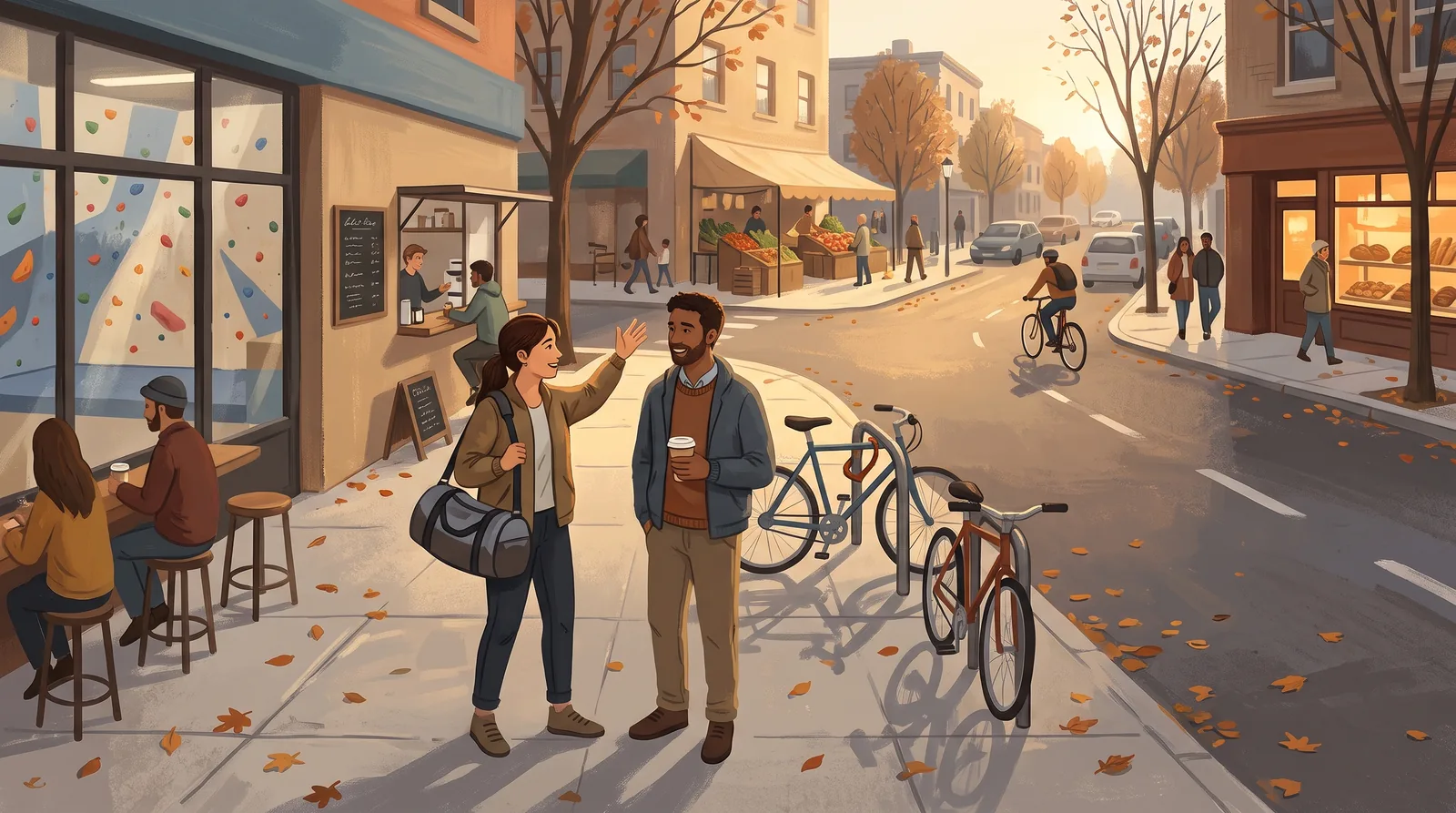
Quick answer: how to ask someone to hang out
Ask for one real thing, on one real day, and leave an easy way out. We call this Thing, Time, Door:
- Thing: a specific plan, ideally tied to something you've already talked about. "The ramen place you mentioned."
- Time: a day, or two to choose from. "Thursday after work or Saturday lunch?"
- Door: a light way to say no. "No worries if you're swamped."
Put together: "I keep thinking about that ramen place you mentioned. Want to try it Thursday after work or Saturday lunch? No worries if your week's packed."
That's the whole move. It sounds friendly rather than needy because it's about the plan, not about you. It's easy to answer because they only have to pick a day. And it's easy to decline, which, oddly, makes a yes more likely.
If a one-on-one plan feels like too big a step, start lower: invite them to something that's happening anyway ("A few of us are doing the quiz at the Crown on Tuesday. Come along?"). Then move up. Below you'll find that ladder, lines for coworkers, neighbours, gym regulars and old friends, text templates, how to make it clear whether it's a date, and a table for reading the answer you get.
Want to make friends in general, not just send one invitation? Our 658-question friendship study covers the bigger picture. This page is about the invitation itself: the moment you go from "nice chatting" to "want to do something?"
Why asking feels harder than it is
Most people who hesitate to ask someone to hang out aren't short of words. They're afraid of the answer. The research on that fear is unusually consistent: we expect a worse outcome than we get.
| Finding | Study | What it means for an invitation | What it doesn't say |
|---|---|---|---|
| People underestimate how much others appreciate being reached out to, and the gap is bigger when the two are less close. | Liu, Rim, Min and Min, "The surprise of reaching out", JPSP, 2022 (preregistered experiments) | Your acquaintance is likely to be more pleased than you expect, precisely because they didn't see it coming. | The messages were check-ins and small gifts, not invitations. |
| After a conversation, people underestimate how much the other person liked them. Among new dorm mates the gap lasted for months. | Boothby, Cooney, Sandstrom and Clark, "The liking gap in conversations", Psychological Science, 2018 | If you enjoyed talking to them, they probably liked you more than you think. | It says nothing about whether a specific person wants to meet again. |
| People who say no to an invitation overestimate how upset, hurt and unlikely to invite again the inviter will be. | Givi and Kirk, "Saying no", JPSP, published online December 11, 2023; five experiments, more than 2,000 participants (APA release) | A "no" is usually about the invitee's week, not about you. And if you have to decline, it costs less than you fear. | Several studies used imagined scenarios; one asked 160 people in couples about real invitations. Most results come from people imagining a decline, not from friendships tracked over time. |
| Strangers expect conversations to go worse than they do. Seven studies, 2,304 people. | Sandstrom and Boothby, "Why do people avoid talking to strangers?", Self and Identity, 2020 | The fear before a social step is a poor forecast of how it will feel. | It's about talking, not about meeting up. |
| Commuters predicted they'd enjoy a ride more alone, and enjoyed it more when they talked to a stranger; one reason was underestimating others' interest in connecting. | Epley and Schroeder, "Mistakenly seeking solitude", J. Exp. Psych.: General, 2014 | Other people are more open to contact than they look. | Trains, buses and a waiting room, not friendships. |
| People underestimated by as much as 50% how likely others were to agree to a direct request for help. | Flynn and Bohns, "If you need help, just ask", JPSP, 2008 | A related pattern: we overweight how easy it is for others to say no. | Requests for help, not invitations. |
| A coworker's invitation to a social activity sparked gratitude, and also stress, especially for people less confident socially. | Lin, Lin, Poulton and Chi, "Do you want to hang out?", Personnel Psychology, 2025 (experiments and field studies, Western and Eastern cultures) | Invitations at work are welcome, and the Door matters: make it easy to say no. | It measures workplace outcomes, not friendship. |
| Adults who had recently moved, and first-year students, needed roughly 50 hours together to become casual friends, about 90 to become friends, over 200 to become close friends. Leisure time counted more than time working together. | Hall, "How many hours does it take to make a friend?", JSPR, 2018 (355 + 112 people; hours as summarised by the University of Kansas) | One hangout won't make a friend. A habit will. | The hours are people's own estimates. |
Jeffrey Hall, the author of the hours study, put the practical lesson plainly in the University of Kansas release: "You can't make people spend time with you, but you can invite them." His advice was to "switch up the context": if you work together, go to lunch or out for a drink. That change of setting is exactly what an invitation does.
None of these studies promises a yes. They suggest something smaller and more useful: the odds are better than your nerves claim, and a no costs both of you less than you think.
Thing, Time, Door: how to word the invitation
This is our own working formula, not a tested method. Each part solves a problem that people raise again and again when they ask for advice about this.
Thing: name a real plan
"We should hang out sometime" is friendly, and it almost never happens. It hands the other person the work of turning it into a plan, and most people won't.
Name something specific. The best plans connect to something they told you:
- "You said you'd never had proper dumplings. There's a place on Mill Street. Want to go?"
- "I'm going to the climbing wall Sunday morning. Want to come and laugh at my technique?"
- "That band you mentioned is playing on the 14th. Should I get two tickets?"
A plan built on their words shows you listened, and it gives the invitation a reason that isn't "please like me". One answer on Interpersonal Skills Stack Exchange suggests starting with low-key things the other person already does, like a coffee break or a weekend bike ride, so the invitation feels like no big deal to anyone.
Keep it short and easy to leave. A coffee, a walk, a lunch, one exhibition. Not a full Saturday, not a weekend away. A short plan is easier to say yes to, and easier to enjoy when you barely know each other.
Time: offer a day, or two
Give a time, or two to choose from: "Thursday after work or Saturday lunch?" Two options are easier to answer than "when are you free?", which opens a long back-and-forth. The accepted answer to a question about scheduling meetups suggests exactly this: propose a couple of specific windows and ask which works.
Door: leave an easy way out
End with a light exit: "No worries if your week's packed," or "Totally fine if not." It takes the pressure off, and the research on coworker invitations suggests that matters: invitations brought gratitude and also stress, especially for people who feel less socially confident (Lin and colleagues, 2025).
Keep the Door light. One short phrase is enough. A long apology ("I know you're probably busy and it's totally fine and I won't be offended…") puts your nerves on them.
The Invite Ladder: Join, Plan, Habit
You don't have to jump straight to a one-on-one plan. Think of it as three rungs.
| Rung | What it is | Example line | Good for |
|---|---|---|---|
| 1. Join | Invite them to something already happening, usually with other people. | "A few of us are doing the pub quiz Tuesday. Come along if you're free." | Acquaintances, new coworkers, people you'd feel shy with one-on-one, cultures where one-on-one invites from acquaintances can seem odd. |
| 2. Plan | One named plan, just the two of you (or you plus one). | "Want to try that ramen place Thursday after work?" | People you've already talked to a few times, or met at a Join. |
| 3. Habit | Turn a good plan into a regular one. | "That was fun. Same time next month?" | After one or two good meetings. This is where friendships actually grow. |
Join is the easiest rung. If they can't come, nothing is lost: you're going anyway. Several answers on Interpersonal Skills suggest it. One, for a shy reader who wanted to get to know a classmate, recommends inviting the classmate and her friend first, then suggesting something one-on-one next time. Another, from a German reader, points out that in Germany meeting an acquaintance one-on-one "without a reason" can feel strange, and suggests organising a small group get-together instead.
Plan is where most of this page lives: Thing, Time, Door.
Habit is the rung people skip. Hall's numbers (roughly 50 hours to casual friends) mean a single nice evening is a start, not a friendship. The easiest way to get there is to turn the first good plan into a repeating one: the monthly lunch, the Sunday run, the quiz team.
Lines by relationship
All of these follow Thing, Time, Door. Change the details to fit.
A coworker you get on with
- "I'm getting lunch at the Thai place on Friday instead of eating at my desk. Want to come?"
- "A few of us are going for a drink after the quarterly meeting. Join us?"
- "You mentioned you've been meaning to try bouldering. I go Wednesdays at 6. Want to come along once?"
Colleagues may want their evenings for other people. The top answer to one Stack Exchange question suggests events that aren't only about work, so the talk doesn't fall back to the job. If drinking isn't your thing, lunch, coffee, a walk or a class works just as well. For everyday work chat before this step, see how to make small talk at work.
A gym, class or club regular
- "Some of us grab coffee after the Saturday class. Want to come this week?"
- "You're training for the 10K too, right? Want to do the long run together on Sunday?"
A neighbour
- "We're having a few people over for soup on Sunday afternoon, nothing fancy. Come by if you're around."
- "I'm walking the dog round the lake about 8 most mornings. Join us one day?"
A friend of a friend you clicked with
- "It was great talking at Maya's. A group of us are going to the street food market Saturday. Want to come?"
- "You said you'd never seen the old observatory. I'm going on the 20th. Interested?"
An old friend you lost touch with
- "Hey, it's been too long. I'm in your part of town next Saturday. Coffee?"
- "I was thinking about our terrible road trip and laughed out loud. Can I buy you a beer and catch up? I'm free Thursday or Sunday."
Liu and colleagues found the appreciation gap is biggest when the message is a surprise (2022), which is exactly the case with a friend you haven't heard from in a while.
A parent you see at school pickup
- "The kids won't stop talking about each other. Want to take them to the playground on Saturday morning? We could get a coffee."
Someone new in town
- "How are you finding the city? I'm going to the Sunday flea market, it's a nice way to see the neighbourhood. Want to come?"
A friend you usually see in a group, one-on-one
- "I feel like we always see each other in a crowd. Want to grab dinner, just us, next week?"
Over text: four templates
Text is fine, and often easier for both of you. Keep the same three parts.
- The callback: "Hey! Still thinking about that dumpling place you mentioned. Want to go Thursday or Friday after work?"
- The tag-along: "A few of us are doing the quiz at the Crown on Tuesday at 7. Come along if you're free 🙂"
- The reconnect: "Hey, long time! I'm near your office next week. Coffee Tuesday or Wednesday?"
- The follow-up after a "maybe": "Hi, checking in about Saturday. I'm booking the table tonight, so let me know if you're in. No pressure either way."
The fourth one uses a tip from the accepted answer to the "I'll check my schedule" question: give a reason you need to know by a certain time, like booking tickets or a table. A deadline with a reason doesn't feel pushy.
Friend or date? Make it clear either way
This is the most-read theme in our reading of invitation questions below. People worry that a friendly invitation will look like a date, or that a date will look like a friendly invitation.
If you mean it as a friend:
- Choose a daytime or activity plan (a walk, a market, a class, lunch) over a candlelit dinner.
- Use Join first: a group plan reads as friendly.
- Say what it is: "I'd like to get to know you better as a friend. Want to grab lunch Friday?" One answer to a reader worried about this suggested a farewell get-together with the people from the project, which gives the invitation an obvious, friendly reason.
If you mean it as a date:
- Say the word. The top answer to the most-viewed question on this (72,636 views) says that "just the two of us" is not enough, because many people hear it as a friendly outing. If it's a date, call it a date: "Would you like to go on a date with me? I was thinking the jazz bar on Friday."
If they bring a friend along: that tells you something. The accepted answer to a question about a friend who keeps bringing someone (57,418 views) reads it as a way to keep things safe and comfortable; another answer adds that if you only want the two of you, the honest move is to ask for a date. Either way, don't use "hang out" to hide a date. It confuses both of you.
For conversation once it is a date, see first-date conversation starters.
What their answer means, and what to do next
Most of the worry comes after you've asked. This table pulls together what the top answers on Interpersonal Skills suggest, plus the research above.
| They say | What it usually means | Your next move | A line |
|---|---|---|---|
| "Yes!" | Yes. | Confirm a time and place in one message. | "Great. Thursday, 6:30, at the ramen place on Mill Street?" |
| "Can't Thursday, but how about next week?" | A counter-offer is a good sign. | Take it and pin it down. | "Perfect. Tuesday or Wednesday?" |
| "I'll check my schedule." | Often "I don't know yet" or "I don't want to say no right now" (top answer). | Give a real reason for a deadline, then let it go. | "Sure. I'm booking Friday, so tell me by Thursday." |
| "We should definitely do that sometime!" | Friendly, but not a plan. | Offer one specific time. | "How about Sunday afternoon?" |
| "Sorry, I'm busy" (no alternative) | Maybe busy, maybe not interested. You can't tell from one no. | Ask once more, another week. Givi and Kirk's work suggests a decline is often about the invitee's week, not about you. | (A week or two later) "Doing the market again on the 20th. Want to come this time?" |
| Busy, again and again | They may be overloaded or not interested. | Hand them the timing, then wait. The accepted answer to the 85,915-view question on this: say you'd like to meet, acknowledge they're busy, and let them pick when. | "I know things are hectic. I'd love to catch up, so just ping me when you've got a free evening." |
| No reply | Often forgot; sometimes a soft no. | One friendly nudge after a few days. Then leave it. | "Just checking you saw this. No worries if not!" |
| They keep talking about plans but never make them | They may be shy about inviting, not insincere. One answer describes doing this out of nerves. | Make the specific invitation yourself. | "You keep mentioning that board game. Saturday at 3, my place?" |
How many times should you ask? There's no study on that. One answer on Interpersonal Skills offers a simple personal rule: after three no's in a row, stop inviting; start again the moment they invite you. It's a sensible default. After three, it's their turn, and you haven't closed the door, just left it open.
When you're the one who has to say no
Invitations go both ways. If someone invites you and you can't go but would like to, say so and offer another time. The top-voted answer to a reader who kept declining a neighbour's invitations suggests explaining briefly and suggesting what does work, for example "I'm away most weekends, but I'd love to do something on a weeknight."
If you simply don't want to go, Givi and Kirk's finding applies: the person who invited you is likely to mind less than you expect. In their pilot, more than three-quarters of respondents said they had accepted an invitation they didn't want, out of worry about declining. A kind, short no is fine: "Thanks for thinking of me. I'll sit this one out." Our guide to saying no politely counts 276 questions about refusing and what the most-voted answers recommend.
What people ask about invitations online
We read 18 questions on Interpersonal Skills Stack Exchange about making or answering an invitation to spend time with someone. We picked them by hand from a keyword search of all 3,958 questions on the site (pulled November 3, 2026). Eighteen is a reading, not a study, so here are the four themes with the questions behind them rather than percentages.
| Theme | Questions | Most-read example (views, Nov 2026) |
|---|---|---|
| Friend or date? Will it look like a date? How do I make clear it is (or isn't) one? | 4 | How to clearly communicate that you're asking someone on a date (72,636) |
| After the ask: busy or not interested, "I'll check my schedule", vague replies, endless back-and-forth | 6 | Busy, or doesn't want to spend time with me? (85,915) |
| Getting included without inviting yourself | 3 | Showing interest without inviting yourself along (38,637) |
| The first ask outside the usual place: work, gym, class | 5 | Inviting a colleague to hang out outside office hours (2,538) |
The pattern is worth noticing. The questions about making the first invitation are common but read little. The questions read tens of thousands of times are about meaning: what does the invitation say, and what does the answer say? That's why this page spends as much time on the friend-or-date line and the reply table as on the invitation itself.
On getting included: the top answers to the 38,637-view question suggest showing interest and availability without asking outright, for example saying the plan sounds fun and you'd love to hear how it goes, or saying they should let you know if they want more people. Both leave the other person free to invite you or not, without anyone being put on the spot.
Stack Exchange content is CC BY-SA 4.0. Questions and answers are linked, not quoted at length; we don't name the people who wrote them.
Three worked scenes
These are hypothetical scenes, written to show the moves.
1. The coworker (Join, then Plan). Priya has been at her new job for six weeks. She gets on well with Tom from the design team; they've joked about the office coffee twice. On Thursday she says, "A few of us are getting lunch at the noodle bar tomorrow. Want to come?" He does. At lunch he mentions he's never been to the Saturday market. On Monday she messages: "Was going to hit the Saturday market this week. Want to come and see what the fuss is about? Totally fine if you've got plans." He says he's away, but "next one?" She replies: "Deal. The 23rd?"
2. The gym regular (a vague reply). Marco and Ben have chatted after the Tuesday class for a month. Marco: "Want to grab a coffee after class next week?" Ben: "Yeah, definitely, sometime!" Marco doesn't take "sometime" personally. He makes it real: "How about right after class Tuesday? The place on the corner." Ben: "Sure."
3. The old friend (busy, twice). Ana texts her university friend Leah: "Hey! Been too long. I'm near your office next week. Lunch Tuesday or Wednesday?" Leah: "Ah, I'd love to, but this month is mad." Two weeks later Ana tries once more, with an open door: "No rush at all. I'd love to catch up, so just tell me when things calm down." A month later Leah writes: "Finally out of the tunnel! Still up for lunch?"
A five-minute drill
Do this today, before you talk yourself out of it.
- Pick one person you've enjoyed talking to at least twice.
- Find the Thing: one thing they mentioned that you could do together, or one plan you're already going to.
- Choose the rung: Join (group or something already happening) or Plan (one-on-one).
- Write the line: Thing, Time (two options), Door. Read it out loud once. Cut anything that apologises.
- Send it or say it within 24 hours.
- Prepare your reply for "maybe": a specific time, or a reason you need to know by a certain day.
If the answer is no, take it lightly, try one more time on another week, and in the meantime ask someone else. Hall's hours study suggests the friend you're looking for is built over many meetings, and each invitation you send is practice for the next.
The one thing to remember
Turn "we should hang out sometime" into a real plan on a real day, with an easy way out. Thing, Time, Door. Most people are more pleased to be asked than you expect, and a no costs both of you less than it feels like it will.
Pocket card: asking someone to hang out
- Thing: a real plan, ideally from what they told you.
- Time: a day, or two to pick from.
- Door: "No worries if you're busy."
- Ladder: Join → Plan → Habit.
- "Sometime"? Offer one specific time.
- Busy twice? Let them pick when. Three no's, then it's their turn.
If it's a date, say "date".