
Quick answer: what to say at a high school reunion
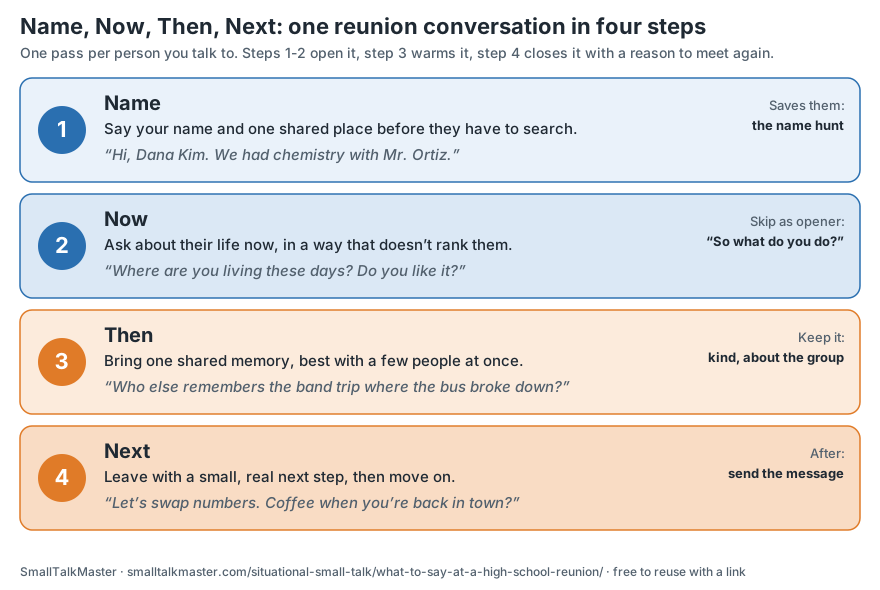
Say your name first, ask about their life now, share one memory, and leave with a next step. We call it Name, Now, Then, Next:
- Name. Give your name and one shared place before they have to search: "Hi, Dana Kim. We had chemistry with Mr. Ortiz."
- Now. Ask about their life today in a way that doesn't rank them: "Where are you living these days? Do you like it?"
- Then. Bring one shared memory, ideally to a few people at once: "Who else remembers the band trip where the bus broke down?"
- Next. Close with something small and real: "Let's swap numbers. Coffee when you're back in town?" Then actually send the message.
And have your own answer ready for the question everyone will ask you: "So, what are you doing now?" Three short sentences do it: one true headline, one detail you'd enjoy talking about, and a question back. There's a builder for that below.
This page: why reunions feel like a test (the sociology), what the memory research says about names after 10, 20 and 50 years, the four steps with lines, your own answer for nine situations, a table for the hard cases (the bully, the friends who dropped you, the old crush, the embarrassing story), what changes by anniversary, three made-up scenes, and a drill. Hosting the welcome or a family reunion is a different job; this page is for the person walking in.
Why a reunion feels like a test (and why it usually isn't one)
If you've ever thought "My God, what am I gonna say?" before a reunion, you're in good company: that's the title of a paper by the sociologist Vered Vinitzky-Seroussi, who studied American high school reunions. In "My God, what am I gonna say?": Class reunions as social control (Qualitative Sociology, 2000; abstract) she argues that reunions are moments that require you to account for your life, and that while they create a community, they also bring back "classification, hierarchy, and evaluation" that adult life usually spares us. Her book on the subject, After Pomp and Circumstance (University of Chicago Press, 1998), calls the reunion an "autobiographical occasion": it asks you to tell your story, to people who may remember the past differently.
People feel it before they arrive. In an earlier paper, Vinitzky-Seroussi and Robert Zussman described "remarkably extensive" preparations: new outfits, diets, and even quitting, finding or inventing jobs or relationships, which they read as self-conscious impression management (Symbolic Interaction, 1996, as summarised by JSTOR Daily, July 2018).
So the nerves have a real cause. But the research on what happens inside conversations is kinder than the anticipation:
| Finding | Source | What it means for you | What it doesn't say |
|---|---|---|---|
| After conversations with new people, people underestimated how much the other person liked them and enjoyed their company (the "liking gap"), in the lab, among new dorm mates and at a workshop; it lasted for months among dorm mates. | Boothby, Cooney, Sandstrom and Clark, Psychological Science, 2018 (abstract) | Walking away from a chat thinking "that was awkward" is not good evidence it was. | It studied new acquaintances, not old classmates. |
| Across 7 studies (N = 2,304), people's fears about talking to strangers (not enjoying it, lacking skill, not being liked) were overblown: conversations went better than expected. | Sandstrom and Boothby, Self and Identity, 2020 (abstract) | The classmates you barely knew are closer to strangers, and that's fine. Your forecast is probably too gloomy. | Strangers, not people with a shared history. |
| People overestimate how much others notice their appearance and what they say, the "spotlight effect". | Gilovich, Medvec and Savitsky, JPSP, 2000 (abstract) | Everyone in that room is busy worrying about their own hair, job and waistline. | Lab studies (a T-shirt, a group discussion), not reunions. |
| In 4 studies (N = 798), more frequent and more extreme upward comparisons on social media led to immediate drops in how people rated themselves; people with low self-esteem made more of them. The paper's title: "When every day is a high school reunion". | Midgley, Thai, Lockwood, Kovacheff and Page-Gould, JPSP, 2020 (abstract) | Comparing is what stings, so don't make it the opening move, for them or for you. Ask questions that don't rank. | It studied social media, not reunion rooms. The authors only borrowed the image. |
| Nostalgic memories usually feature the self with close others, carry more positive than negative feeling, and nostalgia bolstered social bonds, positive self-regard and mood in experiments. | Wildschut, Sedikides, Arndt and Routledge, JPSP, 2006 (abstract) | A shared memory is the warmest thing you can bring, which is why "Then" is a step. | It didn't test reunion small talk, and a painful memory isn't nostalgia. |
| People underestimated how much others appreciated being reached out to, and the gap was bigger when the message was more surprising and between people who were less close. | Liu, Rim, Min and Min, JPSP, 2022 (abstract) | The "great to see you, coffee soon?" message the next day is worth more to them than you think. | Check-ins and small gifts, not reunions specifically. |
None of the five top guides we read for this search on November 11, 2026 (Fluently's 50 starters, AARP's Girlfriend survival guide, Sixty and Me, Don Whitney's ten questions and a Vanderhacks Substack post) cites the reunion sociology or the research on how well people remember classmates. Fluently's guide is the most thorough and cites three of the studies above (the spotlight effect, the liking gap and reaching out); the others are opinion and experience.
Names after 10, 20 and 50 years: what the memory research says
The fear of forgetting a name is the most practical one, and there's a classic study on exactly this. Harry Bahrick, Phyllis Bahrick and Roy Wittlinger tested 392 high school graduates on the names and yearbook portraits of their own classmates, from 2 weeks to 57 years after graduation (Journal of Experimental Psychology: General, 1975; abstract). A later review by Conway, Cohen and Stanhope (1991, full text) sums up the results:
- Recognising classmates' names and faces, and matching names to faces, stayed about 90% correct for the first 15 years, then declined. Face recognition held longer, declining only after about 35 years.
- Recalling a name on your own, or naming someone from their photo, was much harder and declined steadily from the start.
- How recently people had looked at their yearbook showed no systematic link with how well they remembered, in the authors' analyses. (Larger classes were linked to the recognition and matching scores.)
- The steep drop near 47 years may partly reflect age, since those people were in their late sixties, rather than time alone.
Two other findings explain the moment at the name tag. Forgetting a name while knowing the face mixes up two different tasks: in Burton, Jenkins and Robertson's experiments (Quarterly Journal of Experimental Psychology, 2018; abstract), people were actually better at recognising names than faces when both were tested the same way; the trouble is recalling a name from scratch. And in Alan S. Brown's review of tip-of-the-tongue states (Psychological Bulletin, 1991; abstract), they're nearly universal, happen about once a week, increase with age, are often set off by proper names, and get resolved during the experience about half the time.
What this means at the door:
- Your classmates will very likely recognise you, but many won't be able to pull up your name. So say it first. It's a kindness, not an admission that you're forgettable.
- When you're stuck on theirs, recognition is your friend: a glance at a name tag, a "remind me your name?" or someone else saying it turns the job into recognising the name, which is much easier than recalling it.
- Don't count on cramming the yearbook the night before. Make your name easy instead.
For names in general (why they vanish the second you hear them, and how to ask again), see the names section of our guide to how to introduce yourself.
Name, Now, Then, Next, step by step
This is our own working plan, built on the research above and on the top answers to real reunion questions on Interpersonal Skills Stack Exchange. It hasn't been tested as a package.
Step 1: Name (before they have to search)
Lead with your name and one shared anchor: a class, a team, a street, a teacher.
- "Hi, Dana Kim. We had chemistry with Mr. Ortiz."
- "Marcus Lee, I was the one who always lost his locker key."
- "It's Priya. Track team, the year we came last at everything."
- When you've forgotten theirs: "Remind me your name? I want to get it right. I'm Sam, from homeroom."
- When they've clearly forgotten you: "No worries, it's been twenty years. I'm Sam, I sat behind you in history."
Don't play "Do you remember me?" or cover your name tag. It turns a hello into a quiz, and the Bahrick results say most people will fail it on recall even when they know your face.
Step 2: Now (a question that doesn't rank)
Ask about their life today with a question every answer can pass.
- "Where are you living these days? Do you like it?"
- "What's keeping you busy at the moment?"
- "What's been the best part of the last few years?"
- "Did you travel far to get here?"
- "Last I heard you were in Denver. Still there?" (check, don't assume)
Then follow the first detail they give you. In speed dates and online chats, people who asked more questions, especially follow-up questions, were liked more by their partners (Huang and colleagues, JPSP, 2017; abstract). "A bakery? How did that happen?" is worth more than your next prepared question.
Why not "So what do you do?" It's not forbidden, but as the first question it invites the ranking that makes reunions tense (Vinitzky-Seroussi; Midgley and colleagues above). Let work come up in its own time, often after they've chosen to mention it.
Step 3: Then (one shared memory)
Once the present is on the table, bring one memory. It works best with three or four people, because everyone has a piece of it.
- "Who else remembers the band trip where the bus broke down?"
- "Is Mrs. Halvorsen still teaching? She's the reason I still can't spell 'necessary' without humming."
- "Where did we all go after school? Is that place still there?"
- "What song takes you straight back to junior year?"
Keep it kind and about the group. Memories about the whole class (the trip, the teacher, the flood in the gym) unite. Memories at one person's expense (the haircut, the breakup, the time someone threw up in chemistry) can reopen something for them. One answer on Stack Exchange points out that the people who come "for old time's sake" are there to relive the good times, and someone's embarrassing story may be one of them, so if it's yours, see the hard cases.
Step 4: Next (a reason to meet again, then move on)
Every reunion conversation should end; there are a hundred people in the room. Close with something small and true:
- "I don't want to keep you from everyone. Let's swap numbers first."
- "I'm going to say hi to Coach Reyes before he leaves. Find me later?"
- "This was the best part of my night. Coffee when you're back in town?"
- "Should we start a group chat for the old lunch table?"
And send the message the next day. Liu and colleagues' experiments suggest it'll be appreciated more than you expect, especially by people you weren't close to. For more exits, see how to end a conversation politely.
Your answer to "So, what are you doing now?"
This is the question everyone will ask, and you know it's coming. As one writer on social preparation puts it, the opening questions at most gatherings are predictable, so you can decide your answer ahead of time (Vanderhacks, May 2025).
The best answer to a reunion question we found makes a useful point: "What have you been up to?" is not a question about your job. One answer to a question about a husband who didn't want to discuss his work notes that his classmate never asked his occupation, and that "what have you been up to" can truthfully be answered with anything from the last ten years: a move, a hobby, a trip, the farmers market that morning.
The three-sentence answer:
- A true headline (short, no apology).
- One detail you'd enjoy being asked about (this is where you steer).
- A question back.
| Your situation | A true headline | The detail you steer to | Question back |
|---|---|---|---|
| Between jobs | "I'm between jobs right now, looking at a few things in logistics." | "Which means I finally finished the kitchen." | "What about you, still in Portland?" |
| A job you'd rather not discuss | "Office work, pays the bills." | "The best thing lately has been the cycling club." | "Do you still play guitar?" |
| A job you love | "I'm a nurse, nights mostly." | "I love it, strange as that sounds." | "What's your week like?" |
| Doing really well (and not wanting to brag) | "Work's been good to me, I've been lucky." | "The real news is we adopted a very silly dog." | "Do you have any animals?" |
| Divorced or single | "Single these days, and life's pretty good." | "I've been learning to sail, badly." | "Did you come with anyone tonight?" |
| No kids, when everyone's showing photos | "No kids, but I'm a very proud aunt." | "My niece just beat me at chess." | "Show me yours?" |
| At home with kids | "Home with our two for now." | "Which mostly means I know every dinosaur." | "How old are yours?" |
| Still in the hometown | "Never left! I'm about five minutes from here." | "The old diner is a bookshop now." | "What's it like coming back?" |
| Hard years (illness, loss) | "It's been a hard few years, but I'm doing better." | Pick anything you're glad about now. | "How have you been?" |
If someone keeps pressing on something you've chosen not to share, stay relaxed and vague rather than visibly guarded. An answer to a question about exactly that warns that making a big show of not talking about something makes people more curious: give a calm, vague line and move to a topic you do want. Another suggests the "true but boring" version, like "Oh, software stuff", followed at once by the same question back. Our study of 70 people facing nosy questions found a short, true answer was the move top answers backed most; the change-the-subject ladder has the next rungs.
Hard cases: a table
These are the situations people actually ask about. Of the 3,958 questions on Interpersonal Skills Stack Exchange (our census, pulled November 3, 2026), only six are about a class reunion, so this is a reading, not a count. The most-read, meeting someone who used to bully me, had 23,530 views. None of the six asks for icebreakers: they're about a bully, friends who dropped someone, a job the asker would rather not discuss (twice), an embarrassing old story and bringing a guest. That's why this page gives your own answer and the hard cases as much room as the openers.
| The situation | What to do | A line you can say |
|---|---|---|
| The person who bullied you walks up, friendly, as if nothing happened | You don't owe them a reckoning or a long chat. One answer suggests rehearsing a short line and moving on; the top answer adds that people do change, so let a friendly greeting be friendly if you want to. | "Hi, nice to see you're doing well. Excuse me, I want to catch up with a few people." If they keep at it: "I'd rather not rehash school. Enjoy your night." |
| Friends who dropped you (during an illness, a move, a hard year) are there | Treat them like any other classmate: greet, keep it short, don't single them out. One answer from someone who was often ill at school suggests a safe topic or a polite exit if it gets tense. | "Hey, good to see you. Have you seen Jeff yet?" Then go and find Jeff. |
| Someone you treated badly back then | If it was real, an apology once, privately and briefly, is enough. Let them decide what comes next. | "Can I say something quickly? I wasn't kind to you in tenth grade, and I'm sorry." |
| An old crush or an ex, with their partner | Talk as you would with anyone, in the open, and include the partner early. | "It's really good to see you. And you must be Alex, how did you two meet?" |
| An embarrassing story about you comes up | If you can, own it and tell it yourself, shorter and funnier. One answer: the harder you resist, the more people insist, so play it down or joke first. If it still hurts, a quiet "please don't" to the teller beforehand. | "Yes, I was the one in the fountain. In my defence, it looked warm." |
| Someone who's done spectacularly well | Be curious, not competitive. A real question beats a defensive one. | "That's amazing. What's the part people don't see?" |
| Someone who's clearly struggling | Don't probe. Ask about now in an easy way and let them choose. | "It's really good you came. Are you still into music?" |
| A classmate who has died comes up | Share one good memory; don't move quickly to "how". | "I keep thinking about how he used to make everyone laugh in homeroom." |
| You're at your partner's reunion and know no one | Ask what only an outsider can ask, and let your partner do the introductions first. | "What was Sam like in school? Give me the real version." |
| You brought a friend, not a partner | Fine if the invitation allows a guest, as one answer notes; introduce them clearly once. | "This is Mira, my friend from work. I bribed her with free dinner." |
If anyone threatens or follows you, tell an organiser or venue staff and leave; that's not a conversation problem. And on whether to go at all, the accepted answer to the "ghosted" question has a clean test: would you go to a party with these same people? If there's anyone you'd like to see, go and spend your time with them.
What changes by anniversary
The four steps work at any reunion. What shifts is how much people remember and what the "Now" question will reach.
| Reunion | Names and faces | Good "Now" questions | Watch out for |
|---|---|---|---|
| 5th to 10th | Recognition is usually high (about 90% in the Bahrick results through 15 years). Recall will still slip for people you weren't close to. | "Where did you end up after school?" "What's the best city you've lived in so far?" | Plenty of people are still job-hunting or studying. Lead with places and interests, not titles. |
| 20th to 25th | Recognition is still mostly fine; names you rarely used are the ones that go. Say yours first. | "What's a normal week like for you now?" "What's the biggest change since school?" | Kids-and-house questions can sting people without either. Let them bring it up. |
| 30th to 40th | Faces held up longer than names in the research; name tags with yearbook photos help everyone. | "What are you enjoying most at the moment?" "Have you picked up anything new lately?" | Health, divorce and caring for parents may be part of the answer. Follow, don't probe. |
| 50th and later | The steepest drop appeared near 47 years, partly linked to age. Big readable name tags matter most here. | "What's the best thing about this stage of life?" "Who from back then do you still see?" | Remembering classmates who have died. A memory table or a moment of quiet helps. |
Three worked scenes
These are hypothetical scenes, written to show the steps.
The name tag (Name, then Now). At the check-in table, Ben sees a woman waving at him and has no idea who she is. She gets there first: "Ben! Leah Ostrowski, we did the science fair volcano together." Ben laughs: "The one that set off the alarm. Leah, it's so good to see you. Where are you living now?" "Back here, actually, since last year." "What brought you back?" Ten minutes later they're still talking about her parents' orchard.
The job question (the three-sentence answer). Ana was laid off in September. When Chris asks, "So what are you doing now?", she's ready: "I'm between jobs, looking at a few things in design. Which means I finally finished restoring my grandmother's piano. Do you still play?" Chris does, badly. They spend the next ten minutes on pianos. Nobody asks about the job again.
The table that went quiet (Then, then Next). Four classmates stand around a high table and the small talk runs dry. Mei tries one memory for the group: "Does anyone else remember Mr. Bauer's fire drills, the ones he timed with an egg timer?" Two of them groan, one has a photo on her phone. When the laughter settles, Mei says, "I'm going to find Rosa before she leaves. Let's do a group chat?" She adds them on the spot and sends a photo the next morning.
A ten-minute drill before you go
- Write your name line with one anchor (a class, a team, a teacher). Say it out loud twice.
- Write your three-sentence answer to "What are you doing now?": headline, the detail you'd enjoy being asked about, a question back. Say it twice.
- Pick two "Now" questions that don't rank, from the lists above.
- Pick one group memory that's about everyone, not one person.
- Pick your exit line and a real next step (a number, a coffee, a group chat).
- Decide on any hard case in advance: the one person you'll keep short, and your one line for them.
If the hour before still feels heavy, our guide to conversation anxiety before a social event has a short plan for exactly that window. And for walking up to a group of three or four classmates already mid-story, see how to join a group conversation.
The one thing to remember
Make it easy for people: say your name first, ask about their life now without ranking it, bring one memory that belongs to everyone, and leave with a next step you'll actually take. Have your own three sentences ready for "What are you doing now?". The research suggests the room is less focused on you than you fear, and that they'll like you more than you'll guess on the drive home.