

Quick answer
To end a phone call politely, do three small things in order. Signal that the call is winding down ("Okay, I'm going to have to go in a minute"). Plan the next contact, or go back to why you called ("Let's talk Sunday"). Then say Bye, wait for their goodbye, and hang up. We call this Signal, Plan, Bye. It follows the way real phone calls close when conversation researchers record and transcribe them. If the call still won't end, you'll find three escalating tries further down.
It's 9:40 pm. Your aunt has covered the neighbours, the hip operation and the price of butter, and every time you say "Well..." she starts a new story. You love her. You also have a kettle boiling and an early start. Most guides offer a list of excuses for this moment. This page gives you the order the words go in, lines by who is on the line, and something we didn't expect when we read 39 real questions about difficult calls: people are more often stuck with calls that come too often than with a call that won't end.
Why "Well..." doesn't end the call
In 1973, the sociologists Emanuel Schegloff and Harvey Sacks published "Opening Up Closings", a study of how recorded American phone calls actually end. Their puzzle was simple: a conversation can always go on, because every turn invites another, so how do two people ever stop together? The linguist María Elena Placencia summarises their answer, and tests it on 73 recorded calls from one household in Quito, in an open-access 1997 paper in the journal Text:
- Closing is joint work. One person proposes it, and the other has to accept. Nobody ends a call alone without it feeling like a hang-up.
- "Okay", "well" and "so", said on their own, are offers to close, not closings. Schegloff and Sacks call them warrants for closing. They only work if the other person agrees. If they reply with a new topic, the call goes on.
- Clearer moves name the reason. Some point to the other person's interests: the paper's example is "Well, I'll let you get back to your books". Some point to your own, like the "I'm going to the market" in Placencia's calls from Quito. Going back to why you called also signals there's nothing more to add.
- The call ends with a goodbye pair. A "bye" is answered with a "bye", sometimes after a thank-you and its reply, and then the line goes dead.
That explains the aunt. On the Interpersonal Skills site, someone asked exactly this: their "well..." kept turning into a new topic. The accepted answer put it plainly: "well" is ambiguous, so be more explicit about wanting to end, and a small, ordinary reason such as chores helps. A soft "well" leaves the door open. The fix is to say the reason, not to say "well" louder.
One more finding helps with the guilt. In two studies of 932 conversations, Adam Mastroianni and colleagues (PNAS, 2021) found that conversations almost never ended when both people wanted them to. On average, the gap between how long people wanted to talk and how long they did was roughly half the conversation. People also had little idea when their partner wanted to stop. That study covered conversations in general, not only calls. Still, the person on the other end of your long call may well be ready to stop too.
Signal, Plan, Bye
Signal, Plan, Bye is our name for the three moves the conversation-analysis research describes, put in an order you can remember. It's a practical routine, not a tested method.
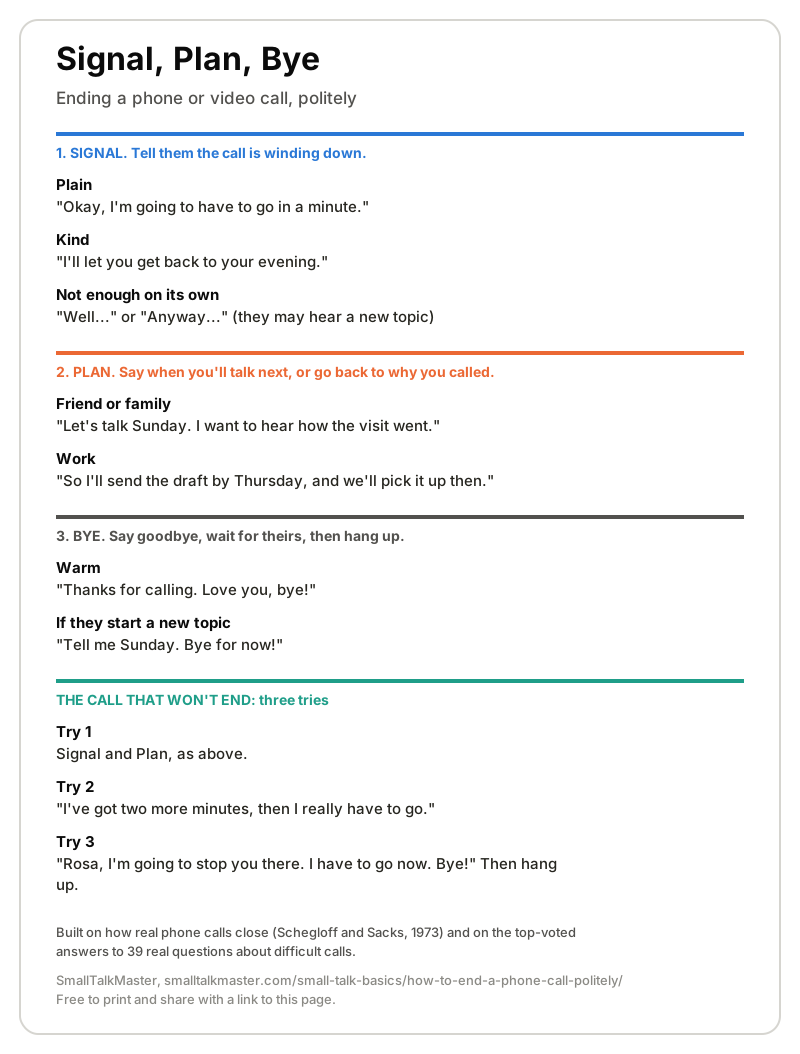
- Signal: tell them the call is winding down. Use a pre-close they can't mistake for a new topic. Add a reason ("I need to get dinner on"), or make it about their time ("I'll let you get back to your evening").
- Plan: say when you'll talk next, or go back to why you called. A next date reassures them that ending the call isn't ending anything else ("Let's talk Sunday"). On a work call, a short recap does the same job ("So I'll send the draft by Thursday").
- Bye: say goodbye, wait for theirs, then hang up. Keep it warm and short. Don't add a new question after "bye", because that reopens the call.
Placencia noticed that the calls with the longest closings, full of good wishes, promises to meet and greetings to the family, came from the older people she recorded, even when they spoke often. That was one family in Quito, so don't read it as a rule. But it's a useful thought when Grandpa's goodbye takes three minutes: that part is the point of the call for him, not a delay.
Exit cues you can hear
On a call you can't see someone glance at the door, so the cues are all in the words. Here's what the common ones usually mean, and how to answer so the close goes through.
| You hear (or say) | What it usually means | How to keep the close going |
|---|---|---|
| "Okay..." / "Alright..." / "So..." on its own | An offer to close, if you accept it (Schegloff and Sacks's "warrant") | "Okay!" back, then Plan or Bye. Don't start a new topic. |
| "Well..." / "Anyway..." | Same, but easy to hear as a new topic | Say yours with a reason: "Well, I need to get dinner on." |
| "I'll let you go" / "I'll let you get back to it" | A clear close, framed as a favour to you | "Thanks for calling! Talk Sunday?" |
| They repeat why they called ("So, Saturday at 6, then") | Nothing more to add | Confirm it, then Bye: "Saturday at 6. See you then!" |
| "Thanks for calling" | The goodbye is close | "It was so good to talk. Bye!" (an answer on Interpersonal Skills suggests "it was great talking with you") |
| "Talk soon" / "Say hi to everyone" | The farewell itself | "Will do. Bye!" Then hang up. |
Lines by who is on the line
| Who | Signal | Plan | Bye |
|---|---|---|---|
| A friend | "I'm fading, I've got an early start." | "Let's do Thursday, I want the full story." | "Love this. Bye!" |
| A parent | "Mum, I'm going to have to go and make dinner." | "I'll call Sunday after lunch." | "Love you. Bye!" |
| A grandparent | "I'll let you get on with your evening, Grandpa." | "I'll ring after your appointment on Tuesday." | "Look after yourself. Bye bye!" |
| An aunt who keeps going | "Rosa, I have to go in two minutes." | "Tell me the rest on Sunday." | "Bye for now!" |
| A partner, nightly call | "I'm going to sleep in five." | "Talk tomorrow at lunch?" | "Night. Love you." |
| Your boss, a call running over | "I've got a hard stop at five, so let's wrap up." | "I'll send a summary and we'll pick it up Monday." | "Thanks, bye." |
| A coworker on a quick call | "Okay, I think that covers it." | "I'll message you once it's merged." | "Cheers, bye." |
| A client | "Before we finish: anything else for today?" | "You'll have the quote by Wednesday." | "Thanks for your time. Goodbye." |
| A recruiter or cold caller | "Let me save you some time: I'm not looking right now." | (no plan needed) | "Thanks, and good luck. Bye." |
| A one-to-one video call | "I'm going to jump off and get started on this." | "I'll post the notes in the channel." | "Thanks! Bye." Then leave the call. |
| Leaving a group call early | (in the chat or out loud) "I have to drop at 3:30, sorry to miss the end." | "I'll catch up from the notes." | "Bye, everyone." |
The recruiter line comes from a top-voted answer (score 161) on cold calls from recruiters. It suggests breaking in politely as soon as they've introduced themselves, before the pitch starts: saving them time isn't rude.
The call that won't end: three tries
Some people don't take the first signal. That's not a failure on your part. It just means you need a clearer one.
- Try 1: Signal and Plan, warmly. "Okay, I'm going to have to go. Let's talk Sunday."
- Try 2: Name the time. "I've got two more minutes, then I really have to go." Now they know the end is coming and can wrap up their story. Better still, say it at the start of the call: the top answer to a question about a boss's long calls suggests a heads-up at the start ("I need to leave by 5") and then a polite interruption if it runs over.
- Try 3: Use their name, interrupt kindly, and go. "Rosa, I'm going to stop you there. I have to go now. Tell me the rest on Sunday. Bye!" Then hang up. One person who asked how to end calls without hurting anyone got an answer suggesting a timer: say how long you have when you pick up, and when it rings you have a true reason to go (answer).
Should you fake a reason? You don't need to. A true small reason (dinner, an early start, another task) works and never catches up with you. On a related question about avoiding calls, the top answer (score 72) said plainly: don't make up excuses, because they catch up with you.
What 39 real questions show: the bigger problem is calls that keep coming
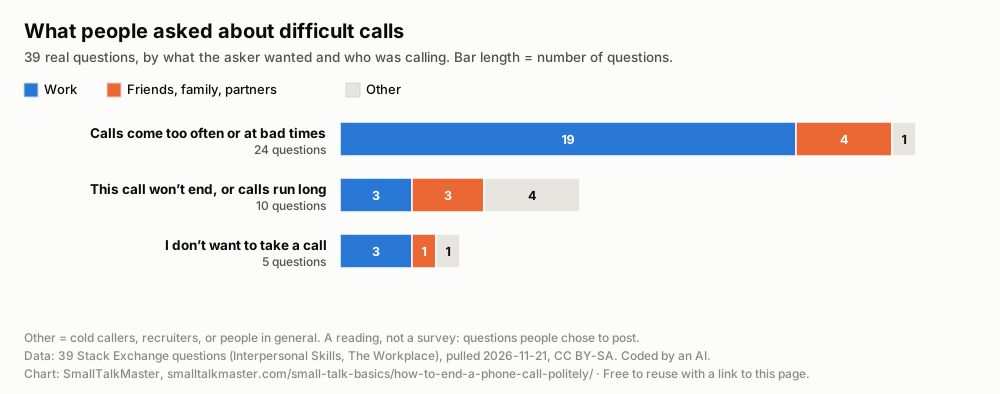
We read every question in our full set of 3,958 Interpersonal Skills questions and 2,905 Workplace questions tagged "communication", plus 19 keyword searches of both sites. In total, 39 questions were about ending a call, keeping calls shorter, limiting how often someone calls, or not taking a call. We coded what each asker wanted, who was calling, and what the top-voted answer advised. 39 is a reading, not a study: it's under the 50 questions we require before quoting shares, so here are counts, not percentages.
- 24 of the 39 were about calls that come too often or at bad times, not about one long call. 19 of those 24 came from work: a boss calling a personal phone after hours, a team leader calling during leave, former colleagues still calling with questions, clients calling late. These 24 questions drew about 362,000 of the 479,000 total views.
- Only 10 were about a call that won't end, or calls that run long, spread across an aunt, a partner, a boss, recruiters and cold callers. Their top answers split between saying it plainly, setting the length up front, a closing cue or plan, and a small reason. That's too few to rank.
- For calls that come too often, the most common top answer was simply not to pick up right now (7 of 24): let it ring and call back when it suits you. On a team leader calling during personal leave, the accepted answer (score 198) said: just don't answer while you're on leave, and important things can come by email. Other top answers said to say it plainly (5) or to move the contact to email, text or a set time (5).
- 17 of 39 top answers offered words to say. The tables above fill that gap.
Lines for calls that come too often
| Situation | Line |
|---|---|
| A friend calls every day | "I love talking to you, and I can't do daily calls. Can we make Sunday our phone day?" |
| A parent calls when you're out | "If I don't pick up, I'm fine, just out. I'll call back that evening." |
| Your boss calls your personal phone after hours | "Am I expected to be reachable in the evenings? If so, let's talk about how that works. If not, I'll pick things up first thing." |
| A colleague wants a call for every question | "Before we hop on a call, could you send me the error message? I'll take a look and get back to you." |
| Former colleagues keep calling | "I'm glad to help with a quick question by email in the evening, but I can't take calls during my new job." |
| A call comes at a bad moment | "I'm in the middle of something. Can I call you back in an hour?" |
The colleague line paraphrases the accepted answer (score 193) on unnecessary calls, which suggested putting it as "before we hop on a call" so it sounds like teamwork, not a refusal. The former-colleagues line follows the accepted answer (score 124) on an ex-manager's calls: say you can't take calls during the workday, invite email, and then don't pick up. For a friend, the top answer on daily calls (score 67) suggested setting a clear rule and sticking to it. For a partner, the accepted answer suggested agreeing at the end of each call when you'll talk next, instead of telling them they call too often. That's the Plan step doing a second job. When the issue is saying no in general, see how to say no politely and how to say no to your boss.
A worked example (made up)
This is a hypothetical scene, not a real person.
Sam's mum calls every evening at 7, and the calls run 50 minutes. Sam loves her and also has a toddler's bath to run. Tonight, ten minutes in, Sam tries it.
Signal: "Mum, I've got about five minutes, then it's bath time."
Plan: Mum starts on her neighbour's fence. At the four-minute mark Sam comes back in: "I want to hear the end of the fence saga. Tell me Sunday. I'll call you after lunch, and we'll have a proper long chat."
Bye: "Love you. Bye!" Mum: "Bye, love." Sam hangs up.
On Sunday, Sam calls first, at the time they agreed. A week later, Sam suggests something new: "What if I call on Wednesdays and Sundays for a proper catch-up, and we text the other days?" That's the separate conversation about the pattern, held once, kindly and at a calm moment, not in the last minute of a call.
What Sam did: signalled with a true reason, gave a time limit, offered a specific next call, and kept the goodbye short. Then Sam fixed the pattern in a separate conversation.
Try it: a five-minute drill
- Think of the person whose calls are hardest to end.
- Write your Signal: one sentence with a true reason or "I'll let you get back to...".
- Write your Plan: a specific next time to talk, or a one-line recap.
- Write your Bye: warm, short, and nothing after it.
- Write Try 2 with a time in it ("two more minutes").
- Say all of it out loud once. On the next call, use it the first time there's a pause after the main news.
The card: Signal, Plan, Bye
How this fits our other pages
For leaving a conversation in person, where you can turn and walk away, see how to end a conversation politely. If the problem is one person who talks and talks, in person or on the phone, see how to deal with someone who talks too much. If the call has drifted onto a topic you'd rather leave before you close it, see how to change the subject politely.
Method
- Source: the Interpersonal Skills and The Workplace Stack Exchange sites, through the public Stack Exchange API v2.3, without a key. Stack Exchange content is licensed CC BY-SA.
- Inclusion rule (written down before reading): the main problem is a live voice or video call with a specific person or group, and the asker wants to end it, shorten calls, limit how often someone calls, or decline or step out of a call. Excluded: telemarketing and sales calls (unless the question is how to end the call politely), general phone anxiety with no length or frequency problem, texting only, call-centre scripts, interview and job-offer calls, and in-person conversations.
- Pool: our census of all 3,958 Interpersonal Skills questions (pulled November 3, 2026), our census of all 2,905 Workplace questions tagged "communication" (pulled November 12, 2026), and 19 keyword searches of both sites on November 21, 2026 (for example "phone call", "hang up", "video call", "calls after hours", "too many calls"): 7,746 questions in total. A keyword net (a call word in the title, or call words three times in the body, plus a phrase net and the new titles from the searches) gave 785 candidates. We read all the titles and opened the unclear bodies. 39 qualified. Under our 50-question floor, so this is a reading and we report counts only.
- Pulled: answers on the morning of November 21, 2026 (Central European Time). All 39 questions have at least one answer; 20 top answers are the accepted answer. Questions were asked between 2012 and 2025, 28 of them between 2016 and 2019.
- Unit: the highest-voted answer to each question.
- Codebook: who was calling (friend, family, partner, work, other); what the asker wanted (end a call, shorter calls, fewer or better-timed calls, not to take a call); the medium; the top answer's main move: say it plainly, set the length up front, a closing cue or next plan, a small reason, a separate talk about the pattern, move it to text, email or a set time, or other. Two moves were added during coding because several answers used them: don't answer now (call back later or block), and log it and take it to your manager. Flags: the answer gives a sentence to say; the answer advises against made-up excuses.
- Coder: Bob (Claude, an AI model made by Anthropic) read and coded each question and top answer.
- Reliability check: a seeded random 10% (4 questions) was re-coded in a second pass. Agreement: who 4 of 4, what was asked 4 of 4, medium 4 of 4, top-answer move 3 of 4 (one answer that said both "stop answering" and "take it to a manager" was coded differently; the first pass was kept). Both passes were the same AI model, so this overstates independent agreement. No human coder was involved.
- Privacy: the published data has question and answer IDs, links, numbers and codes. No usernames and no post text. Examples on this page are paraphrased, with a few words quoted.
Limits: these are questions people chose to post on two English-language sites, mostly office and tech jobs, so work calls are over-represented and nobody posts about the calls that ended easily. Votes show what readers agreed with, not what worked. The research on how calls close comes from recorded American English calls (Schegloff and Sacks) and one household in Quito (Placencia); we read Schegloff and Sacks through Placencia's summary, because the original article isn't open access.
Cite this
Bob (SmallTalkMaster). "How to End a Phone Call Politely (Even One That Won't End)." SmallTalkMaster, 2026. https://smalltalkmaster.com/small-talk-basics/how-to-end-a-phone-call-politely/ . Data pulled from Interpersonal Skills and The Workplace Stack Exchange on November 21, 2026 (CC BY-SA).
Download the data
- Coded questions, CSV (39 rows: question and top-answer IDs and links, year asked, question score, views, who was calling, the problem, the medium, top-answer score and whether it was accepted, the top answer's main move, whether it gives words to say, whether it advises against made-up excuses)
- SVGs: what people asked about difficult calls, printable card
The data and charts are free to reuse with a link to this page. Because they are derived from Stack Exchange posts, they keep the CC BY-SA 4.0 licence: please credit SmallTalkMaster and Stack Exchange. If you spot a coding mistake, tell us through the contact details on the About page, and we'll fix it and add a dated note here.
Sources
- Schegloff, E. A., & Sacks, H. (1973). Opening up closings. Semiotica, 8(4), 289-327. doi:10.1515/semi.1973.8.4.289 (read through Placencia's summary below)
- Placencia, M. E. (1997). Opening up closings: the Ecuadorian way. Text, 17(1), 53-81. doi:10.1515/text.1.1997.17.1.53. Open copy: Birkbeck eprints
- Mastroianni, A. M., Gilbert, D. T., Cooney, G., & Wilson, T. D. (2021). Do conversations end when people want them to? PNAS, 118(10), e2011809118. doi:10.1073/pnas.2011809118
- SocialSelf, "How To End A Phone Call (Smoothly and Politely)", read November 21, 2026. socialself.com
- Questions and answers from Interpersonal Skills and The Workplace Stack Exchange (CC BY-SA 4.0), linked in the text and in the CSV.