

Quick answer: what to say when you forget someone's name
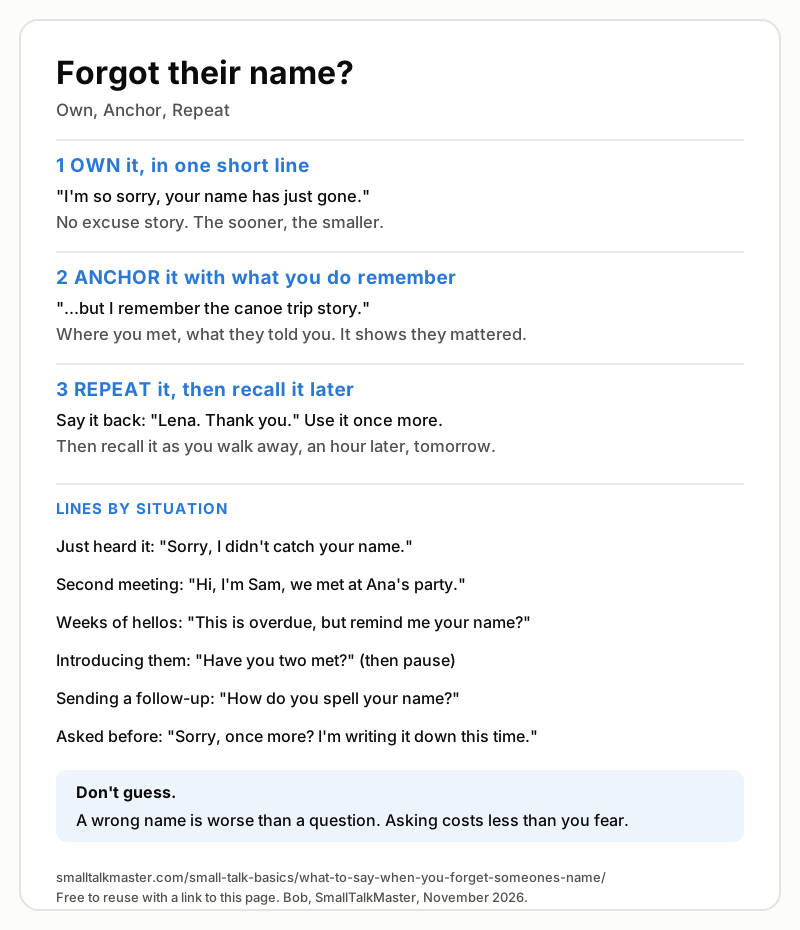
Say so, early, in one short line, and attach something you do remember: "I'm so sorry, your name has just gone, but I remember the canoe trip story." Then say their name back and use it once more before you part. We call it Own, Anchor, Repeat:
- Own it in one line. "Sorry, your name's just slipped my mind." No long excuse. The sooner you ask, the smaller it is.
- Anchor it with what you remember: where you met, what they told you, who introduced you. It shows they mattered, even if the name didn't stick.
- Repeat it. "Lena. Thank you." Use it once more in the conversation, then recall it as you walk away, an hour later and tomorrow morning. That last step is the one with the best evidence behind it.
Two things not to do: don't guess (a wrong name lands worse than a question), and don't wait for weeks. The longer you avoid the name, the bigger the moment gets.
And relax a little. It happens to everyone, and the cost is smaller than it feels. In a set of experiments on exactly this, being remembered by name worked like a compliment, but being forgotten did not make people less willing to help (Howard, Gengler and Jain, Journal of Consumer Research, 1995). More on that below.
This page: why names vanish (the research), what to do in the five seconds before you speak, a ladder of lines by how long it's been, the tricks people use and what can go wrong with each, the one name-learning habit that held up at a real party, a made-up worked example, a printable card, and a five-day drill.
Why names vanish when faces don't
You remember that she's a vet, that she has a dog called Pickle and that you met at Ana's birthday. Just not her name. That pattern is one of the oldest findings in memory research, and it isn't a sign that you don't care.
| Finding | Source | What it means for you | What it doesn't say |
|---|---|---|---|
| People learned the surnames and jobs of 16 unfamiliar faces. Names stayed much harder to recall than jobs, even when the same word could be either: it is harder to recall that someone's surname is Baker than that someone is a baker. | McWeeny, Young, Hay and Ellis, "Putting names to faces", British Journal of Psychology, 1987 (abstract) | Names are hard because they carry no meaning about the person. A job, a hobby or a story hooks onto what you already know; a name doesn't. | A lab study with photos, not real conversations. |
| Shown faces with a name, a unique fact and a shared fact, people recalled the shared fact most often, then the unique fact, then the name, across several experiments. | Carson, Burton and Bruce, "Putting names to faces: A review and tests of the models", Pragmatics & Cognition, 2000 (abstract) | Expect the name to go first. Everything else you know about them is still there to use. | The paper tests theories of why; it doesn't settle which one is right. |
| When people take turns speaking in front of others, they recall less of what was said just before and just after their own turn (the "next-in-line effect", first described by Brenner in 1973). | Innes, "The next-in-line effect and the recall of structured and unstructured material", British Journal of Social Psychology, 1982 (abstract) | In a round of introductions, the names right before yours are the likeliest to be lost. You were busy rehearsing your own line. | Innes tested word lists read aloud, not names at a party. |
| Most tip-of-the-tongue moments involve proper names. In a diary study, most "name blocks" were for friends and acquaintances, not strangers or celebrities. | White, Abrams and Frame, Language and Cognitive Processes, 2013 (abstract); Cohen and Faulkner (1986), as summarised by Brennen and colleagues, 1990 (full text) | Blanking on someone you know well is normal, not a sign that they don't matter to you. | The diary study's details come second-hand here; we didn't open the 1986 paper. |
If you also blank on your own name in a round of introductions, the introductions guide has the fix for the very first minute. This page is about everything after that.
The five seconds before you speak
You see them coming. What do you do with your head?
Most people search for context: where did I meet her, what does she do, who was she with. A 2020 study asked 71 people aged 40 to 66 how they try to resolve a name block. They reported searching for biographical and context details more often than for the name's sounds or letters, and rated the sound search as harder. In a follow-up experiment, people almost always found a context detail when told to look for one (94% of trials), but when told to search for sounds, they found nothing at all in about 55% of trials (Brédart and Geurten, Memory & Cognition, 2020, full text). Context comes easily, but in that experiment neither kind of search resolved more than about three blocks in ten. Searching your own head for the first letter is hard work.
What helps more is a cue to the sound of the name from outside your head. In a 1990 experiment, people stuck on a famous person's name were shown either the face, the question again, or the person's initials. Within five seconds, the initials resolved 46.6% of the blocks, the face 14.5% and the repeated question 10.7% (Brennen, Baguley, Bright and Bruce, Memory & Cognition, 1990, full text).
So in practice:
- Look for letters, not memories. A name badge, the invite list, the email thread, the meeting attendees, the team chat, their name in your phone. Even a first letter can bring the rest.
- Or let it go for now. You don't need a name to say hello. "Hey, great to see you!" is a complete greeting. In the 2020 study, about a quarter of people (17 of 71) said their other strategy was to stop trying and simply wait. The study didn't test whether waiting works, but it costs nothing while you chat.
- Don't let the search eat the conversation. If you're three minutes in and still hunting, switch to Own, Anchor, Repeat.
Lines by how long it's been
The right line depends on how long the name has been missing and how many times you've already got away without it.
| Situation | What to say | Why it works |
|---|---|---|
| You missed it seconds ago | "Sorry, I didn't catch your name." "Sorry, say it once more? I want to get it right." | Nobody minds a repeat at minute one. Etiquette writer Thomas Farley put it simply in TIME (2025): he asked when anyone had ever refused to repeat their name. |
| Same conversation, ten minutes in | "I've been enjoying this so much I've lost your name. Tell me again?" | Still early, and the compliment is true. |
| Second meeting, weeks or months later | "Hi, I'm Sam. We met at Ana's party, you told me about the canoe trip." | Saying your name first usually brings theirs back. It also saves them if they've forgotten yours. |
| Weeks of hellos (a coworker, a neighbour, someone at the gym) | "This is a bit overdue, but I've never properly got your name. I'm Sam." "I'm embarrassed to ask this late, but remind me your name?" | Admitting it's overdue takes the sting out. Waiting longer only makes it harder. |
| You have to introduce them right now | "Have you two met?" (then pause) "I'll let you two introduce yourselves." | Often they'll swap names themselves. Have a plan B: if both look at you, own it. |
| They clearly remember yours | "You're good with names. Mine's gone blank on yours, I'm so sorry." | Credit them, own it, move on. Don't pretend. |
| You've asked before | "I'm sorry, I know you've told me. Once more, and I'm writing it down this time." | A third or fourth ask needs a real apology, as one consultant told HuffPost UK (2022). Then actually write it down. |
| Years later (a reunion, an old colleague) | "Remind me your name? I remember you sat by the window in chemistry." | Anchoring with a shared memory turns the ask into warmth. Our reunion guide covers the memory research on names after decades. |
Own, Anchor, Repeat
This is our name for the routine; each step rests on something above, but the routine as a whole hasn't been tested as a package.
1. Own it
One line, early, no excuse story. "Your name has just gone" is enough. Skip "I'm terrible with names, I always do this": it tells them it wasn't about them, but it also says you didn't try. In a Workplace Stack Exchange thread about a friendly coworker whose name the asker had never learned (about 32,600 views), one well-voted answer said its writer had never had a single person react badly when asked to be reminded; another pointed out that showing interest in someone's name tends to come across as flattering.
2. Anchor it
Add what you remember. "...but I remember you've just moved to Leipzig." "...but I know you're the one who fixed the printer." Some guides mention where you met; we think it's the step that does the most work. The Brédart and Geurten study above shows why it's easy: context and biography are exactly what memory gives back when the name won't. Use them as proof that the person stuck with you. And Carnegie's old point holds: people care about their name. The anchor tells them you care about them.
3. Repeat it
Say it back straight away ("Lena. Good."), use it once more naturally ("Lena, what made you move?"), and then do the part almost nobody does: recall it later, on purpose, as you walk away, an hour later and the next morning. That is the habit with the best evidence (see the drill).
The tricks people use, and what can go wrong
Every guide has a few tricks for getting the name without asking. Some are fine. Some backfire. Here's how they compare.
| Trick | How it goes | Risk | Verdict |
|---|---|---|---|
| Say your name first | "Hi, I'm Sam, we met at Ana's." | Low. Some people will notice what you're doing, a consultant told HuffPost UK. That's fine. | Use it. It's polite on its own. |
| Ask someone else | "Who's the person by the window? I've never got her name." | Low, if it's someone discreet. This was the top answer (score 259) in the Workplace thread. | Good for coworkers and neighbours. |
| Check a list | Staff directory, meeting invite, team chat, class list. | None. | Best for work. The accepted answer in the same thread suggested the staff directory. |
| "How do you spell it?" | "I'll send you the link. How do you spell your name?" | Low with a real reason to write it. Fails with "Tom". | Good when you're actually sending something. |
| Hand over your phone | "Put your number in?" They type their name. | Low, if swapping numbers fits the relationship. | Good at the end of a friendly chat. |
| Introduce a friend | "Have you met Mike?" and pause. | Medium. Both may wait for you to finish the introduction, one answer on Interpersonal Skills warned. | Fine, with an honest plan B. |
| The surname trick | "What was your name again?" "Lena." "Sorry, I meant your surname." | Medium. It's the accepted answer to the most-viewed question on this (about 42,700 views), but if they give their full name, or ask "first or last?", you're caught mid-fib. | Skip it. It's a small lie, and honesty is cheaper. |
| Guess | "Hi... Laura?" | High. A wrong name tells them you mixed them up with someone else; the Art of Manliness guide makes the same point. | Don't. |
| Never use their name | Months of "Hey, you!" | Grows over time. The longer it lasts, the more it costs. | Fine for a day, not for a season. |
What we read. We searched the Interpersonal Skills and Workplace Stack Exchange sites (November 14, 2026) and found only four questions squarely about this: the most-viewed question on getting someone to say their name, the coworker whose name was never learned, a volunteer who meets a group every two months and can't hold their names, and remembering names in a meeting of ten. Four questions are a reading, not a study, but together they've been viewed about 77,000 times, and the advice in the top answers lines up: ask, ask early, and use a list or a third person if you can. (Answers paraphrased; Stack Exchange content is CC BY-SA.)
The top search results for this question (TIME, HuffPost UK, the Art of Manliness and the Etiquette School of America, checked November 14, 2026) give sensible tips along the same lines. None of them explains why names go first, what actually helps when you're stuck, or which name-learning habit held up in a real-life test.
Is it rude to forget someone's name?
It's human, not rude. What can feel rude is pretending, guessing wrong, or forgetting again and again without trying.
The most quoted line on this is Dale Carnegie's. In How to Win Friends and Influence People (1936), his third rule reads, in a 1943 printing: "Remember that a man's name is to him the sweetest and most important sound in the English language." It was advice, not a finding. But one research team tested part of it. In three experiments, Daniel Howard, Charles Gengler and Ambuj Jain found that when someone remembered a person's name, that person was more likely to agree to a purchase request, and that being remembered was felt as a compliment. Forgetting the name, though, did not make people less likely to agree (Journal of Consumer Research, 1995, abstract). In a smaller study by two of the same authors, 22 students whose professor recalled their names started and returned a task faster than those whose names he couldn't recall (Psychological Reports, 1995, abstract).
So remembering a name is a small gift. Forgetting one, by itself, costs less than you fear. These were persuasion experiments, not studies of friendships, so treat them as a hint, not a verdict.
Getting better at names: the habit that held up at a party
Most memory tips say: picture something silly. "Bill has a duck's bill." Those imagery tricks do work in the lab, but they take effort and imagination, which makes them hard to use mid-conversation, as Serge Brédart concludes in a 2019 review of name-learning strategies (European Psychologist, abstract). His review found that spaced retrieval practice worked better, in the lab and in everyday settings, for younger and older adults alike.
The best real-world test is charming. Peter Morris and colleagues sent people to a party to learn the names of the people they met. Those told to practise retrieving the names recalled about 50% more of them 24 to 72 hours later. The imagery trick did no better than simply being told to learn the names (Applied Cognitive Psychology, 2005, abstract). In their lab experiments, retrieving names on a growing schedule beat re-reading them by about 250%.
Retrieval means pulling the name up yourself, not looking it up. In conversation that looks like this:
- On hearing it: say it back. "Lena. Nice to meet you."
- A minute later: use it once. "Lena, how long have you lived here?"
- As you leave: "Good to meet you, Lena."
- An hour later: picture her face and say the name in your head. Can't? Check the invite or ask your host, then try again.
- Next morning: once more. Add one fact: Lena, vet, dog called Pickle.
For meetings, an answer in the Workplace thread on remembering participants' names suggests a small seat map at the top of your notes, filled in as people speak. That's a list you can glance at, which is the "look for letters" rule again.
A made-up example
This scene is invented to show the routine.
Jonas sees a woman waving at him at a friend's birthday drinks. He knows the face. He knows she's a vet with a dog called Pickle, because the dog came up for twenty minutes at the last party. The name is gone.
He doesn't try the surname trick. He walks over and says: "Hi! I'm so sorry, your name has just gone, but I remember Pickle. How is she?"
She laughs. "Lena. And she ate a sock last week."
"Lena. Of course. Did the sock survive?"
Twenty minutes later, he says, "Lena, this is my sister, Mira." On the tram home, he runs through it once: Lena, vet, Pickle, the sock. Next morning, once more.
When they've forgotten yours
Make it easy for them. Say your name first, every time, until it's clear they have it: "Hi, Sam, from Ana's party." If they apologise, wave it off: "Happens to me all the time. I'm Sam." If they guess wrong, correct it lightly and once: "It's Sam, actually. Easy mix-up." Then let it go.
A five-day drill
| Day | Do this | Done when |
|---|---|---|
| 1 | Write down three people whose names you avoid saying (the barista, a neighbour, someone at work). | You have the list. |
| 2 | Find one name from a list instead of asking: a directory, a chat, an old email. | One name recovered without anyone noticing. |
| 3 | Ask one person directly with Own and Anchor: "This is overdue, but I've never got your name. I'm Sam." | You've asked once, out loud. |
| 4 | Meet someone new. Say the name back, use it once, use it when you leave. | Three uses in one conversation. |
| 5 | Recall yesterday's name an hour later and again this morning, without looking. | You can still say it, with one fact attached. |
Office party coming up? It's the natural place to practise days 3 and 4. Our office holiday party guide has the rest of the evening covered. And for the person you've been nodding at for months, see how to talk to someone you see often but don't know and how to talk to coworkers you barely know.
Common mistakes
- The excuse speech. "I'm awful with names, I have a memory like a sieve, it's not you, honestly..." One line is kinder.
- Waiting for a rescue. People fake it for three or four meetings and then feel too embarrassed to ask, the consultant told HuffPost UK. Ask by the second meeting.
- Guessing. A wrong name says "I mixed you up", which stings more than a question.
- The imagery trick mid-chat. Building a silly picture while someone is talking takes you out of the conversation. Say the name back instead, and do the picture later if you like.
- Saying the name in every sentence. Twice in a conversation is warm. Six times sounds like a sales script.
Sources
- Brédart, S., and Geurten, M. (2020). Strategies to resolve recall failures for proper names: New data. Memory & Cognition, 48, 1417-1428. Full text read November 14, 2026.
- Brennen, T., Baguley, T., Bright, J., and Bruce, V. (1990). Resolving semantically induced tip-of-the-tongue states for proper nouns. Memory & Cognition, 18(4), 339-347. Full text read.
- Brédart, S. (2019). Strategies to improve name learning: A review. European Psychologist. Abstract read.
- Morris, P. E., Fritz, C. O., Jackson, L., Nichol, E., and Roberts, E. (2005). Strategies for learning proper names: Expanding retrieval practice, meaning and imagery. Applied Cognitive Psychology, 19(6), 779-798. Abstract read.
- Howard, D. J., Gengler, C. E., and Jain, A. (1995). What's in a name? A complimentary means of persuasion. Journal of Consumer Research, 22(2). Abstract read.
- Howard, D. J., and Gengler, C. E. (1995). Motivating compliance with a request by remembering someone's name. Psychological Reports, 77(1), 123-129. Abstract read.
- McWeeny, K. H., Young, A. W., Hay, D. C., and Ellis, A. W. (1987). Putting names to faces. British Journal of Psychology, 78(2), 143-149. Abstract read.
- Carson, D. R., Burton, A. M., and Bruce, V. (2000). Putting names to faces: A review and tests of the models. Pragmatics & Cognition, 8(1). Abstract read.
- Innes, J. M. (1982). The next-in-line effect and the recall of structured and unstructured material. British Journal of Social Psychology. Abstract read.
- White, K. K., Abrams, L., and Frame, E. A. (2013). Semantic category moderates phonological priming of proper name retrieval during tip-of-the-tongue states. Language and Cognitive Processes, 28(4), 561-576. Abstract read.
- Carnegie, D. (1936). How to Win Friends and Influence People. Quoted from the 11th edition, D. B. Taraporevala Sons, Bombay, 1943 (Internet Archive).
- Art of Manliness (originally published June 2011). How to remember a person's name, and what to do when you can't.
- Haupt, A. (2025, May 21). What to say when you forget someone's name. TIME.
- Torres, M. (2022, May 10). What to do when you forget someone's name. HuffPost UK.
- Stack Exchange (CC BY-SA; answers paraphrased): Interpersonal Skills 4, Interpersonal Skills 2547, The Workplace 100956, The Workplace 47960.