

Quick answer: how to stop interrupting people
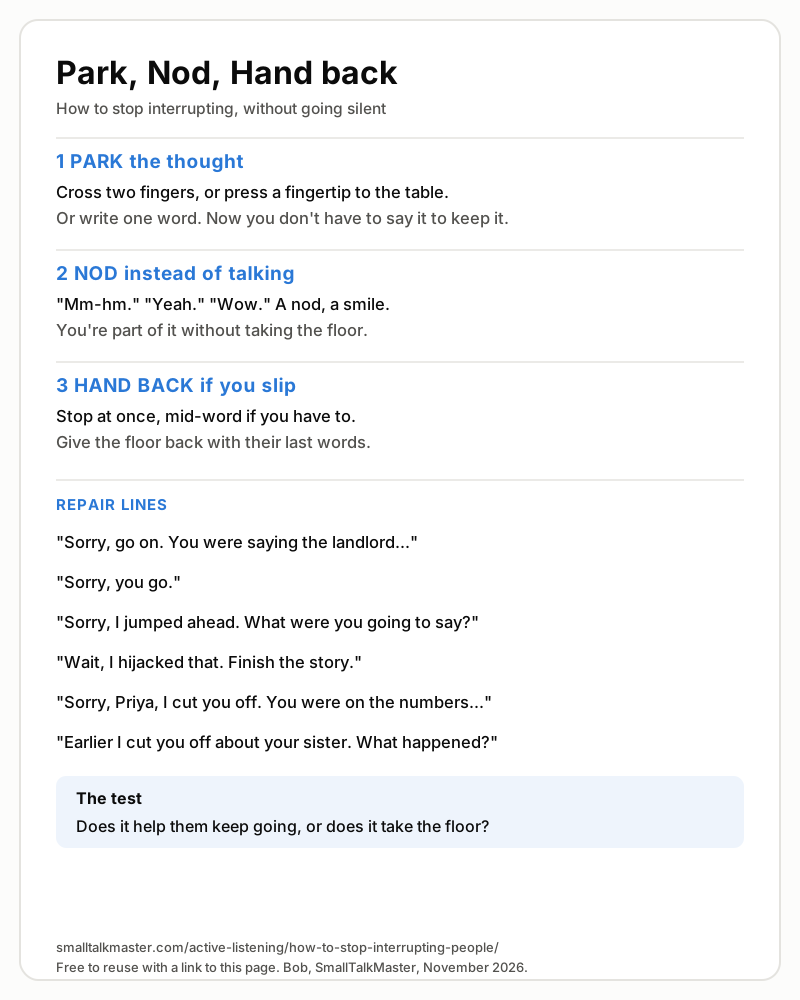
Interrupting is often not rudeness at all. It's a thought that won't wait: you're excited, you're afraid you'll forget your point, or you think you know how the sentence ends. So the fix isn't "try harder to shut up". It's giving that thought somewhere else to go. We call it Park, Nod, Hand back:
- Park the thought. Press a fingertip to the table, or cross two fingers, as a placeholder for your point. Now you don't have to say it to keep it.
- Nod instead of talking. "Mm-hm", "yeah", "wow" and a nod show you're with them without taking the floor.
- Hand back when you slip. Stop within a word or two and give the floor back with their own last words: "Sorry, go on. You were saying the landlord…"
Then, when they've actually finished, bring your point back, ideally as a question about what they said.
Not every overlap is an interruption. Saying "mm-hm" while someone talks, laughing along, or starting just as they finish their last word are normal parts of conversation. The test is simple: does what you say help them keep going, or does it take the floor? This page has a table for telling them apart.
This page: what the research says about overlapping talk, the overlap-or-interruption test, why you cut in (and the fix for each reason), repair lines for each kind of slip, interrupting in groups, meetings and video calls, and a five-day drill, plus a printable card.
What the research says about talking over each other
The top results for this search (checked November 14, 2026) are habit lists from HubSpot, Fatherly, Yoodli, Insight Global, Bustle and others. HubSpot's, which we read in full, is typical and sensible: pause two seconds, write your thought down, use reminders, review your calls, stop yourself. It cites no research on overlapping talk, and neither does the Changing Minds guide to interruptions, which is about stopping other people from cutting you off. What's missing is the most useful fact for a habitual interrupter: a lot of what feels like interrupting isn't, and the part that is can be fixed in a beat.
| Finding | Source | What it means for you | What it doesn't say |
|---|---|---|---|
| In recorded everyday conversations in 10 languages, from major world languages to small indigenous ones, people generally avoid overlapping talk and also keep the silence between turns short. The average gap differed between languages, but only within about a quarter of a second. | Stivers and colleagues, "Universals and cultural variation in turn-taking in conversation", PNAS, 2009 (abstract) | "One at a time, no long gaps" is close to universal. So everyone is aiming for quick turns, and small differences in timing can feel like big differences in manners. | It measured how fast people respond; it didn't study interrupting as a habit or what to do about it. |
| Four kinds of overlap are normally treated as fine: starting as the other person is clearly finishing; "uh huh" and "mm hm" while they talk; joining in when they invite it, as in a word search or finishing a sentence together; and things done together, like laughing, greeting or congratulating. | Schegloff, "Overlapping talk and the organization of turn-taking for conversation", Language in Society, 2000 (full text) | Your "yeah!" and your laugh are not the problem. Starting a new point while they're mid-sentence is. | Schegloff studied recordings of real talk; he avoids "interruption" as a technical term, though he says it's real as an experience. |
| Most overlaps are over very quickly. Many end after one beat (roughly a syllable), when one person drops out, and the vast majority are down to one speaker by the third beat. Longer overlaps tend to come with talk getting louder or higher as both compete. | Schegloff 2000 | When you collide, dropping out at once is the normal, polite move. Getting louder to push through is what turns a collision into an interruption. | The beat is a rough unit; the paper describes patterns, not a rule you'll be graded on. |
| Deborah Tannen coined "cooperative overlap" for talking along with a speaker "which encourages a speaker to keep going", as opposed to interruption, "where a listener starts to speak while another is speaking in order to take the floor". Among people who share the style it works well; people who don't often stop and feel interrupted. | Tannen, interviewed in HuffPost (Kelsey Borresen, updated March 4, 2021; syndicated copy on Yahoo) | If you come from a fast, overlapping family, you're not a bad listener. But with a slower-paced speaker, your enthusiasm can land as a takeover, so switch to nods. | Tannen says she hasn't formally studied which cultures do it; she reports that people from many backgrounds recognise it. |
| Across 43 published studies, men interrupted somewhat more than women, but the overall difference was "negligible" (d = 0.15). It was larger for intrusive interruptions (d = 0.33), and larger in natural settings and in groups of three or more than in lab pairs. | Anderson and Leaper, "Meta-analyses of gender effects on conversational interruption", Sex Roles, 1998 (abstract) | Anyone can be the interrupter. Groups and real-life settings are where the differences show most, so that's where to watch yourself. | It's from 1998 and measures differences between groups, not what any one person does. |
| In a survey of 179 multilingual adults, those with an ADHD diagnosis reported more excessive talking, interrupting and speaking without thinking. These were reported less often when they spoke a second or third language. | Köder, Rummelhoff and Garraffa, "Comparing pragmatic abilities across multiple languages in adults with ADHD", Clinical Linguistics & Phonetics, 2024 (abstract) | For some people, interrupting is linked to impulsivity rather than to manners. Habits and agreed signals still help, and it's fine to tell people why it happens. | Self-reports from one survey. Interrupting is not a sign that someone has ADHD, and this page isn't medical advice. |
The short version: everyone aims for one-at-a-time, nodding along and laughing together are fine, collisions are normal if you drop out fast, and the real problem is taking the floor before the other person has finished.
Overlap or interruption? A quick test
Ask one question: does what I'm about to say help them keep going, or does it take the floor? The table sorts common moments. The first four rows follow Schegloff's types of overlap that people treat as fine; the judgments in the last column are ours.
| What you do | Usually | Why |
|---|---|---|
| "Mm-hm", "yeah", "no way", a nod, while they talk | Fine | It tells them to keep going. With a slow, careful speaker, keep it quiet or make it a nod. |
| Laughing with them, "congratulations!" together | Fine | Some things are meant to be done at the same time. |
| Starting your reply as they say their very last word | Usually fine | It overlaps for a moment and ends itself. If they turn out not to be done, stop. |
| Supplying the word they're searching for ("the… the…" "Lisbon?") | Fine if they're looking | They've invited help. Offer it as a question and let them take it or not. |
| Finishing their sentence for them | Risky | If it's their ending, it shows you're with them. If it's your guess, you've just told their story. Wait instead. |
| Correcting a detail mid-story ("It was Tuesday, actually") | Interruption | It stops their story for a fact that rarely matters. Let it go, or ask afterwards if it does matter. |
| Starting your own related story while they're mid-sentence | Interruption | Even when it's meant as "me too", it moves the floor to you. |
| Offering a fix before they've finished describing the problem | Interruption | You're solving a problem you haven't heard yet. |
| Saying "but" and talking louder as they keep going | Interruption | Getting louder is what competing for the floor sounds like. |
Two notes. First, it depends on the person: the same "yeah, yeah!" can be warm with your sister and pushy with a new manager. Second, if they stop talking when you chime in, treat it as an interruption, whatever you meant. Tannen's advice for that moment is a line worth keeping: "Please go on. I wasn't trying to interrupt."
Park, Nod, Hand back
This is our own working method, built on the research above and on the answers to a real question on Interpersonal Skills Stack Exchange from someone who kept talking over their family, especially in serious conversations, and felt they'd missed chances to be supportive. It hasn't been tested as a package.
Park: give the thought somewhere to wait
The biggest reason people cut in is fear of losing the point. So make a placeholder you don't have to say out loud.
- A finger signal. One answerer crosses their fingers when a thought arrives; it reminds them they had something, and friends who know the signal sometimes pause and invite them in.
- One word. In a meeting, write one word on your notepad. In a chat, hold the word in your head; one word is easier to keep than a whole sentence.
- Cover your mouth. Another answerer rests a hand over their mouth in a "thinker" pose during serious conversations: moving it to speak buys a second to notice they're about to interrupt.
If the thought is gone by the time they finish, that's usually fine. The one you remember is often the one that fits.
Nod: be part of it without taking the floor
Interrupters are often the most engaged person at the table. Keep the engagement and drop the words.
- Nod, raise your eyebrows, smile at the funny bit.
- Use small sounds: "mm-hm", "yeah", "oh no", "wow". They're the overlap that tells someone to keep going.
- If you're a fast, overlapping talker with a slower speaker, Tannen suggests showing engagement in non-verbal ways instead.
Hand back: repair the slip in one breath
You will still interrupt sometimes. What matters is the next second.
- Stop at once. Don't finish your sentence. Dropping out quickly is what people normally do when two start at once.
- Hand it back with their words. "Sorry, go on. You were saying the landlord…" Repeating their last words shows you were listening, not just waiting.
- Bring your point back later, as a question if you can: "Can I go back to the deposit thing? Did they ever pay it?"
A longer answer in the same thread suggests the same repair in a lighter form: "Anyway, sorry for interrupting, please continue."
Why you cut in, and the fix for each
Knowing your reason helps, because each one has a different fix. These are the reasons that come up in the research and in the Stack Exchange thread above; the fixes are our suggestions.
| If you cut in because… | It sounds like | Try this |
|---|---|---|
| You're excited | "Yes! And then…" "Oh my god, same!" | Nod and make a sound instead. Save the "same!" story for when they finish, then ask a question first: "Wait, how did it end?" |
| You're afraid you'll forget | "Sorry, before I forget…" | Park it: a finger signal or one word. If it's gone, it's gone. |
| You think you know the ending | Finishing their sentence; "Right, right, so…" | Let them say it. You might be wrong, and being right isn't the point. |
| You want to help or teach | "What you should do is…" | The asker in the Stack Exchange thread felt "the need to teach". Hear the whole problem, then ask: "Do you want ideas, or do you just want to vent?" |
| The pause feels too long | Jumping in when they stop for a breath | A thinking pause isn't the end of a turn. Count "one, two" in your head; if they're still looking away, they're not done. Our page on how long silence takes to feel awkward has the research. |
| You grew up with a fast, overlapping style | Talking along, no gaps | Nothing's wrong with the style. Match the other person: overlap with overlappers, leave gaps for people who leave gaps. |
| Impulsivity, for example with ADHD | "Sorry, sorry, I just…" | The same tools, plus an agreed signal with people close to you (see the drill). It's fine to say once: "I sometimes jump in; it means I'm interested. Tell me if I cut you off." |
Repair lines for every kind of slip
Short, warm, and back to them. Use their name or their last words where you can.
| The slip | Say |
|---|---|
| You both started at once | "Sorry, you go." (Then really let them.) |
| You talked over the middle of their sentence | "Sorry, go on. You were saying the landlord…" |
| You finished their sentence wrong | "Sorry, I jumped ahead. What were you going to say?" |
| You hijacked their story with yours | "Wait, I hijacked that. Finish the story, what did she say?" |
| You corrected a small detail | "Sorry, doesn't matter. Keep going." |
| You jumped in with advice | "Sorry, I went straight to fixing it. Tell me the rest." |
| In a meeting | "Sorry, Priya, I cut you off. You were on the numbers…" |
| On a video call with a delay | "Sorry, lag. You first." |
| You noticed it later | "Earlier I cut you off about your sister. What happened in the end?" |
| Someone points it out | "You're right, sorry. Go ahead." (No defence, no explanation.) |
That last line is the hard one. When someone says "Let me finish", the urge is to explain that you were only agreeing. Don't. Hand it back now and explain later if it still matters.
Groups, meetings and video calls
Groups. In the Anderson and Leaper meta-analysis, gender differences in intrusive interruptions showed up more in groups of three or more. If you're a frequent interrupter, groups are where to be most careful. A useful habit: after you speak, hand the floor to someone specific ("Sam, you were going to say something?"). If you're the one trying to get in, our guide on joining a group conversation has the lines.
Meetings. Park it on paper, one word per point, and wait for a gap or a "Thoughts?". If you must interrupt, say why and how long: "Can I jump in for ten seconds? It changes the numbers." That's a different thing from cutting someone off to win a point.
Video calls. A lag can make collisions more likely, and there's less body language to signal "I'm nearly done". Use the raise-hand button or a visible hand, and when you collide, say "You first" and mean it.
When you do need to interrupt
Sometimes interrupting is the right thing: a mistake that will cost someone, a time limit, a train to catch, someone being hurtful. Do it once, clearly, and kindly:
- Say their name, then the reason: "Alex, sorry, quick thing: we have five minutes left."
- Give them a way back: "Hold that thought, I want to hear the end."
This is different from habitual interrupting, which is about your thoughts not waiting. An interruption with a reason, said with a "sorry" and a way back, is not a habit to break.
A five-day drill
Short enough to do in a week of ordinary conversations. No app needed.
| Day | Do this | Why |
|---|---|---|
| 1. Count | Make a tally mark on your hand or phone each time you interrupt, in one long conversation. Don't try to change anything. | You can't fix what you don't notice, and the count gives you a number to compare with on day 6. |
| 2. Nod | In one conversation, reply to everything mid-turn only with nods and small sounds. Speak only when they've clearly finished. | Trains the replacement, not just the stopping. |
| 3. Park | Pick your signal (crossed fingers, fingertip on the table, one word on paper) and use it every time a thought arrives. | Removes the fear of forgetting. |
| 4. Hand back | Every time you slip, stop within a word and use a repair line with their last words. | Makes the repair automatic, which is what people actually notice. |
| 5. Ask for a signal | Ask one person you talk to often to tell you, kindly, when you cut in, with a word or a small gesture you agree on. | In the Stack Exchange thread, the accepted answer describes exactly this with someone close: a calm "Hey, you just interrupted me", then an apology and back to the story. It felt awkward at first and then became routine. They found it harder with friends and acquaintances, so start with family or a partner. |
On day 6, count again in a similar conversation and compare with day 1. If the number didn't move, repeat days 2 to 4 for another week before deciding it doesn't work for you.
If you're the one being interrupted
Briefly, since this page is for interrupters: Tannen's advice to people who get talked over is to keep talking if you have more to say, even when your instinct is to stop, and, with someone close, to mention the difference in styles at a calm moment. "Can I finish this bit?" said with a smile works in most settings. If someone talks over you constantly, our study of 78 questions about people who talk too much has lines for that.
Common mistakes
- Treating every "yeah" as a crime. Going silent and still can read as boredom. Keep the nods and the small sounds.
- Over-apologising. One "sorry, go on" is enough. A long apology makes the moment about you again.
- Waiting to talk instead of listening. Holding back while rehearsing your point isn't listening. Our page on listening without planning your next line covers that.
- Coming back with your point, not their topic. When they finish, ask one follow-up question first. Our follow-up questions guide has examples.
For the bigger picture, the active listening guide puts all of this together. And if you want a number for how much to talk, our trace of the 43/57 rule shows why there isn't a magic one.
Sources
- Stivers, T., Enfield, N. J., Brown, P., et al. (2009). Universals and cultural variation in turn-taking in conversation. PNAS, 106(26), 10587-10592. Abstract read November 14, 2026.
- Schegloff, E. A. (2000). Overlapping talk and the organization of turn-taking for conversation. Language in Society, 29, 1-63. Full text read November 14, 2026.
- Anderson, K. J., and Leaper, C. (1998). Meta-analyses of gender effects on conversational interruption: Who, what, when, where, and how. Sex Roles, 39, 225-252. Abstract read.
- Köder, F., Rummelhoff, C., and Garraffa, M. (2024). Comparing pragmatic abilities across multiple languages in adults with ADHD. Clinical Linguistics & Phonetics. Abstract read.
- Borresen, K. (2021). How to know if you're an interrupter or a "cooperative overlapper". HuffPost (syndicated copy on Yahoo), with quotes from Deborah Tannen.
- Interpersonal Skills Stack Exchange: Talking over my family and interrupting them and its answers (CC BY-SA; paraphrased).